
Hiring a better media buyer is the most popular answer to weak Amazon sales. For many food and beverage brands, it's the wrong first move. They don't have an advertising problem first. They have inventory, listing, or Vendor Central problems that advertising makes more expensive.
The familiar failures are operational: freshness complaints, expiry-date receiving issues, stranded inventory, broken pack-size variations, and purchase orders that don't reconcile. Slow-moving consumables accumulate storage costs, which you can model with the FBA storage fee calculator. The Amazon profit calculator helps expose products that sell without contributing enough profit, while the sales rank checker helps diagnose sales velocity alongside your own order history.
Fix the constraint first: Don't pay for more traffic to an unavailable offer, a confusing multipack, or a product you can't replenish profitably.
Creative still matters. You should prepare Amazon product video assets that explain serving size, preparation, and pack contents before scaling traffic. But the best Amazon agencies for food and beverage brands need evidence beyond campaign screenshots. These seven offer different combinations of catalog repair, fulfillment support, Vendor Central work, content, and advertising. Their positions below reflect those operational use cases, not who spends the most on ads.
1. Online Brand Growth
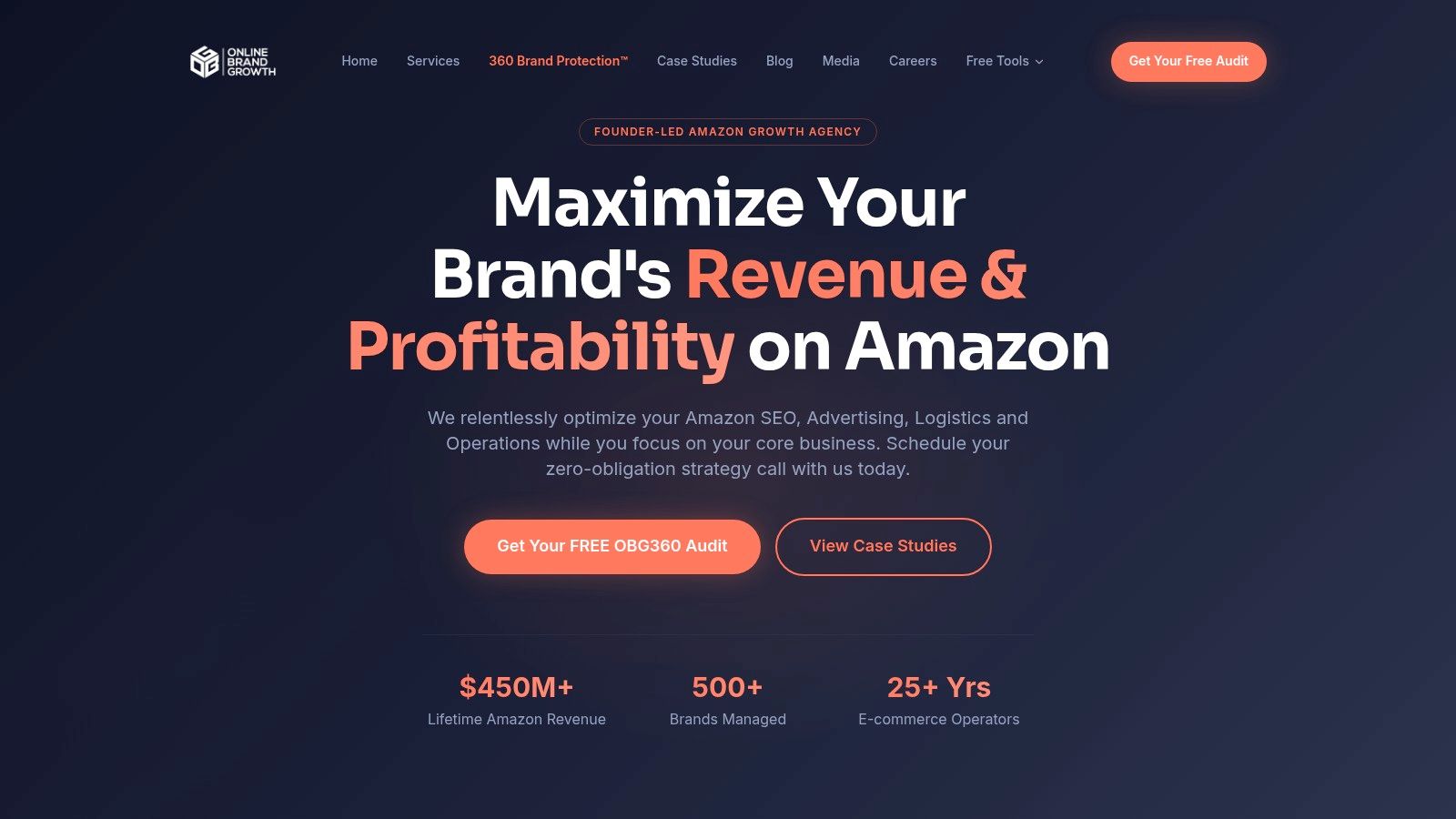
Best fit for brands that need Amazon operations and growth managed together. Online Brand Growth is a founder-led agency combining PPC, SEO and conversion optimization, FBA logistics, catalog management, account health, and brand enforcement. Its team delivers services in-house, and the co-founders are directly involved in client account strategy and execution.
For a food manufacturer, promotions, replenishment, and suppressed ASINs all affect the same channel economics. Online Brand Growth's core partnership model ties compensation to channel contribution margin, rather than ad spend or top-line revenue. That keeps attention on profit after fees, fulfillment, promotions, and advertising, not just traffic or sales.
The agency reports managing 500+ brands. Its founders also own and operate Amazon brands, giving them firsthand experience with the operational decisions brand owners face. That breadth is useful, though it does not mean every food category or fulfillment setup has the same economics.
Where the integrated model helps
A beverage multipack can convert well and still produce weak contribution profit. Check packaged dimensions and fulfillment fees, confirm that the pack-size listing is clear, review inbound and storage costs, and then set an advertising target that fits the product's economics. Lowering ACoS alone won't fix an unprofitable pack configuration.
The service scope connects those decisions:
- Catalog and conversion: Keyword research, conversion copywriting, listing testing, A+ Content, Storefront design, and browse node optimization.
- Operational repair: FBA inventory management, reimbursement claims, seller support cases, listing takedown resolution, and account health management.
- Brand control: Brand Registry and enforcement work addresses unauthorized reseller activity and MAP violations, protecting the Buy Box and catalog integrity.
Daily Slack communication, weekly calls, and business intelligence reporting keep the workstreams connected. The agency can also train internal teams, so brands can build in-house operating capacity rather than keeping every task external.
The trade-off: Online Brand Growth works with brands and manufacturers, not resellers, and typically partners with brands spending at least a few thousand dollars monthly on Amazon ads. Services can be engaged individually or combined under full account management. Terms depend on account size and scope; a complimentary audit and strategic roadmap are available before an engagement.
2. Accrue
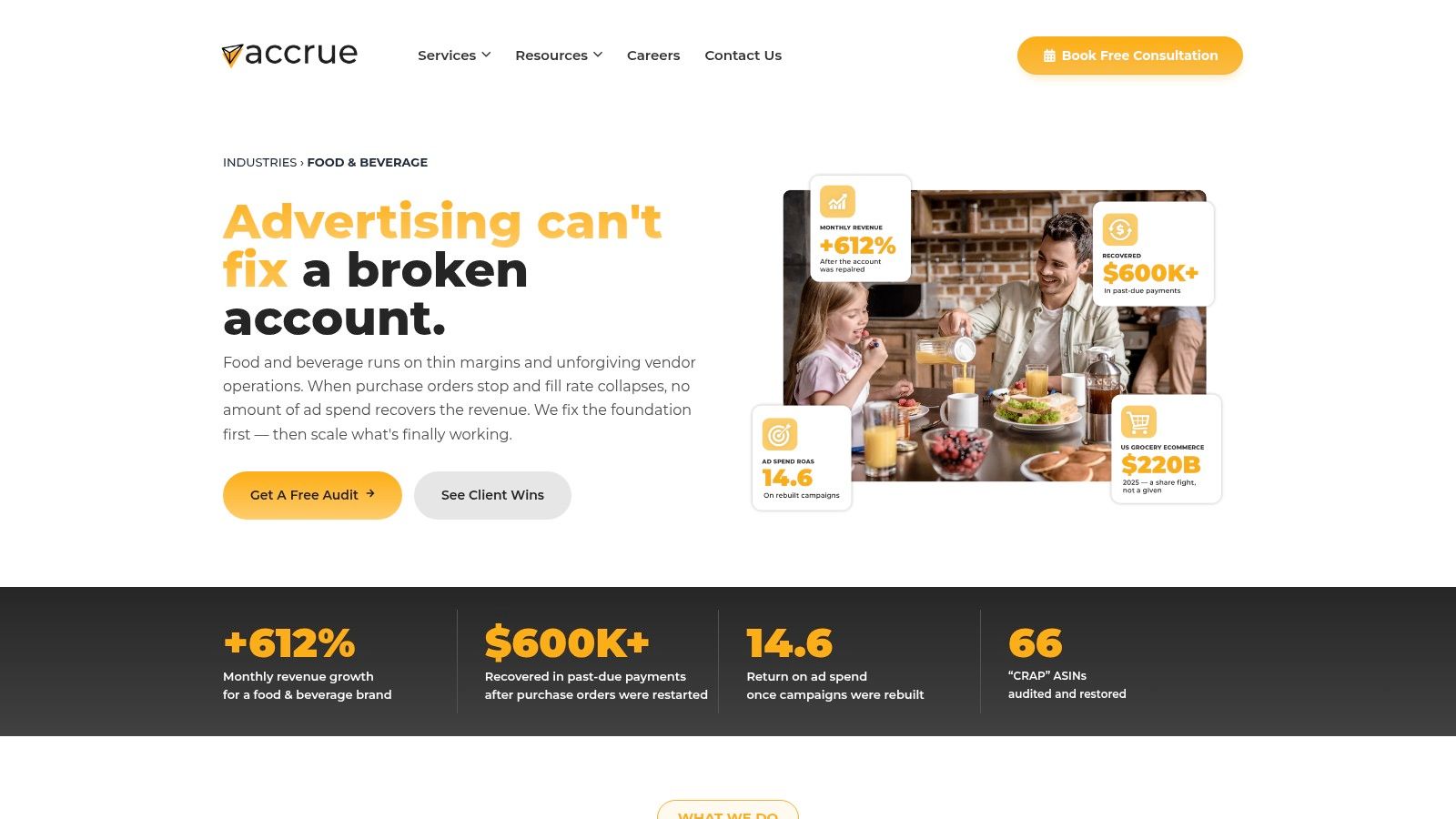
An unpaid Vendor Central purchase order isn't a keyword problem. Accrue is particularly relevant when pricing disputes, catalog availability, and retail operations are blocking growth.
In its food and beverage service material, Accrue reports resolving a pricing dispute involving more than $600,000 in unpaid purchase orders, restoring 66 ASINs, and subsequently increasing monthly revenue 612%, with 14.6 ROAS. Those are agency-reported results from a specific engagement, not independently established expectations.
The useful evidence is the order of operations: commercial and catalog repair before rebuilding advertising. For a vendor, an attractive advertising dashboard means little if Amazon isn't issuing workable purchase orders or keeping the offer available.
Separate vendor recovery from FBA readiness
A Vendor Central recovery plan should reconcile purchase orders, accepted quantities, shipment records, invoices, deductions, and disputed pricing. Track each issue by document, commercial impact, case owner, and next action rather than treating vendor support as an inbox.
Seller Central fulfillment requires a different skill set. Amazon's expiration-dated inventory guidance specifies 270 days before expiry as the minimum arrival requirement for beverages such as coffee, tea, soda, and juice. Review the practical implications in this guide to selling beverages on Amazon and FBA requirements.
- Strength: Concrete published evidence involving food-brand purchase orders, pricing, and ASIN recovery.
- Limitation: The featured evidence is Vendor Central-heavy. Seller Central inventory planning and expiry-date controls need an explicit scope.
- Commercial consideration: Standard public pricing isn't available.
Accrue's strongest operational fit is a brand whose Amazon retail relationship needs repair, not a brand seeking cheaper clicks.
3. Amazowl
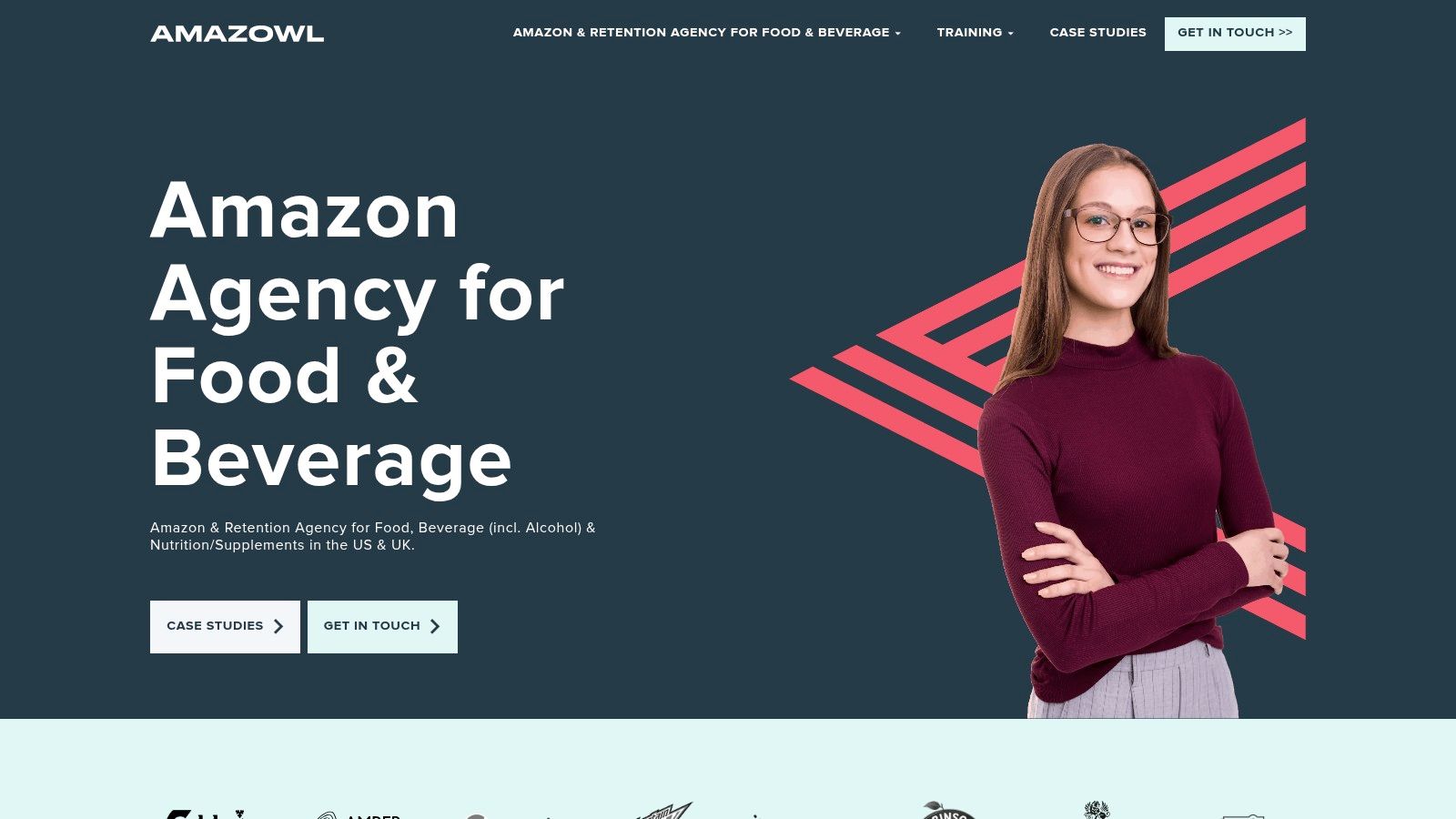
A shopper orders a variety pack but receives a single flavor. Before changing bids, inspect the title, variation structure, images, and product attributes. Amazowl's combination of food and beverage positioning, content services, and listing monitoring makes it relevant to that kind of catalog-control problem.
Amazowl describes services spanning Amazon PPC, A+ Content, Brand Storefronts, and ongoing listing monitoring, with North American and international marketplace support. Its positioning includes food, beverage, and selected health and wellness brands.
That's useful for a manufacturer whose catalog needs consistent product presentation across marketplaces. It doesn't, by itself, establish responsibility for expiry-date shipments, receiving discrepancies, or Vendor Central deductions.
Listing monitoring should produce a change record and a recovery action, not just an alert that something changed.
Keep variation architecture defensible
For consumables, establish a source of truth for flavor, unit count, net content, ingredients, and pack configuration. Then compare the live detail page against that record, including the selected child ASIN and mobile presentation.
Don't join unrelated products merely to pool reviews. Use supported variation themes and preserve accurate product identities when adding multipacks or extending a flavor range.
- Useful breadth: Advertising and content sit alongside listing monitoring rather than operating as isolated services.
- Expansion advantage: International support can help coordinate catalog work, but destination-market labeling and fulfillment rules still need separate review.
- Unresolved scope: Current comparable food-category references, operational task ownership, and ongoing service fees should be established before work begins.
Amazowl looks most relevant when product presentation and marketplace expansion are the constraints. A brand needing hands-on FBA lot planning should distinguish that work from general listing management in the scope.
4. Cartograph
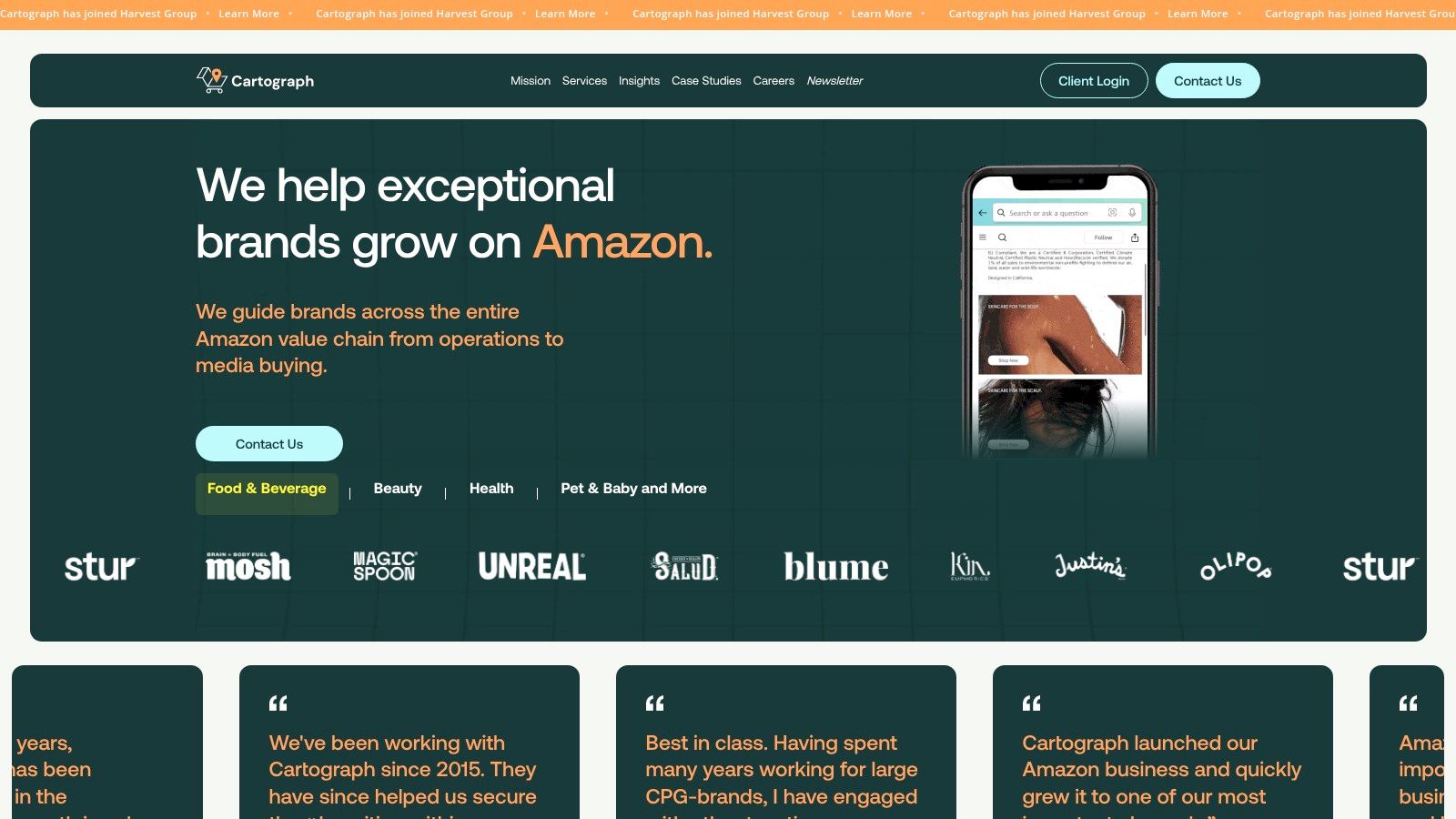
Cartograph offers the broadest operating proposition when Amazon sits inside a larger CPG retail-media strategy. Its scope includes strategy, operations, inventory and logistics, content, SEO, advertising, DSP, and Streaming TV, plus support for channels such as Instacart.
Cartograph reports managing more than $700 million in annual client sales and providing 24/7 access to proprietary reporting dashboards. Those are company-reported scale and access claims, not evidence that a particular account will improve its margins.
The breadth can be valuable when your team otherwise coordinates separate inventory, creative, search advertising, and retail-media partners. The trade-off is complexity: a smaller catalog may not need that much service infrastructure.
Make the dashboard reconcile
A food-brand dashboard should connect total ordered sales, advertising spend, inventory cover, contribution margin, and lost availability. It should also distinguish Seller Central sales from Vendor Central economics rather than treating both as interchangeable revenue streams.
Amazon's Inventory Performance documentation defines excess inventory in economic terms, comparing the cost of holding stock against interventions such as markdowns or removal. That's a useful operating principle for deciding whether to replenish, promote, or clear a slow-moving SKU.
- Operational advantage: Inventory and logistics services can connect media plans to stock availability.
- Channel advantage: Instacart support may help coordinate assortment and promotions across grocery channels.
- Trade-off: Broad coverage can exceed a smaller brand's needs, and public pricing isn't listed.
Before expanding into DSP or Streaming TV, establish whether the search-ready assortment is profitable and replenishable. Cartograph's service breadth is most useful when the brand has a genuine cross-channel coordination problem, not just unused advertising budget.
5. SupplyKick
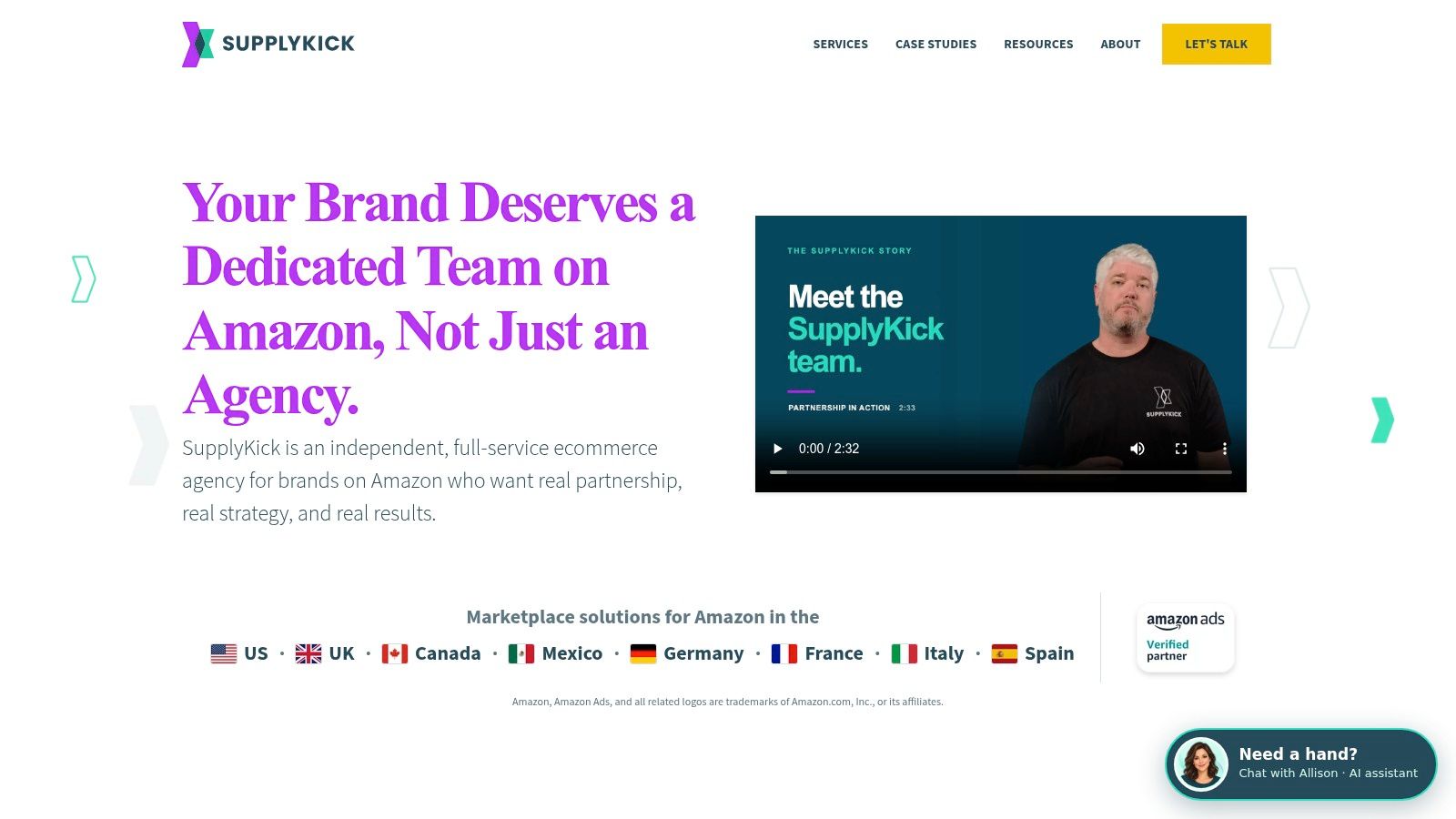
Coffee date labels and meltable chocolate require different operating plans. SupplyKick's food-related material is useful because it addresses those physical-product differences instead of treating consumables as ordinary inventory.
SupplyKick presents itself as an agency built by sellers, with advertising, listing, logistics, and brand-protection services. Its published coffee and chocolate examples discuss date labeling, FBA setup, shipping costs, listing variations, Storefront quality, seasonal meltable products, and Vendor Central.
That's relevant evidence for brands whose margin problems begin before a shopper sees an ad. An incorrect date label can disrupt receiving; an unsuitable fulfillment plan can make a profitable-looking product difficult to sell consistently.
Build a shipment release process
Before approving an inbound shipment, reconcile the production lot, product date, barcode, carton contents, and destination-market requirements. Keep the expiry date visible and check that the prep team hasn't covered it with an FBA label.
Use this guide to Amazon FBA expiration-date requirements for food products to organize that review. Don't substitute a generic remaining-shelf-life assumption for the applicable product and marketplace rules.
Shipment discipline: A campaign launch date should follow confirmed fulfillment readiness, not force a warehouse to ship questionable inventory.
SupplyKick's advantage is practical consumables evidence across fulfillment and catalog work. Its limitation is that some relevant examples are older engagements, and they don't establish an exclusive food and beverage specialization.
Standard public pricing wasn't available in the reviewed material. The scope should specify who owns prep instructions, seasonal fulfillment decisions, removal orders, and variation corrections. Advertising support is only part of the job when the product itself creates storage or shipping constraints.
6. Marknology
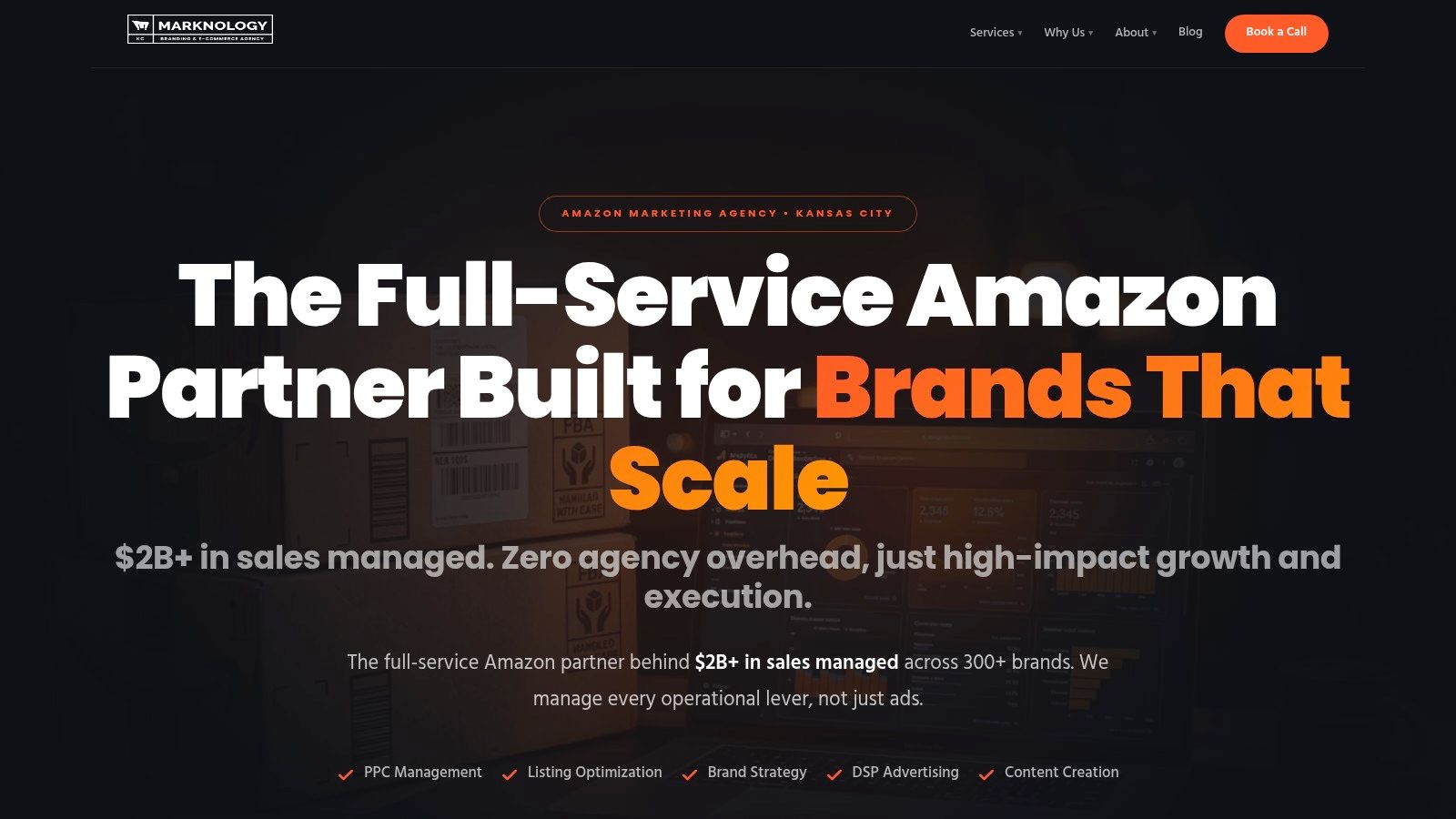
A launch needs a functioning catalog before it needs aggressive bids. Marknology is relevant to brands introducing or relaunching food and beverage products because its published launch work describes listing, catalog, content, and advertising changes together.
In its coffee candy and beverage launch example, Marknology reports generating more than $560,000 in revenue over nine months, while reducing ACoS from 22% to 5.9%. Those are agency-reported results specific to that product, market, and measurement period.
The agency's services include listing optimization, A+ Content, Brand Storefront development, PPC, and broader marketplace management. The strongest food-specific evidence described here remains a single agency-published launch case, not proof of repeatable performance across grocery subcategories.
Gate the launch before releasing spend
Start with category access and product documentation. This guide to Amazon grocery category approval requirements helps separate approval work from the advertising launch itself.
Then validate the offer from the shopper's perspective:
- Catalog readiness: Confirm the correct browse node, product type, pack count, ingredients, and supported variation relationships.
- Fulfillment readiness: Verify that inventory is available to purchase, not merely shipped or checked in.
- Measurement readiness: Set ASIN-level margin targets and distinguish branded search from discovery campaigns.
A lower ACoS doesn't prove higher contribution profit. It can reflect stronger branded demand, a different campaign mix, or reduced investment in customer acquisition.
Marknology's launch evidence makes it a plausible fit when a brand needs coordinated catalog and media execution. Pricing isn't publicly available, and a mature food manufacturer should establish ongoing replenishment, account health, and expiry-management responsibilities separately from the launch deliverables.
7. Olifant Digital
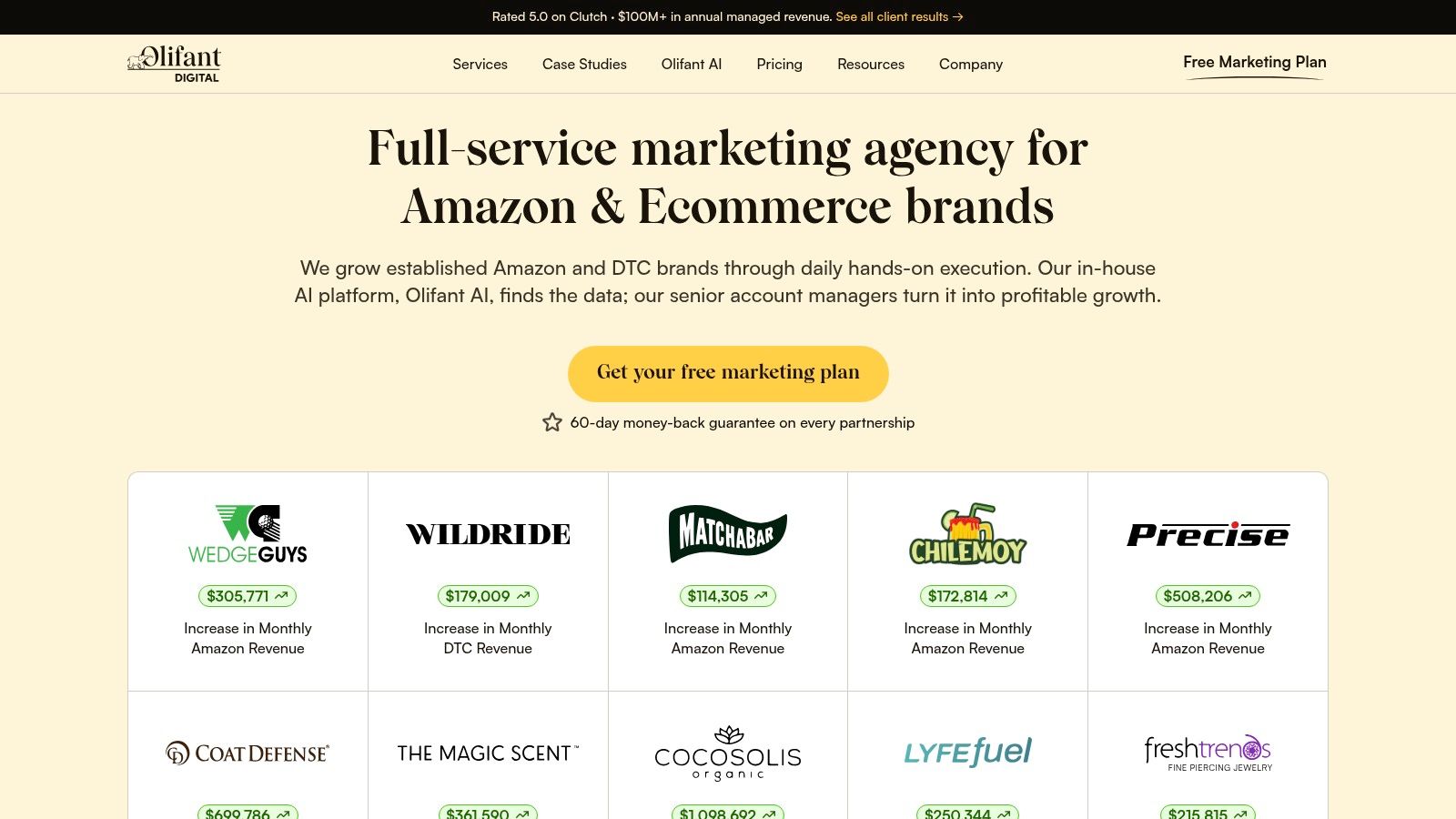
For a replenishable beverage or pantry product, the useful question isn't just whether shoppers buy once. It's whether the assortment, offer, and account management support profitable repeat purchases.
Olifant Digital publishes food-related examples spanning matcha beverages, honey, and protein bars. In its matcha beverage case, the agency reports adding $114,305 in monthly Amazon revenue, alongside full account management, listing optimization, PPC, A+ Content, creative, and catalog work.
That revenue figure needs a starting baseline and measurement period before it becomes useful for forecasting. The described execution is more informative: bundles, Subscribe & Save, catalog management, and content can influence how a replenishable product performs beyond its initial acquisition campaign.
Separate repeat purchase from discount dependence
Inspect whether Subscribe & Save customers reorder profitably after discounts and advertising costs. Compare bundles with individual products on contribution profit, not just basket size, and account for the extra inventory commitment behind each bundle.
- Strength: Several food-related examples provide broader category context than a single isolated food engagement.
- Useful combination: Content, catalog management, and advertising can support a coordinated repeat-purchase strategy.
- Limitation: The reviewed material doesn't establish food and beverage as its exclusive or primary specialization, and engagement scope and pricing need confirmation.
Creative testing belongs after offer accuracy. If you generate beverage ads with AI, review every asset for accurate packaging, serving depiction, ingredients, and claims before publishing.
Olifant Digital's evidence is most relevant to brands seeking combined account management and demand generation. It doesn't remove the need for a separate operating plan covering shelf life, inbound inventory, and storage exposure.
How the Seven Food and Beverage Amazon Agencies Compare on Focus, Engagement, and Evidence
For food and beverage brands, agency fit depends on the operating problem, not just ad expertise. Expiry-date listings, FBA storage costs, Vendor Central purchase orders, and listing variations can shape results as much as campaign management. This comparison shows where each agency has category or operational evidence, and where published information leaves questions open.
| Item | Food and Beverage Focus | Engagement and Pricing | Published Results | Best For |
|---|---|---|---|---|
| Online Brand Growth | Broad consumer-brand Amazon agency; food and beverage specialization not specified | Partnership based on a percentage of channel contribution margin; pricing not published; free audit available | A single-product baby brand grew Amazon revenue 30X in 18 months | Brands seeking hands-on Amazon growth tied to profitability |
| Accrue | Dedicated food and beverage services, including Vendor Central and operational support | Standard pricing not publicly available | Agency-reported case: monthly revenue increased 612%, with 14.6 ROAS, after resolving a purchase-order dispute and restoring 66 ASINs | Food brands facing Vendor Central, catalog, or purchase-order issues |
| Amazowl | Focuses on food, beverage, and selected health and wellness brands | Ongoing fees not publicly listed; scope should be confirmed | No comparable food or beverage results provided | Brands seeking food-focused content, advertising, listing monitoring, or international support |
| Cartograph | CPG-focused agency that includes food and beverage | Broad Amazon and multichannel services; pricing not publicly listed | Reports managing more than $700 million in annual client sales, a company-reported figure | CPG brands needing broad Amazon operations, advertising, and channel support |
| SupplyKick | Food examples include coffee and chocolate; consumables operations experience | Services include advertising, listings, logistics, and brand protection; pricing not publicly listed | Publishes client stories covering coffee and chocolate, with fulfillment and listing challenges | Consumables brands needing operational support alongside advertising |
| Marknology | Food and beverage launch example with Kopiko | Amazon management, listing, and advertising services; pricing not publicly available | Agency-reported Kopiko case: more than $560,000 in revenue over nine months, with ACoS falling from 22% to 5.9% | Brands launching or relaunching products on Amazon |
| Olifant Digital | Food examples include beverages, honey, and protein bars | Full-service account management; engagement scope and pricing should be confirmed | Agency-reported MatchaBar case added $114,305 in monthly Amazon revenue; measurement context not specified | Food brands seeking combined advertising, content, and account management |
The evidence differs in both category relevance and measurement detail. Accrue's example addresses a purchase-order dispute and restored ASINs, while SupplyKick's published stories describe coffee and chocolate fulfillment and listing challenges. Those specifics are useful when operational friction is the problem.
Online Brand Growth's reported baby-brand result gives a clear growth timeframe, though it does not establish a food and beverage specialization. Its engagement is based on a percentage of channel contribution margin, with exact pricing not published and a free audit available. Compare each agency's evidence with the issue you need solved, then confirm scope and measurement terms before choosing.
Start With the Leak Before Choosing the Fix
Before changing the growth plan, reconcile your last 90 days of Seller Central data at ASIN level. Export Detail Page Sales and Traffic by Child Item, settlement transactions, advertising reports, and inventory data. Keep canceled orders, refunds, promotions, and reimbursements visible so they don't disappear inside a blended revenue figure.
Start with Account Health for policy violations and product compliance requests. Check Inventory Performance and the FBA inventory dashboard for excess, stranded, and aging stock. Then review Brand Analytics, including Search Query Performance where available, to separate weak discovery from weak conversion.
Put the work in operating order
- Price inventory exposure: Use the storage fee calculator linked above to compare inventory scenarios. Amazon's FBA dashboard guidance says inventory stored for 181 days or more is subject to an aged inventory surcharge, assessed on the 15th of each month.
- Rebuild the margin view: Use the Amazon profit calculator linked above with actual product cost, fulfillment fees, inbound costs, promotions, and advertising. Compare smaller replenishment shipments with deeper inventory purchases.
- Repair the offer: Correct pack counts and variations, address suppressed listings, and clarify product imagery before paying for more traffic.
- Protect the channel: Investigate unauthorized sellers and Buy Box disruption before funding demand another seller may capture.
For Vendor Central accounts, review purchase orders, invoices, deductions, and pricing disputes separately. Seller Central inventory reports won't explain unpaid vendor invoices or an Amazon retail offer that isn't replenishing.
Brand Registry enforcement against unauthorized resellers can help protect MAP and the Buy Box. A low advertised price alone does not automatically support an intellectual-property complaint, so distinguish pricing issues from violations that can be addressed through Brand Registry.
Give each operational problem an owner, an expected financial impact, and a clear completion condition. Raise ad spend only when the offer is accurate, the stock is sellable, and replenishment can preserve contribution profit. Otherwise, more traffic can amplify listing and inventory problems instead of improving the economics.
Online Brand Growth combines Amazon advertising, catalog management, FBA operations, and brand protection around channel profitability. Bring your inventory, margin, or account bottleneck and book an intro call.