
Ask ten brand owners what to do about an unauthorized seller and nine will give the same answer: report them for counterfeiting. That advice is the most expensive mistake in Amazon channel management. Most sellers you will find on your listings hold genuine units bought from a distributor, a closeout lot or a retail shelf, and a counterfeit report against them fails review more often than it succeeds.
Every rejected submission weakens your standing with Amazon's brand enforcement team, and the offer stays live under your price floor the entire time. The operators who clear listings and keep them clear work the other way around. They identify which kind of offer they are looking at first, then pick the response that fits that type. That sequence decides whether a listing is clean in six weeks or contested for a year.
Who Resellers on Amazon Are and Where Their Stock Comes From
A reseller on Amazon is any seller listing products they did not manufacture. The stock arrives through a wholesaler, a distributor, a liquidation lot, a retail store shelf or directly from the brand, and where it came from determines almost everything about how that seller behaves on your detail page.
The scale is not marginal. Amazon's 2025 Small Business Empowerment Report states that more than 75,000 independent sellers surpassed $1 million in sales in 2025, a 36% increase from 2024. Independent sellers also sold more than 4.6 billion items in Amazon's U.S. store in 2025, which Amazon's Selling Partners impact page puts at over 8,900 items a minute. These are businesses with real capital, real systems and, in many cases, a lawyer who reads the complaints you file.
| Reseller model | Where stock comes from | Typical brand impact |
|---|---|---|
| Retail arbitrage | Store shelves and clearance aisles | Low volume and sporadic offers, usually no authorization |
| Wholesale or distributor | Wholesale accounts, some authorized and some not | Price pressure when acquisition cost sits close to MAP |
| Closeout and liquidation | Bulk lots from liquidators | Risk of old packaging, expired or altered goods |
| Authorized reseller | Brand-approved distributor agreement | Controlled channel the brand can audit and enforce against |
| Unauthorized or gray market | Sourced outside brand channels | Price erosion, lost Buy Box share and presentation problems |
The model matters more than the label. An authorized reseller is a channel partner you can audit, brief and hold to terms. An unauthorized seller competes for the same detail page with no agreement, no MAP obligation, no warranty language and no reason to protect your presentation. Place every seller you find into one of those five rows and you already know what evidence you will need and whether removal is realistic.
How the Buy Box Picks One Reseller Over Another
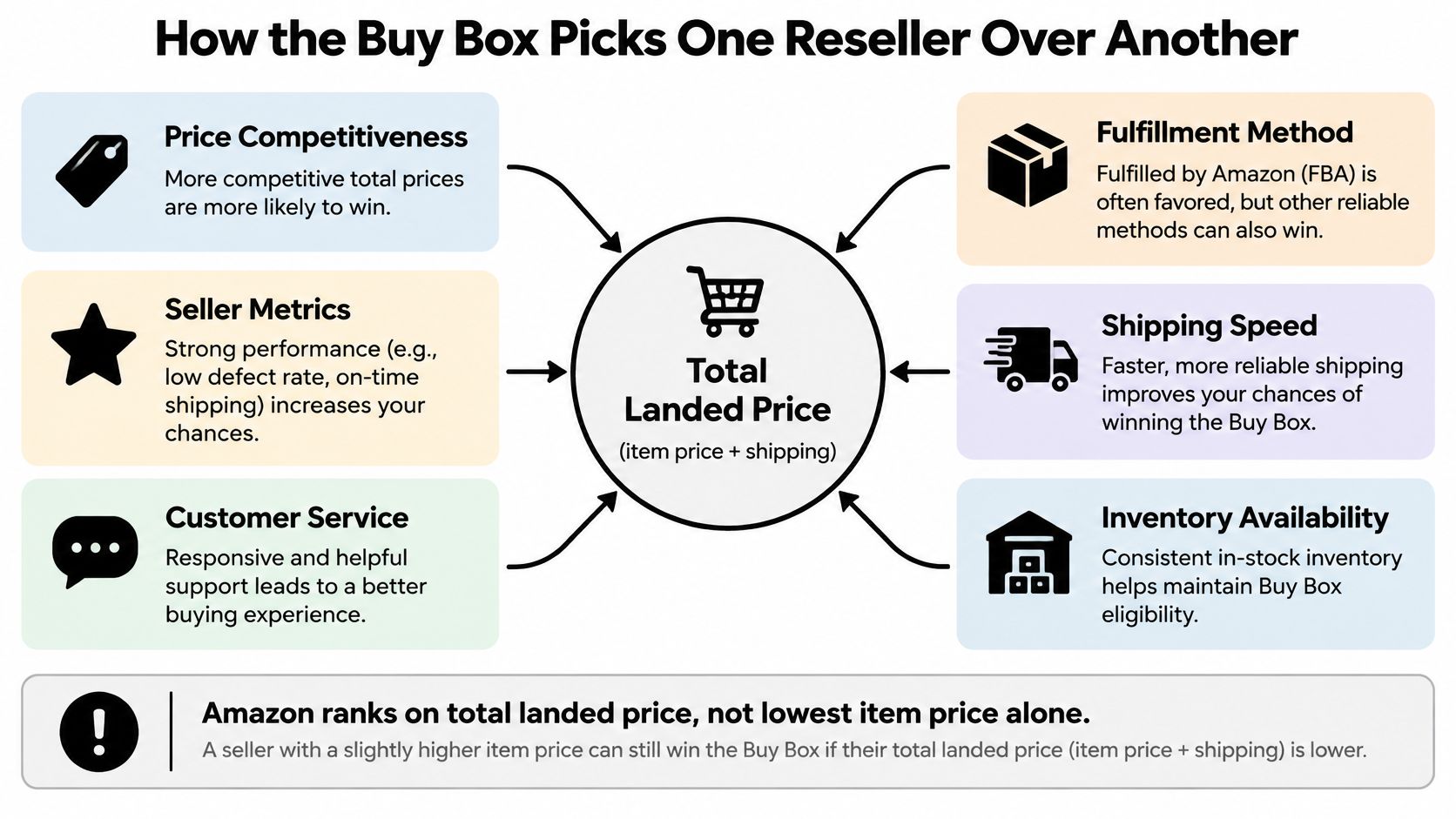
Amazon does not rank offers on item price. It ranks on total landed price, meaning item price plus shipping, and then weighs the rest of the offer against it. Amazon's Featured Offer eligibility guidance lists the criteria: price competitiveness against other sellers and external retailers, inventory availability, shipping speed, delivery certainty, listing accuracy and seller-performance standards.
Where a cheaper offer loses
Because the comparison includes shipping, a reseller at $24.50 with paid shipping routinely loses the Featured Offer to an offer at $25.99 with free two-day delivery. The higher unit price wins because the buyer's total cost and delivery promise are better.
The opposite failure catches discount sellers. An offer at $19 that Amazon flags as an implausibly low price can lose eligibility outright, so undercutting deeper does not recover the Buy Box. Stockouts do the same thing: no inventory means no consideration at all, whatever the price.
Practical rule: Set your repricing floor from contribution margin, never from the lowest competitor price. A floor derived from fees and cost of goods protects you when the market drops; a floor copied from a competitor guarantees you follow them into a loss.
Monitor two fields at ASIN level every week, Featured Offer status and Pricing Health, and treat a lost Featured Offer as an operating signal rather than a sales annoyance. If you want the mechanics in more depth, this explanation of what the Amazon Buy Box is and how it is won covers the full set of ranking inputs.
The Real Profit Math Behind Reselling on Amazon
A reseller can sell authentic inventory and still lose money. The difference between sales and profit comes down to fees, inventory costs, advertising and how much room remains to price competitively. Amazon's 2024 Small Business Empowerment Report reports that independent U.S. sellers averaged more than $290,000 in annual Amazon sales in 2024, a 16% increase from 2023. That average says nothing about margin, inventory investment or whether a few SKUs account for most sales.
The cost stack that decides whether a sale is worth having
| Cost line | Typical value | Why it matters |
|---|---|---|
| Professional selling plan | $39.99 per month plus category selling fees | Fixed overhead that only volume can absorb |
| Individual selling plan | $0.99 per item plus applicable fees | Only cheaper below about 40 units a month |
| Referral fee | 8% to 15% of the sale price for most categories | Sets the floor cost on every sale |
| FBA fulfillment | Per unit by size tier, with a 2026 average increase of $0.08 per unit | Lower for items under $10, larger for higher-priced standard-size items |
| FBA monthly storage | Charged on daily average cubic volume, with seasonal rates | Bulky or slow stock costs more every month it sits |
| Aged inventory | Charged for units stored more than 181 days | Slow SKUs turn into a recurring surcharge |
| Advertising | PPC spend as a share of sales | Can erase margin on SKUs with identical listings |
Amazon lists plan fees, the 8% to 15% referral band and the 2026 fulfillment change on its Selling on Amazon pricing page. Its FBA fees guide explains storage charges, including the aged-inventory charge that starts after 181 days.
Work through one sale. A 12% referral fee on a $20 item is $2.40, leaving $17.60 before fulfillment, storage, returns, advertising and the unit itself. Subtract $4 for fulfillment and $8 for cost of goods, and just $5.60 remains to cover advertising, returns and dead stock. That is the margin available before setting a competitive price.
For each SKU, calculate the minimum gross margin its size and price point require. Compare FBA with merchant fulfillment after storage and returns, then check whether the margin can withstand daily Buy Box price changes. Use the Amazon profit calculator and FBA storage fee calculator to model costs by dimensions, units and holding time. The FBA profit margin walkthrough shows how the cost components fit together.
Wholesale cost also determines how much price flexibility a reseller has. A breakdown of pricing bulk incense and oils illustrates the retail-to-wholesale spread on case-pack products. Compare that spread with Amazon fees and operating costs before treating the difference between retail and wholesale prices as profit.
How Unauthorized Resellers Erode Price, Ads and Presentation
The damage from an unauthorized seller shows up in four places, and they compound in that order.
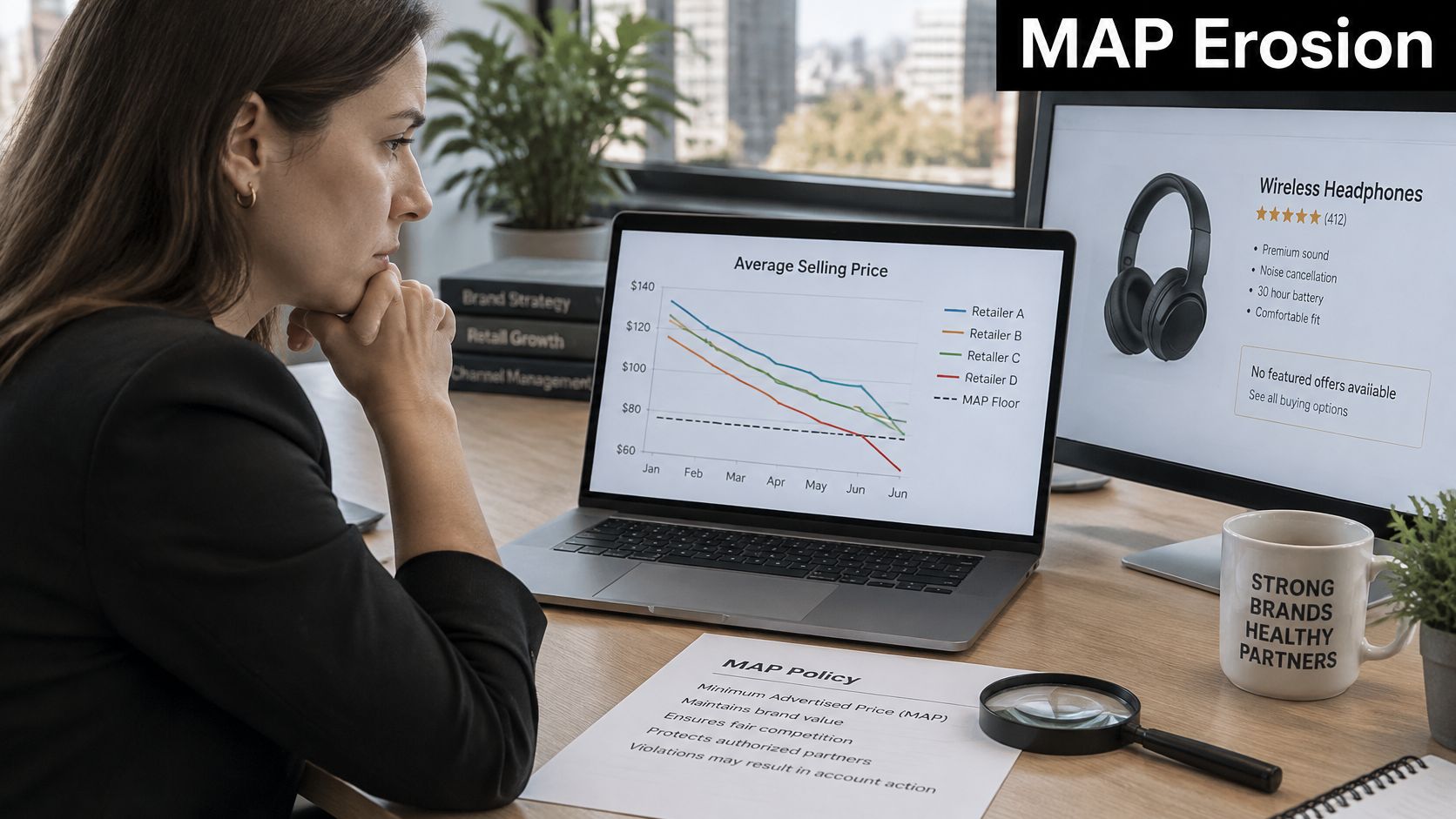
- MAP erosion. One offer drops below your published floor, the next seller reprices to match it, and the floor becomes a suggestion within weeks.
- Buy Box share loss. Your sponsored placements keep generating clicks that convert on another seller's offer, so ACoS climbs while your conversion rate looks fine.
- Inventory visibility problems. Unknown sellers on a shared detail page make your own demand signals murky, and forecasting gets harder because sales velocity no longer reflects your stock position.
- Presentation problems. Damaged, expired or badly stored units reach customers under your brand name, and the review that follows attaches to your listing, not to the seller.
Here is how that plays out. Say a brand runs a $40 MAP and one reseller lists at $33 on the shared listing. Within roughly two weeks, the brand's Buy Box share falls by a visible margin while ACoS climbs, because the same ad spend now feeds a cheaper competing offer. Those figures illustrate the pattern rather than describe a specific account, but the sequence is consistent enough to plan around.
The type of harm tells you which response is available. A genuine but unauthorized seller damages price and control, which is a channel problem with commercial fixes. A counterfeit seller damages trust, reviews and return rates, which is an enforcement problem with documentation behind it.
Before anyone files anything, answer one question: is the damage to price, to customer experience, or to both?
How to Monitor Resellers and Build an Evidence File
Run this cycle on a fixed schedule, weekly for a live brand and monthly for a quiet one. The evidence file is the product; the reports are just the output.
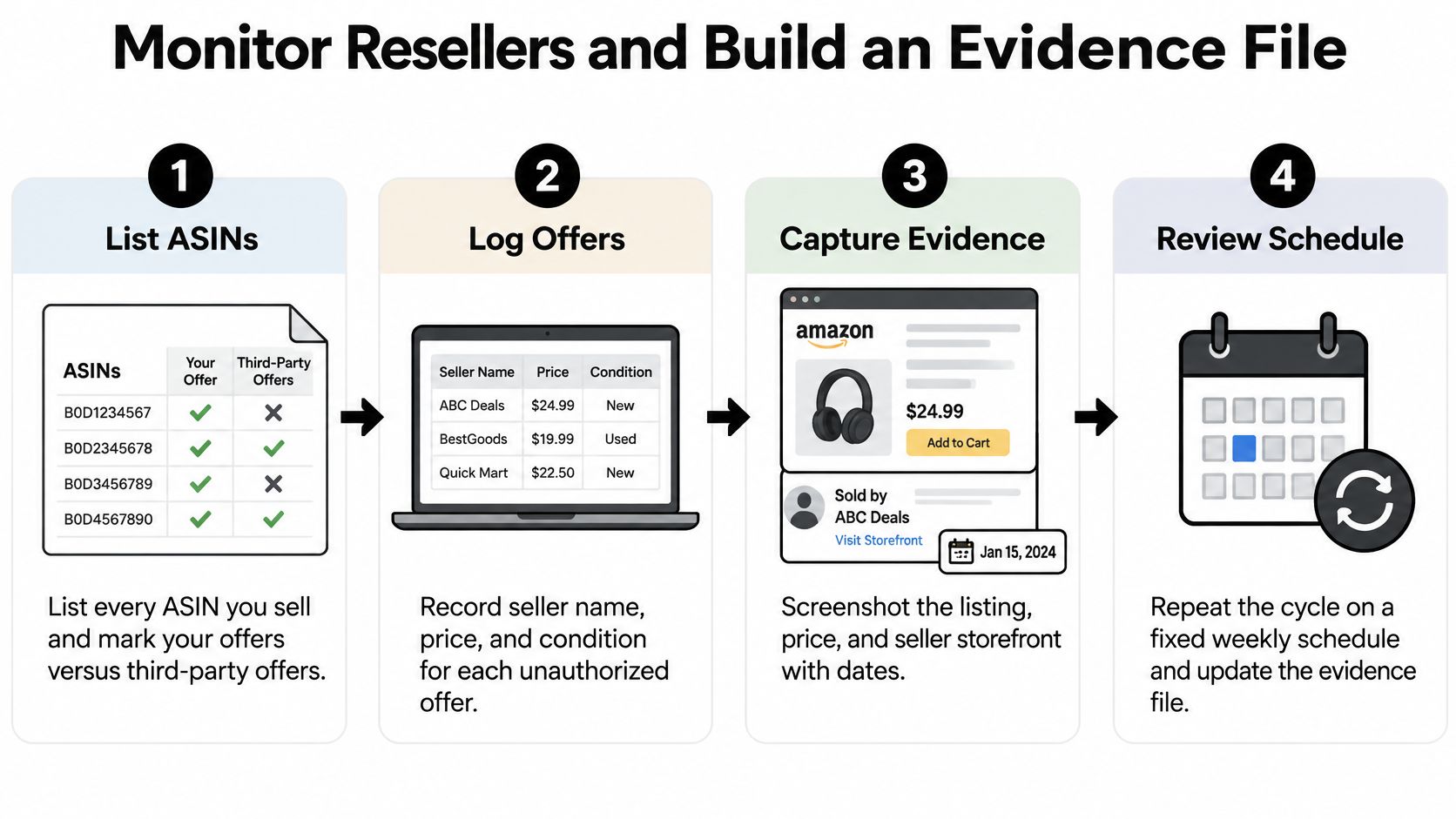
- List every ASIN you sell and mark which offers are yours and which belong to third-party sellers. You cannot judge a reseller without knowing your own baseline.
- Log the Featured Offer seller, the active offer count and each price including shipping in a dated sheet every week. A price move only becomes evidence when you can tie it to a date.
- Screenshot each offer, its seller storefront and any listing claims, with price, stock status and fulfillment method visible. Listings change overnight and a dated capture is what survives a dispute.
- Buy a test unit when authenticity is in doubt, then record lot codes, packaging details and inspection notes. Those details decide which violation category applies.
- Keep your authorization terms and approved channel list current. You can only show a seller is unauthorized if you can show what was permitted.
- Compare each offer against your MAP and your approved channel list before flagging it, then collect the evidence package described in the next section.
- Open the case in Brand Registry through the Account Health area in Seller Central and log the submission date so the response can be tracked.
- Review the trend monthly with our Amazon sales rank checker to see whether a new seller's arrival lines up with a rank drop on the affected ASIN.
If you are tracking hundreds of ASINs, automation earns its keep, and Clearcote Labs' scraping API comparison is worth reading before you build a collection pipeline rather than buying one.
What the file has to prove: who the seller is, what they are selling, when the price changed, and why the offer violates a specific right or policy. Everything else is narrative.
Sorting the Offer
An unauthorized reseller is not automatically an infringer. Amazon's Brand Registry states that the Report a Violation workflow handles intellectual-property infringement, store-policy violations and certain regulatory concerns, which means the same complaint form covers very different situations. Sorting comes before filing.
What Amazon asks for before it acts on distribution
For an unauthorized-distribution complaint, Amazon may request and review a selective or exclusive distribution agreement before taking action. If your authorization terms and channel restrictions aren't already documented, you have nothing to send and the case stalls.
| Violation type | Evidence to gather | Amazon route |
|---|---|---|
| Counterfeit product | Product photos, lot codes and a side-by-side comparison with a genuine unit | Brand Registry Report a Violation for intellectual-property infringement |
| Materially altered or damaged goods | Photos of altered packaging, missing seals and inspection notes | Report a Violation for policy or product condition concerns |
| Genuine but unauthorized resale | Invoices showing purchase channel, authorization terms and channel restrictions | Amazon may review a selective or exclusive distribution agreement before acting |
| MAP violation on a genuine product | Your MAP policy, dated price captures and competitor listing history | Often not enforceable as IP, so escalate through pricing and policy channels with the same trail |
The evidence package needs product identification data, ownership records, authorization terms, channel restrictions, invoices, documented packaging differences and images that tie the specific offer to a specific product. Brand Registry users submit through the Account Health area in Seller Central, and the guided workflow tracks each submission. A pricing or MAP dispute on its own may not establish an Amazon-enforceable IP violation, no matter how clear the undercut looks on the listing.
Run a one-pass test before writing a report. From the listing, the seller storefront and a test unit, decide which row above the offer belongs to. Counterfeit goes to IP. Altered goods go to condition and policy. Genuine gray market goes to authorization and distribution. A pure price complaint goes to your pricing policy and the dated trail behind it.
Choose Your Response to an Unauthorized Reseller
The right response depends on what the offer is. Counterfeit goods, altered products, genuine unauthorized inventory, and a MAP violation create different risks for customer trust, pricing, and control of the detail page. Choose the remedy that fits the evidence, since a weak or misdirected report can waste time without changing the offer.
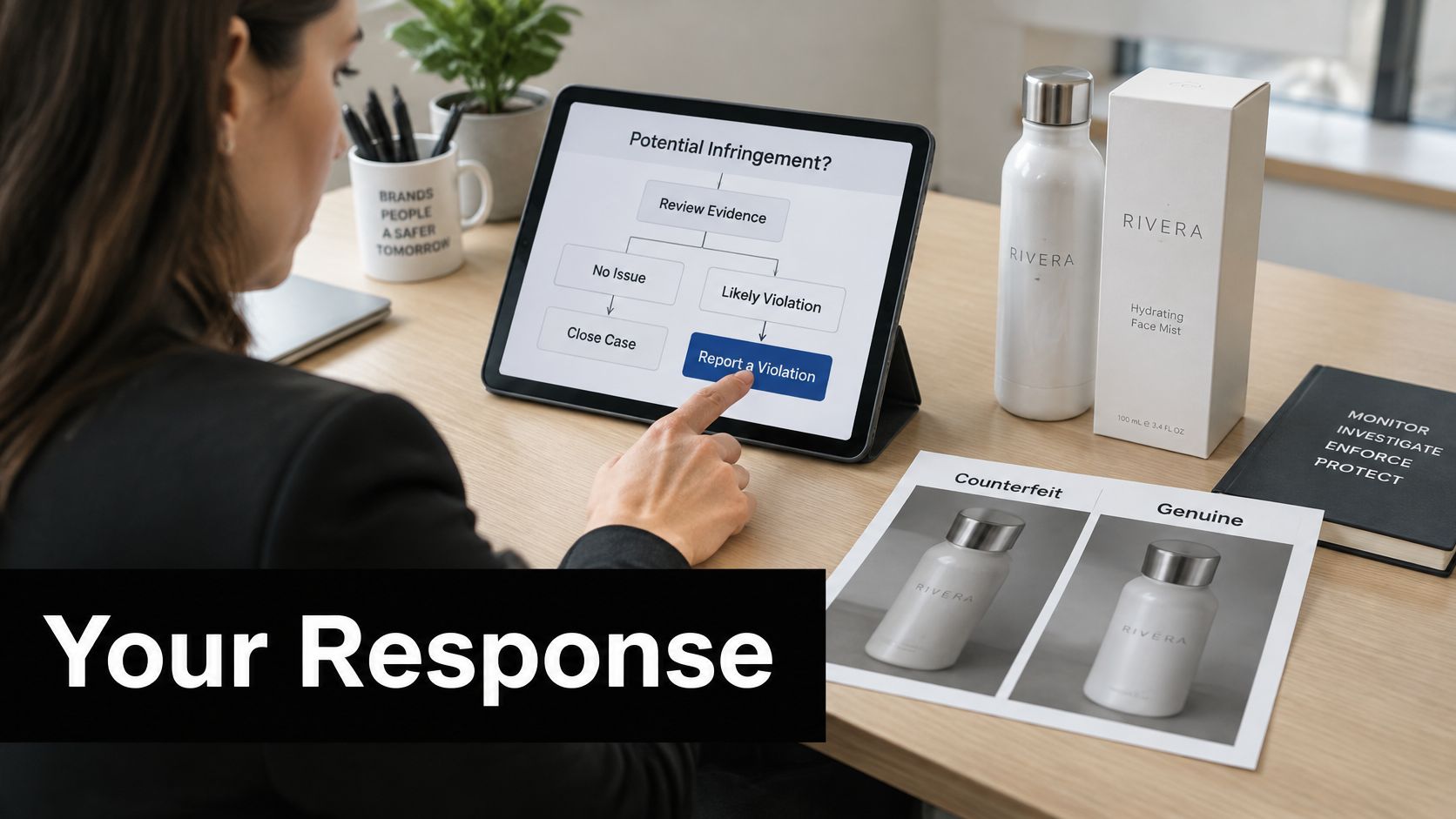
For counterfeit or materially altered product, submit a Report a Violation through Brand Registry with the evidence tied to that specific offer. Include product identification and records that establish the issue. A clear connection between the listing, the seller's offer, and the product gives Amazon a basis to assess the complaint.
For genuine inventory sold by an unauthorized seller, focus on the distribution and channel problem. You can ask the seller to seek authorization under a formal selective or exclusive distribution agreement, tighten distribution to reduce unauthorized supply, or raise a pricing and policy concern with the evidence already assembled. Choose the route that addresses the source of the problem. Filing several complaints at once does not make a weak claim stronger.
When the seller is genuine and the product is too
Amazon's seller FAQ says that when a reseller effectively operates in place of a high-recognition brand, Amazon may apply its Standards for Brands policy to protect customer experience and brand perception. That guidance may be relevant when a gray-market seller controls the listing presentation, warranty language, or customer-facing details without an agreement. It also makes reviewing your own channel control worthwhile before escalating.
A MAP violation on genuine goods generally is not an intellectual-property claim. Keep the pricing case separate: retain dated captures and the relevant channel terms, then use the appropriate pricing or policy route. For a framework on setting seller permissions and channel rules, building an Amazon authorized reseller program explains how agreements can support future enforcement.
A takedown can remove an offer, but it does not by itself stop the same inventory from reaching the marketplace again. Distribution controls address that recurring risk, while listing and policy complaints address the offer in front of you. For brands seeking outside support, Online Brand Growth handles Amazon Brand Registry enforcement, unauthorized reseller removal, and MAP protection.
Online Brand Growth works with brands and manufacturers, not resellers. Its Amazon Distribution Partnership model involves purchasing inventory from the client's company and selling it through its own Amazon store, while other support can address enforcement and channel operations. For details on the business and its services, visit Online Brand Growth.