
An authorized reseller program is a governance framework, not a magic button. Third-party sellers represented roughly 60% of Amazon units sold in 2023 and reached a record 62% share in Q4 2024, yet Brand Registry still doesn't automatically exclude unauthorized sellers or enforce MAP pricing.
That distinction matters because many brands treat authorization as a setting inside Amazon rather than an operating system spanning contracts, inventory, documentation, Seller Central, and enforcement. Brand Registry gives the brand important permissions, but a resilient program must also show who may sell each SKU, where they may sell it, which inventory they received, and what happens when Amazon asks for proof.
Why Authorized Reseller Programs Matter Now
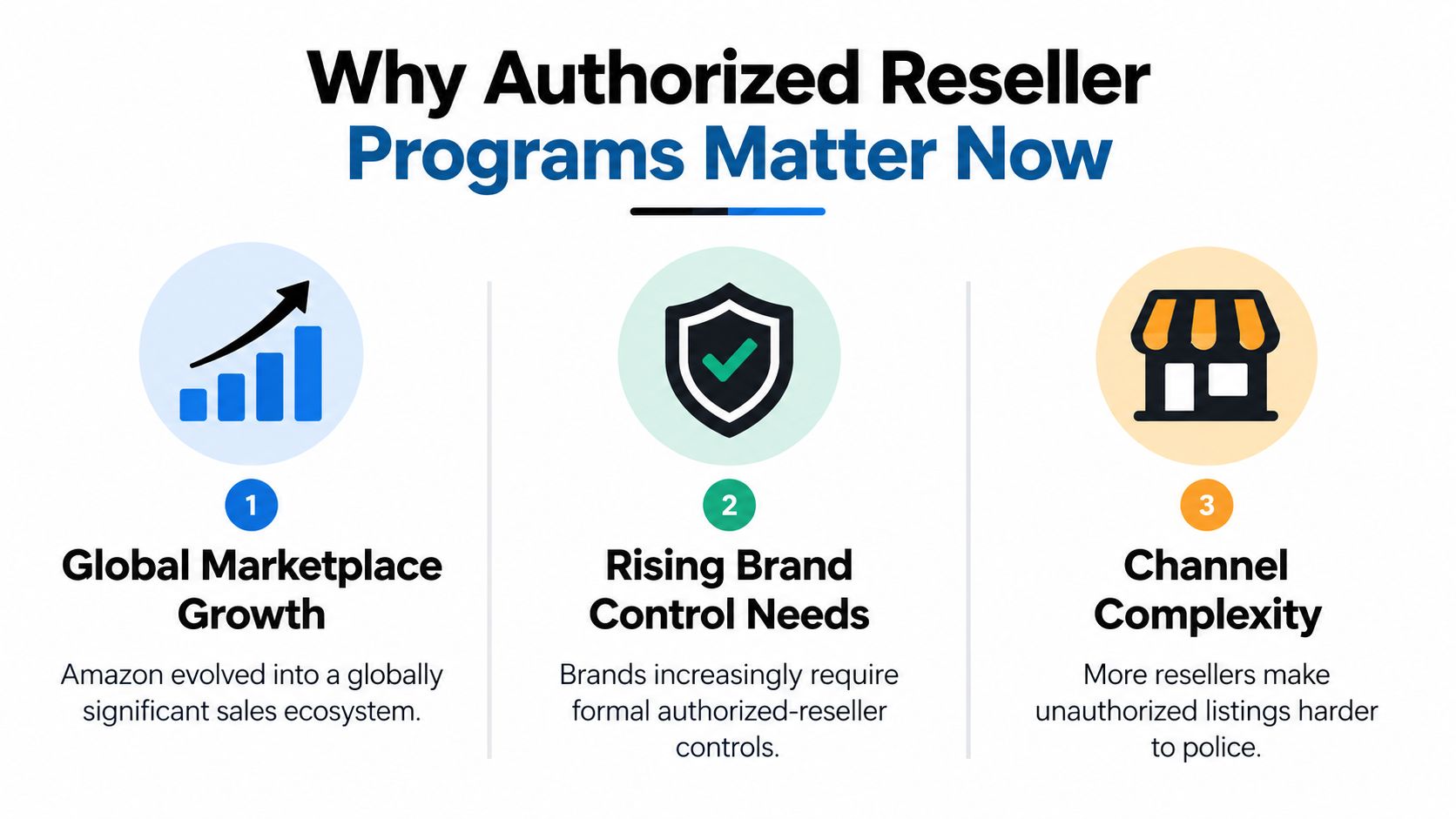
Amazon's marketplace stopped being a minor secondary outlet a long time ago. Independent third-party sellers accounted for approximately 3% of physical gross merchandise sales in 1999, 28% in 2006, and 58% in 2018, then represented roughly 60% of units sold in 2023 and a record 62% share in Q4 2024, according to Amazon seller marketplace data covering the shift.
Those figures change the operating question for a manufacturer. You're not deciding whether to supervise a handful of peripheral merchants. You're deciding whether your brand has a functioning governance model in a marketplace where third-party sellers compete for visibility, Buy Box eligibility, pricing, inventory, and customer ownership.
The channel is bigger than the listing
A reseller program should answer practical questions before a dispute occurs:
- Who can sell: Identify the legal entity, Amazon selling account, and approved distributor relationship.
- What they can sell: Define authorized SKUs, bundles, pack sizes, and catalog permissions.
- Where they can sell: Record the permitted marketplace, territory, and warranty region.
- How they must operate: Set rules for authenticity, condition, returns, content, pricing communication, and inventory diversion.
- What happens next: Establish review, renewal, suspension, and revocation procedures.
Brands that skip these decisions often discover that their supply chain has created marketplace exposure they can't easily trace. A distributor may have a legitimate relationship with the manufacturer while a downstream seller has no permission to list a specific ASIN or sell it in a particular marketplace. Genuine product ownership and authorized channel rights aren't always the same thing.
That's why channel governance should sit alongside product content and advertising, not in a separate legal folder. A useful primer on managing channel conflict helps frame the underlying issue, but the Amazon program must turn that strategy into account-level records and operating rules.
Practical rule: Authorization should make accountability clearer. It shouldn't be sold internally as a promise that every competing offer will disappear.
The program also protects more than price. It gives the brand a structured way to investigate damaged inventory, altered packaging, unsupported warranties, counterfeit complaints, and content misuse. It can support escalation when the evidence points to a policy or intellectual-property violation. It won't eliminate every unauthorized seller, but it gives your team contractual and operational grounds for deciding which cases deserve action and which represent lawful competition.
What Brand Registry Actually Gives You
Amazon Brand Registry is best understood as a permission system, not a complete reseller-protection system. Its dedicated Reseller role lets a Brand Registry Administrator manually assign an authorized external seller to the reseller's Amazon selling account, generally after the brand has confirmed its selling relationship.
The role provides limited access to brand selling benefits. It may allow the reseller to create new product detail pages, but it doesn't provide access to Brand Analytics and it isn't proof that Amazon independently vetted the seller, as Amazon explains in its guidance on Brand Registry user roles and permissions.
Treat the role as one record in a larger register
The administrator should maintain a controlled reseller register outside Amazon. At minimum, each record should contain:
| Record | What to capture |
|---|---|
| Legal identity | Registered business name and relevant business details |
| Amazon identity | Selling account identifier and marketplace |
| Commercial scope | Authorized SKUs, territories, channels, and effective dates |
| Evidence | Signed agreement, invoices, authorization letter, and distributor chain |
| Status | Pending, active, expired, suspended, or revoked |
| Ownership | The internal person responsible for review and escalation |
This register creates an operating connection between the Amazon account and the commercial agreement. It doesn't transfer brand ownership, grant full brand-management privileges, or replace the contract.
Your agreement should separately define pricing communication, authenticity, product condition, warranty support, returns, content usage, inventory diversion, and compliance obligations. Those terms matter because removing a reseller role revokes the Brand Registry relationship, while the commercial agreement governs the broader relationship between the brand and seller.
Use permissions deliberately
Give the role only to accounts you can identify and reconcile. Review the register when an agreement changes, a seller account changes, a territory expands, or a reseller stops buying through the approved route. Don't assume an active role proves that every offer from that seller is compliant.
Many teams overestimate Brand Registry. The Amazon Brand Registry overview is useful for understanding the program, but the practical control comes from connecting Amazon permissions to contracts, invoices, account identifiers, and a revocation workflow.
Authorization Without Automatic Exclusion Power
Brand Registry alone and Brand Registry supported by supply-chain controls produce very different outcomes.
Brand Registry alone gives the brand a formal relationship with selected seller accounts and access to intellectual-property and content-protection tools. It doesn't automatically block every other seller from an existing detail page, and it doesn't convert the brand into the sole party allowed to sell genuine goods.
Brand Registry plus supply-chain controls gives the brand a stronger evidence trail. That system connects seller authorization to serialized or lot-level traceability, distributor contracts that prohibit diversion, documented invoices, warranty-territory rules, and an investigation process for authenticity or condition complaints. Amazon's seller policy on fair marketplace conduct and intellectual-property enforcement makes the boundary important. Sellers must provide accurate information, act fairly, and avoid using infringement reports as a competitive weapon.

Separate bad offers from unwanted offers
A legitimate seller with genuine inventory may be commercially inconvenient without being a policy violator. A lower price alone doesn't establish counterfeit activity, materially different condition, damaged goods, or unauthorized content. Your enforcement team should classify the problem before filing a notice.
| Situation | Evidence to prioritize | Likely commercial response |
|---|---|---|
| Suspected counterfeit | Unit traceability, purchase records, test results, complaint evidence | Investigate and escalate through the relevant Amazon process |
| Materially different product | Packaging, model, accessories, condition, warranty evidence | Document the mismatch and pursue a product-condition complaint |
| Diverted inventory | Distributor invoices, lot records, territory terms | Trace the leak and enforce the distribution agreement |
| Genuine discounted offer | Seller identity, supply route, pricing records | Address through contracts and supply relationships |
| Unauthorized content change | Catalog history, registered brand assets, screenshots | Use appropriate Brand Registry tools and evidence |
This evidence-led approach protects the brand from a second problem, an unsupported complaint that Amazon may view as abusive. The aim isn't to remove every merchant you dislike. It's to identify violations that affect customer trust, product authenticity, warranty support, or catalog accuracy.
Brands with multiple distributors should also address the operational problem often described as avoiding third party data chaos. Product identifiers, pack sizes, market permissions, and content ownership need consistent records across the channel. Otherwise, your team may have a contract that says one thing, an invoice that shows another, and a detail page that supports neither.
Authorization gives you a relationship to manage. Traceability gives you evidence to act on.
Building the Documentation System That Survives Appeals
Amazon may ask a seller to prove both authenticity and the right to sell. Brand Registry doesn't remove that requirement. Amazon identifies invoices and letters of authorization as core documents for enforcement appeals, and the records must demonstrate the seller's rights while matching the selling account details in the Amazon intellectual-property appeal guidance.
Build the file before the first complaint. A reseller who bought genuine products from a real supplier still may not have permission to sell every ASIN, create new catalog content, or sell in every marketplace.
Build one authorization file per reseller
The file should contain:
- Signed distribution agreement: Name the parties, effective dates, permitted channels, territory, and termination rights.
- SKU permissions: List the exact products, variations, bundles, and pack configurations the seller may offer.
- Seller identifiers: Record the legal entity, Amazon selling account identifier, and applicable marketplace.
- Invoice chain: Retain invoices from the brand or authorized distributor, with product identifiers and matching business details.
- Letter of authorization: State the seller's permitted products, territories, and sales channels.
- Traceability evidence: Connect lot, serial, or shipment information to the approved supply route where available.
- Renewal and revocation record: Show approval status, expiration date, reviewer, reason for suspension, and notice history.
Use a document control process guide to establish naming, versioning, access, and retention rules. The specific software matters less than having one current source of truth that Seller Central operators, legal staff, sales teams, and distributors can use without pulling conflicting files from email threads.
Make ownership visible
Assign responsibilities rather than leaving the file with “the Amazon team.” The channel or sales owner confirms the commercial relationship. Operations validates invoices and product flow. Legal approves contract language and territory restrictions. The Brand Registry administrator controls Amazon permissions. Seller Central support staff own case submissions and follow-up.
When Amazon challenges a listing or account, the operator should be able to answer four questions quickly:
- Is this seller authorized?
- Which SKUs and marketplaces are covered?
- Which invoice proves the product entered the approved channel?
- Who can confirm or revoke the authorization?
Walk the approval workflow before you need it
The Seller Central workflow starts in Add a Product. If Amazon requires approval, the seller sees Request Approval and submits documentation through Apply to Sell. The supporting file may include a purchase invoice from a manufacturer or authorized distributor, product images showing every side and the labeling, and category-specific certifications.
Amazon's listed invoice requirements include a date within the previous 180 days, the seller's name and address shown exactly as they appear on the Seller Account, and evidence that the invoice was paid. Accepted file types include PDF, DOC, PNG, GIF, and JPG, with a maximum file size of 10 MB, according to the Seller Central approval workflow guidance. Record the Case ID immediately after submission, then store the submitted files and follow-up responses with the reseller record.
MAP Policy Versus Actual Price Control
Authorizing a seller doesn't guarantee price stability, Buy Box control, or channel profitability. Amazon doesn't enforce a brand's minimum advertised price policy or automatically remove an offer just because it falls below MAP, as explained in this analysis of Amazon MAP pricing and unauthorized sellers.
That means a brand needs two separate enforcement tracks.
Use contracts for commercial behavior
MAP is generally a private policy supported by the brand's own supply and contractual relationships. An authorized-reseller agreement can require sellers to follow the brand's pricing communication rules, identify approved channels, protect product presentation, and cooperate with audits. The brand can then investigate a breach through its commercial relationship, subject to applicable law and the terms of its policy.
Authorization improves accountability because you know which seller and distributor relationship to contact. It doesn't make Amazon the enforcement arm of your MAP policy.
Use Amazon processes for marketplace violations
A genuine seller offering a lower price is not automatically committing an intellectual-property violation. Filing an infringement notice because the offer is discounted can expose the brand or seller to risk if the claim lacks supporting evidence.
Amazon's Brand Registry tools can help brands identify sellers associated with ASINs and respond to certain infringing listings. Those tools are valuable for visibility and content protection, but they don't transform a private pricing rule into an Amazon pricing rule.
| Problem | Primary control | What authorization changes |
|---|---|---|
| Below-MAP offer from a legitimate seller | Contract, supply terms, and commercial response | Identifies the relationship and creates accountability |
| Counterfeit or materially different product | Evidence-led Amazon enforcement | Helps connect the seller to approved product records |
| Diverted inventory | Distributor controls and traceability | Supports investigation of the supply leak |
| Buy Box pressure | Inventory, landed price, offer quality, and account performance | Doesn't guarantee Buy Box ownership |
| Altered branded content | Brand Registry tools and catalog evidence | Clarifies which account has permission to manage content |
For a deeper explanation of the commercial side, review this minimum advertised price policy framework. Then keep the operational distinction clear: MAP enforcement is a channel-management issue, while counterfeit and content violations require evidence that fits Amazon's policies.
Operational Setup and Next Steps
A workable Amazon authorized reseller program for brands can be implemented as an operating playbook rather than a large one-time project. Start with the products and sellers creating the most exposure, then connect authorization, documentation, permissions, and escalation.
Set the rules and assign control
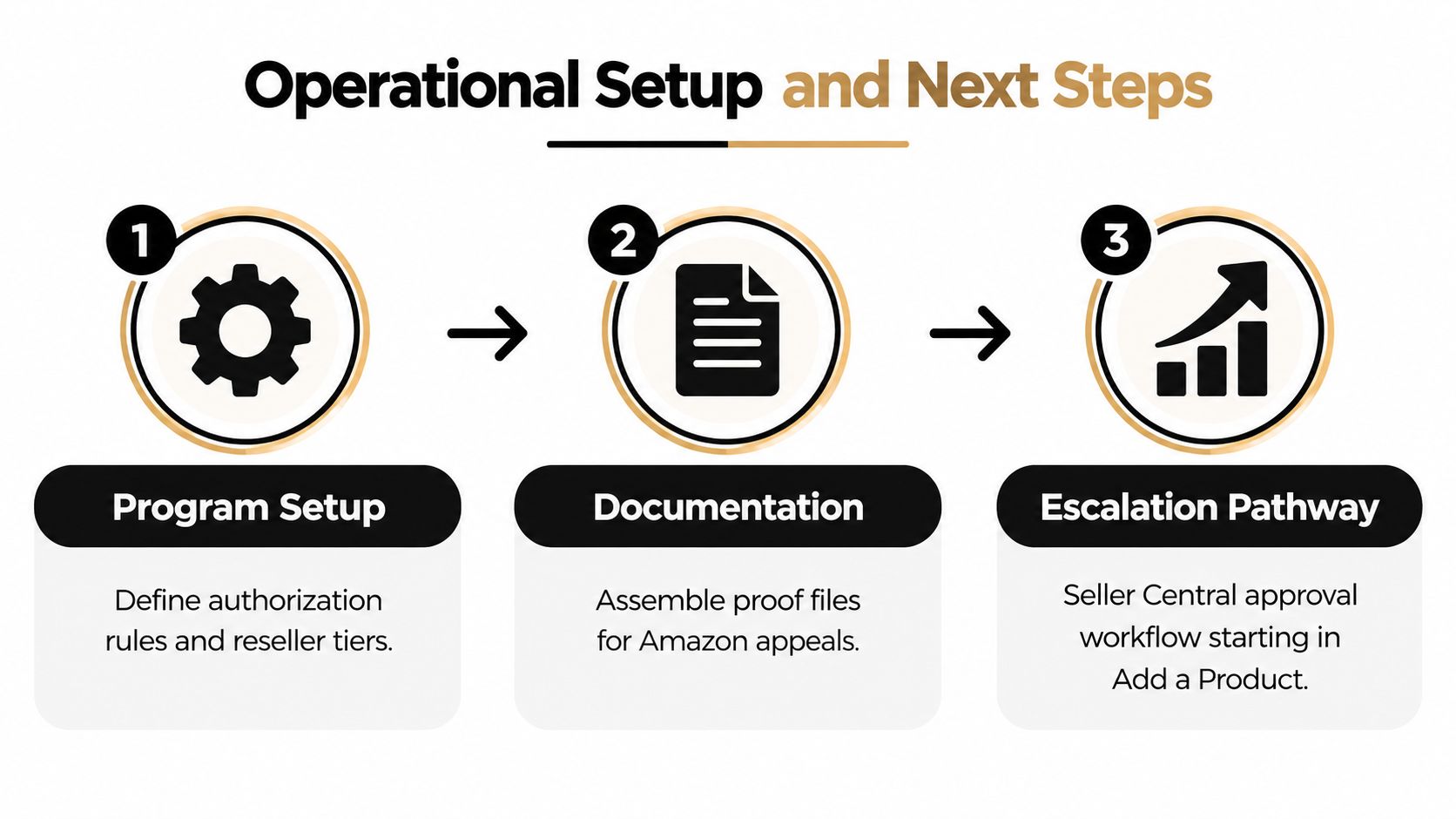
Create the reseller register first. Define authorization tiers, permitted SKUs, territories, marketplaces, warranty regions, content rights, and expiration rules. Assign one owner to approve changes and another to validate the supporting records.
The trademark owner must enroll the brand in Brand Registry. An authorized agent can't independently enroll the brand as the rights owner, then operate without central control. Amazon's Brand Registry guidance for trademark owners and authorized agents explains that the trademark owner enrolls first and adds the authorized agent as an additional user.
Use Transparency where unit-level authentication makes commercial sense. The program requires a Brand Registry account associated with the brand's trademark and rights-owner role, an active registered trademark, a Global Trade Item Number such as a UPC or EAN for each enrolled product, and the ability to apply a unique code to every manufactured unit. Codes must be unique, externally scannable in 1D, QR, or 2D formats, and between 7 and 20 characters, according to Amazon Transparency requirements.
Prepare the approval and escalation path
Have the reseller submit the product approval request through Seller Central, Catalog, Add a Product. If Amazon displays Request Approval, use Apply to Sell and attach the current invoice, authorization letter, product images, and category certifications. Keep every file within the accepted formats and 10 MB limit, and make sure the invoice is dated within the previous 180 days while matching the Seller Account name and address.
After submission:
- Record the Case ID and the exact documents submitted.
- Save Amazon's response with the reseller's authorization file.
- Classify the issue, such as approval, authenticity, catalog, content, or seller conduct.
- Match the evidence to the issue instead of submitting a generic complaint.
- Escalate with a concise chronology showing the seller, product, territory, invoices, and requested resolution.
A structured approach to vendor management guidance can help your team apply the same approval and review discipline to distributors that it applies to Amazon sellers.
For working-level economics, use the Amazon profit calculator, FBA storage fee calculator, and sales rank checker when assessing whether an authorized offer remains viable after fees, inventory costs, and channel requirements. A 360 Brand Protection program can also support unauthorized seller removal and MAP enforcement by combining monitoring with the appropriate commercial and Amazon escalation paths.
The practical standard is simple. Every active reseller should have a current authorization record, every disputed offer should have an evidence trail, and every Amazon case should have an owner and Case ID. That system gives your team a defensible response when a seller appeal, authenticity complaint, catalog dispute, or cross-border distribution question arrives.
Online Brand Growth helps manufacturers and consumer brands structure reseller authorization, monitor unauthorized sellers, manage MAP enforcement, and handle Amazon Brand Registry and Seller Central escalations. Visit Online Brand Growth to book a free strategy call and map your current reseller records, evidence gaps, and enforcement priorities.