
The popular advice on Amazon's return policy is to budget for refunds and move on. That's not enough. A refund, an unsellable unit, a return label and an unresolved inventory discrepancy are different losses, and you need to track them separately. The useful question isn't whether a customer can return something. It's who pays, what inventory you recover and when the transaction closes.
Return Windows and Conditions at a Glance
On most Amazon.com products, customers can request a refund, replacement or exchange within 30 days of delivery, generally in original or unused condition, per the Amazon.com Returns Policy. Until that window closes, each sale stays provisional on your books, which is why the window matters more to your cash position than the headline promise suggests.
Return windows and conditions by case
| Case | Return window | Condition or requirement | What it means for you |
|---|---|---|---|
| Standard products on Amazon.com | 30 days from delivery | Original or unused condition, with applicable tags, seals, accessories and packaging intact | The default exposure on most of your catalog |
| Category exceptions | Longer or shorter than the default | Meet the category's eligibility and condition rules | Check each category before setting listing promises or support scripts |
| Certain digital products | 7 days for eligible items | Product must qualify under the applicable digital-return policy | A shorter window limits how long revenue stays open to reversal |
| Baby items, new and unopened | 90 days from delivery | New and unopened | Triples the time a unit can come back, stretching inventory planning |
| FBA request after the deadline | Case by case at Amazon's discretion | Amazon must accept the late request | A possibility, not a planning assumption |
Amazon's FBA customer returns policy is the source for the exceptions above, including certain digital products eligible for only 7 days and eligible baby items in new and unopened condition with a 90-day return period. The same policy covers Amazon's discretion to accept late FBA requests and the condition requirements applied when a return arrives.
Condition determines your next action
An authorization tells you the buyer can send the item back. It says nothing about whether the unit that arrives matches what you shipped, or whether it belongs back in sellable inventory.
Have receiving staff check tags, hygiene seals, accessories, manuals and packaging before assigning a disposition. Keep an unopened unit separate from an opened-but-complete one, and keep both separate from units with missing components. Three dispositions, three different inventory values. Lumping them together makes your on-hand count look healthy while your recoverable value drops.
Apparel teams refining buyer-facing return instructions can look at ClothME's guide to simplify apparel returns with ClothME for how the clothing-return process reads from the customer's side. Keep your own instructions aligned with the applicable Amazon policy rather than borrowing another retailer's eligibility rules.
Practical rule: Don't promise a return window at the brand level until you've checked it at the category level.
Before changing support scripts, listing language or Seller Central return settings, assign someone to confirm the window for each product family. Separate a physical return from a returnless refund on Amazon in your records as well: the customer gets the same refund, but only one outcome puts a unit back in your inventory.
What Each Return Costs You, Case by Case
A returned order can cost anywhere from a few dollars of handling to the full item price. The gap between those two outcomes depends on five variables: the reason code, who fulfilled the order, the product category, who paid return shipping, and what condition the unit arrives back in. Price the return against those variables, not against the customer's refund amount.
Keep the following cases separate in your refund review:
| Return case | Deduction treatment | Actual cost to assess |
|---|---|---|
| Original condition, inside the window | No restocking fee | Refund, handling and any applicable shipping costs |
| Original condition, outside the window | A permitted late-return restocking deduction may apply | Handling costs less the deduction, plus inventory recovery |
| Used, damaged or materially different | Condition-based deduction under the applicable guidance | Lost resale value, missing parts and inspection work |
| Qualifying opened software, video games or collectible cards | Special category treatment | Whether the product retains any recoverable value |
| Late return shipment | Customer-facing late-return charges may apply | Actual account deductions, timing and inspection outcome |
The reason code a buyer selects sets your starting position, though it doesn't settle the outcome. A "no longer needed" return on a sealed FBA unit behaves differently from "defective" on an opened seller-fulfilled order, because fulfillment method determines who inspected the item and who paid the label. Amazon's seller restocking-fee guidance permits no restocking fee for an original-condition item returned within policy, while allowing up to 20% of the item price, excluding shipping, for an out-of-window return or a used, damaged or materially different item. That ceiling applies only when the condition evidence supports it.
Calculate the recovery, not just the refund
Take a $40 item eligible for a 20% deduction. The refund drops to $32, leaving $8 toward handling and lost value. Run that against the bill first: inspection labor, repackaging materials, and the margin the unit loses if it can only resell as open-box. On a low-margin item, the deduction can cost more in labor than it recovers.
Category rules can flip the arithmetic entirely. For qualifying opened or used software and video games, and opened collectible cards or games, Amazon's restocking-fee and reimbursement guidance describes charges of up to 100% of the item price. Amazon's customer refund guidance also describes late-return charges of 20% during the first 30 days after the deadline and 100% afterward. Customer-facing charges aren't blanket permission for a seller to impose equivalent deductions on every order.
Judge a returned unit by its recoverable value, not by the original selling price.
The inspection outcome is where the case closes. Record serial numbers, dated photos, shipping-label records and a receipt condition code before deciding on a partial refund. A returned unit should reenter sellable stock only after it passes inspection.
Shipping sits on its own cost line, and cross-border orders inflate it. For international orders, seller-paid return freight and potentially reimbursed original freight can sit on top of the product loss. For FBA, reconcile the actual charges rather than assuming every fulfillment expense reverses with the refund; the Amazon FBA fees breakdown helps separate those expense categories.
How the Return Cycle Hits Your Cash Flow
Your finance team needs event dates, not a single returned/not-returned flag. The buyer, Amazon, your warehouse and your accounting team can each complete their part at different times.
Use this timeline to identify where responsibility changes hands.
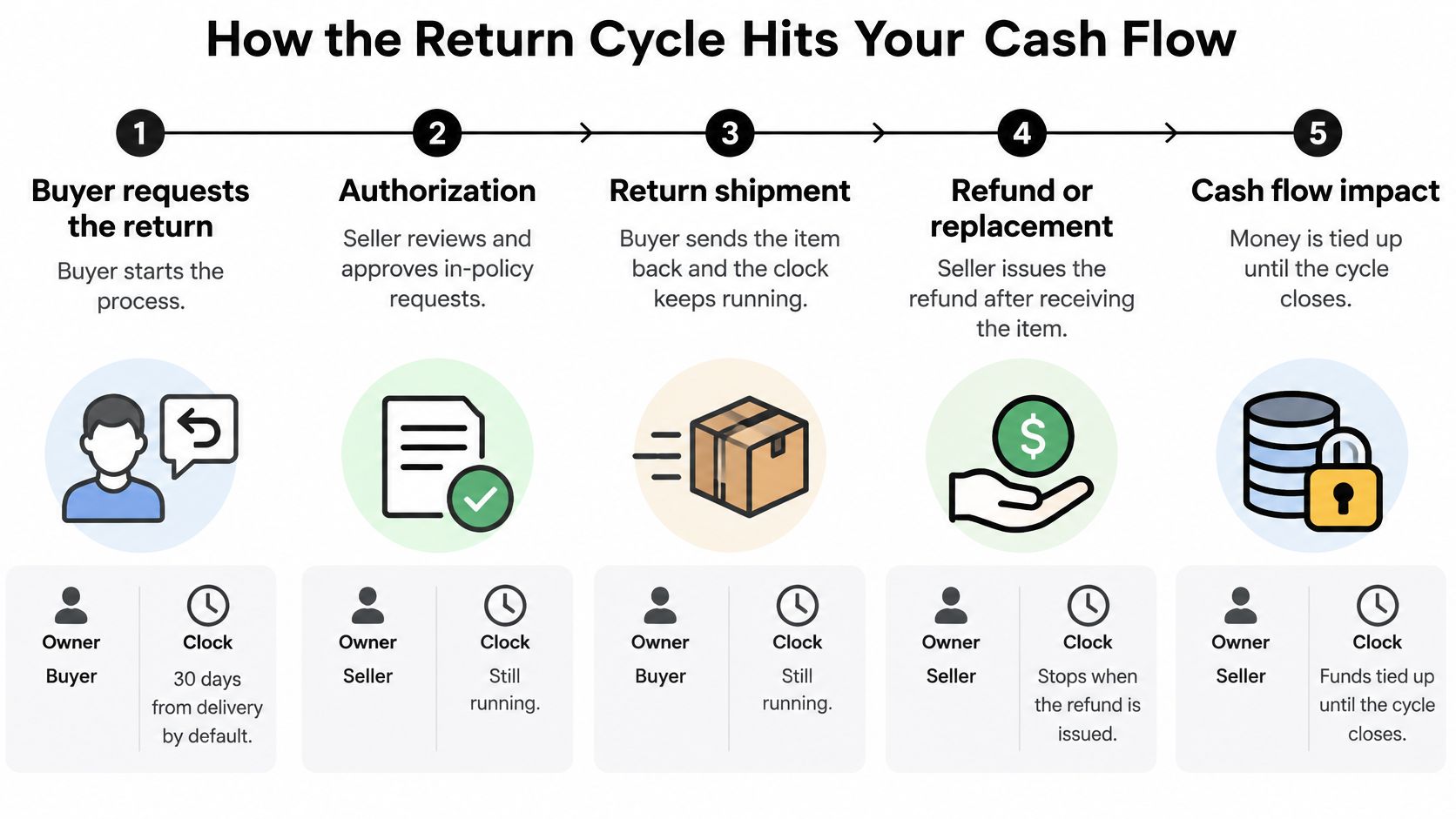
Track each operational clock
Amazon's seller-fulfilled returns guidance establishes the following timing and authorization requirements:
- Buyer request. The standard U.S. window is 30 days from delivery or estimated delivery, subject to category exceptions. Store the request date against the original order.
- Authorization. Amazon automatically authorizes in-policy seller-fulfilled requests. Where manual authorization is required, the seller must respond within 24 hours. Route those requests to a monitored queue.
- Return shipment. After authorization, buyers generally receive an additional 15 days after the return window closes to ship the item. An authorized return is therefore neither received inventory nor a closed liability.
- Receipt and processing. Record the carrier scan separately from warehouse receipt and inspection. For FBA, Amazon handles the physical workflow; don't substitute a customer's drop-off confirmation for an inventory disposition.
- Refund. Seller-fulfilled refunds must be issued within two business days of receipt. Failure to act can allow Amazon to refund the buyer and charge the seller account.
In a hypothetical order delivered on day zero, the buyer requests a return on day twenty-eight and ships near day forty-five. Add transit, receiving and processing, and the sale can remain unresolved for two months or more. The standard eligibility window doesn't describe that full cash cycle.
Change the reporting structure
Build separate fields for request date, authorization date, carrier scan, receipt date and refund date. Add fulfillment method, ASIN, return reason, disposition and reimbursement status. You can then distinguish money refunded from merchandise recovered.
Use two views: original-order cohorts for contribution margin, and current-period cash movements for liquidity. Otherwise, a recent refund can make current sales look worse while leaving the original sales cohort overstated.
For returned units awaiting disposition in FBA, estimate holding costs with the free FBA storage fee calculator. Then decide whether restocking, removal or another permitted disposition offers the best recovery. Don't retain inventory solely because you've already paid to acquire it.
Getting Reimbursed When Returns Go Wrong
Recovery starts with identifying a discrepancy, not assuming that every uncomfortable return qualifies for compensation. A refunded order with no corresponding returned unit deserves investigation. It doesn't automatically establish reimbursement eligibility.
Our FBA reimbursement service covers lost and damaged inventory claims, overcharged FBA fees, and customer-return and refund discrepancy claims. Only legitimate, well-documented claims are filed through Amazon's standard processes, and automated mass-filing is never used.
Reconcile before filing
For FBA, open Reports > Fulfillment and pull the Customer Returns and Reimbursements reports. Match the returned unit's disposition against the refund on the order, then check whether Amazon has already reimbursed the discrepancy.
Run this weekly routine:
- Match returns against refunds. Join records using the order and product identifiers. A refund entry alone doesn't tell you where the merchandise went.
- Flag exceptions. Isolate missing receipts, incorrect products, empty returns and units whose disposition doesn't reconcile with inventory.
- Assemble evidence. Match serial numbers, outbound records, label details and dated inspection photos. Explain the discrepancy in plain language.
- Check the claim route and deadline. Use the relevant FBA process or, for eligible seller-fulfilled cases, SAFE-T. File while the applicable clock is open.
- Log the outcome. Store the case ID, reason, amount requested, decision and reimbursement entry. Close the exception only after the accounting records agree.
For eligible seller-fulfilled SAFE-T claims, Amazon's restocking-fee and reimbursement guidance generally sets a filing period of thirty calendar days after the refund charge or returned replacement. Keep that deadline visible in the exception queue rather than relying on someone's inbox.
Prioritize provable discrepancies
Start with high-value items, mismatched serial numbers and repeated discrepancies associated with the same buyer. Repeat activity is a reason to inspect carefully, not proof of abuse.
For the customer-facing side of refund status, the Compass+ guide to tracking refunds offers useful process context. Your seller ledger needs more detail: who issued the refund, whether inventory returned and whether recovery posted.
Claim discipline: A complete evidence packet is more useful than a large queue of speculative cases.
Track successful recovery by reason code. That shows your operations team which receiving records and inspection checks support valid claims.
Cross-Border Returns and European Obligations
Under Amazon's European international-return guidance, beginning August 11, 2025, sellers shipping from outside Germany or the UK must offer qualifying customers a domestic return address with a prepaid label, a prepaid international label, or a full refund without requiring the item back. Failing to provide an option within three calendar days can result in Amazon refunding the customer and charging the seller.
Physical recovery needs a receiving plan, not just an address.

For eligible international returns, the seller is responsible for return shipping, and faulty products can also require reimbursement of original shipping. Budget those obligations before comparing recovery options.
Choose the route by recoverable value
Consider two hypothetical products shipped from a U.S. warehouse to Germany: an €18 accessory and a €350 kit. Assume, for this scenario, that the accessory's return label costs more than the unit, while the kit retains substantial resale value after inspection.
| Option | Lower-value accessory | Higher-value kit |
|---|---|---|
| Domestic return address and prepaid label | Useful when local receiving and consolidation produce a positive recovery | Strong option when local inspection protects valuable inventory |
| Prepaid international label | Poor choice under the scenario's freight assumption | Worth evaluating against resale value, freight and handling |
| Full refund without return | Avoids spending more to recover less | Usually harder to justify if the kit remains recoverable |
A domestic address isn't sufficient by itself. Someone needs to receive the parcel, inspect it, record the result and decide whether to restock locally or consolidate it for onward movement.
The international-return workflow also needs a clear customer-facing handoff.
Document the decision before launch
Create a routing sheet with destination country, ship-from country, carrier, currency, tax treatment and response deadline. Add the return address, label provider, inspection owner and fallback refund decision.
For expensive or regulated products, include the documentation and handling requirements that determine whether the item can travel back through the selected route. A cheap freight quote isn't useful if the carrier won't accept the product.
Assign a backup owner for weekends and absences. Document the option each SKU uses before launch so the response deadline never depends on someone remembering an exception.
Cutting Return Costs and Stopping Abuse
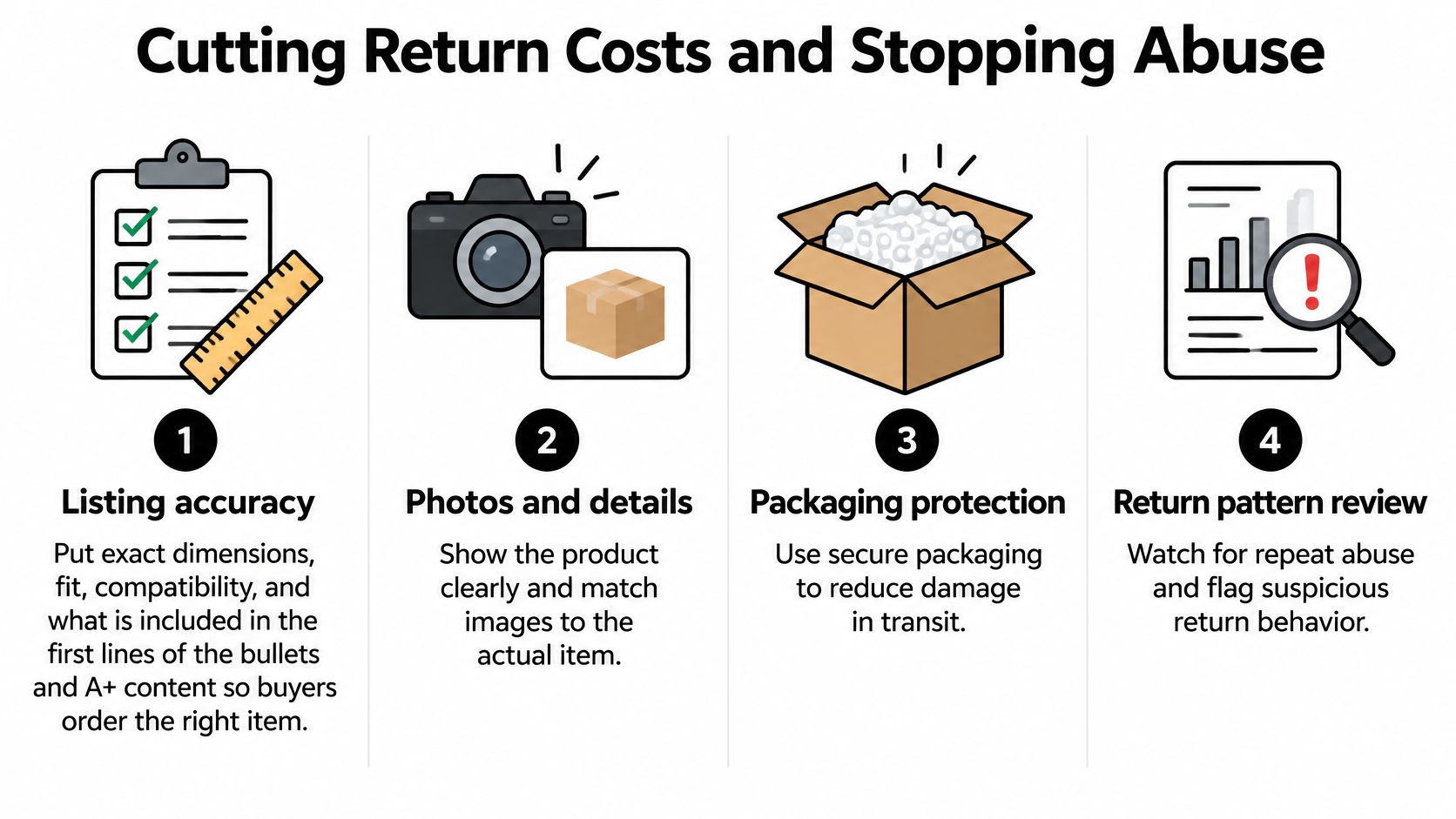
A return rate is not one problem. A refund on a low-value accessory, a damaged FBA unit that fails inspection, and a serial return with missing components all reduce margin differently. Run a monthly prevention review supported by weekly exception monitoring, and rank each ASIN by return reason, fulfillment method, category margin, shipping exposure and expected inspection result.
Use that ranking to choose the control. Buyer confusion needs better page evidence, damage needs packaging or prep work, and suspected abuse needs dated documentation before escalation.
Fix the causes you control
Make listings answer purchase objections. Put exact dimensions, fit, compatibility and included components early in bullets and A+ content. If buyers repeatedly order the wrong replacement part, show compatible model identifiers and exclusions instead of adding more lifestyle copy. For products with close variants, make the deciding difference visible in images and comparison content.
Show the actual product and protect it. Include scale references, component photos and accurate packaging expectations. Compare damage reasons against packaging changes, then test whether the product can move inside the shipping carton. Separate FBA damage from merchant-fulfilled damage so the response addresses the route that created it.
Monitor each ASIN and reason code. Build a review threshold from the product's own return history and category economics, then investigate a sustained breach promptly. Check the free sales rank checker for a coincident rank decline. Treat that decline as context; it does not prove returns caused it.
Price returnless decisions properly. Compare recoverable resale value with freight, inspection, repackaging and disposal using the free Amazon profit calculator. Under Amazon's returnless-resolution guidance, sellers can configure rules in Seller Central return settings, and eligible U.S. returns valued at $25 or less are automatically refunded without return when fulfilled from outside the U.S. without a default U.S. return address. Check existing settings before adding rules. A returnless rule can protect a low-value SKU and still be wrong for a kit with resale value.
Document suspicious patterns. Preserve dated evidence for mismatched products, missing components and serial returns before escalating. Record the order ID, return tracking, product identifiers and inspection photos. Separate an incorrect item from a legitimate defect claim so your team does not apply the same response to both.
Trace seller-related problems carefully. Verify the seller of record when complaints suggest misrepresented condition or inconsistent merchandise. Where unauthorized resellers or MAP violations are implicated, Online Brand Growth's Brand Registry and enforcement services can pursue removal of unauthorized sellers and help protect MAP and the Buy Box.
Judge each action by expected recovery after shipping, labor, repackaging and disposal. A returned item that passes inspection may recover value for resale, while a damaged or substituted unit may only support a documented claim.
Prevent mistakes before shipment
For your DTC operation, Mayra's guidance to prevent returns with pre-fulfillment order edits explains how correcting purchase mistakes can avoid reverse logistics. A DTC editing workflow does not always transfer directly to Amazon, so use the controls available for each channel.
Tie each corrective action to a reason code and a review date. Then compare the affected reasons before and after the change. A lower refund total caused by lower sales is not an operational improvement.
Online Brand Growth helps brands connect return reporting, inventory operations and legitimate reimbursement recovery to contribution margin. Book a free strategy call to review where your return process is losing cash and which fixes deserve attention first.