
A lost unit that would've sold for $100 can now reimburse closer to $30, and that gap is the point. Amazon didn't just tighten filing windows. It changed what a claim is worth, which turns an Amazon FBA reimbursement service from a cleanup task into a cash-flow and confidentiality decision. If you don't know your sourcing cost by SKU, Amazon picks an estimate for you, and you live with it.
Claim Types and Filing Windows at a Glance
Your reimbursement claim starts aging the day the unit goes missing. The table below is the calendar you work from.
| Claim type | Filing window | Valuation basis |
|---|---|---|
| Lost or damaged in Amazon fulfillment or carrier custody | 60 days from loss or damage date | Sourcing cost for pre-fulfillment units, reduced estimated cost for unsellable units |
| Inbound shipment discrepancy | Up to 9 months after verified delivery, one claim per shipment | Sourcing cost (pre-fulfillment) |
| Customer return not received or refund discrepancy | 60 to 120 days after refund or replacement | Value tied to the refunded or replaced customer transaction |
| Removal units lost in transit | 15 to 75 days from shipment creation | Sourcing cost for eligible units |
| Other removal claims | 60 days from delivery back to seller | Sourcing cost for eligible units |
| FBA fee overcharge from wrong measurements | Use the FBA Remeasurement and Reimbursement Tool | Fee difference charged |
| Carrier-confirmed loss on Partnered Carrier shipment | Automatic once the carrier confirms loss, under current Partnered Carrier terms | Sourcing cost for eligible units |
The Partnered Carrier row is the one place Amazon moves first. Confirm the carrier has logged the loss before you count it. Every other row is a manual discipline problem first and a paperwork problem second. The window tells you what is still claimable; the valuation basis tells you whether the claim is worth the supplier cost data you have to expose. Size that exposure per SKU before you hand over invoices.
Why the Window Starts Before You Notice
Amazon's FBA reimbursement policy overview sets defined windows effective October 23, 2024, including 60 days for fulfillment-center operations, 60 to 120 days for customer returns, and 15 to 75 days for removals lost in transit. Windows run from the event date, not the day your analyst spots the variance in a report. Treat the table as a calendar. The event date starts the clock, and the report only confirms it.
Recovery also isn't limited to missing units. Amazon itemizes seller-initiated and automatic credits in the Reimbursements report, and wrong size or weight data creates fee claims through the FBA Remeasurement and Reimbursement Tool. For a legal framing of eligibility and evidence, LA Law Group's FBA reimbursement guide is a useful companion before you file borderline cases.
Run this today: pull every lost or damaged event from the last 60 days and count how many are still inside their window. That count is your real claim pool.
If that count is zero because nobody pulled the report, you don't have a reimbursement problem. You have a cadence problem, and no provider fixes it retroactively once windows close.
How Amazon Values Lost Inventory and What a Claim Is Worth
A $100 unit with a $30 sourcing cost now claims as about $30 when it's lost before a customer order. That single change explains why premium brands felt this policy harder than commodity sellers did.
Amazon's FBA inventory reimbursement policy moved pre-fulfillment losses to sourcing cost effective March 31, 2025, defined as what you paid a manufacturer, wholesaler or reseller, or your production cost if you make the item. Shipping, handling and customs duties are excluded, and the maximum is $5,000 for a single eligible unit. Before that change, valuation followed expected selling value.
| Scenario | Valuation basis | Amount per claim |
|---|---|---|
| Pre-fulfillment loss, one unit at $100 retail and $30 sourcing cost | Sourcing cost, excluding shipping, handling and duties | About $30 per unit |
| Same unit under former selling-price basis | Expected selling value | About $100 per unit |
| Batch of 40 units at $30 sourcing cost | Sourcing cost | $1,200 per batch |
| Same batch under former selling-price basis | Expected selling value | $4,000 per batch |
| Unsellable unit after receipt | Reduced estimated cost | Below the $30 sourcing cost |
| Single eligible unit above the cap | Maximum reimbursement per eligible unit | Capped at $5,000 |
What the Math Does to Your Decisions
A claim is only as large as the invoices behind it. Missing supplier invoices don't delay recovery, they shrink it, because Amazon falls back to its own estimate and you can't prove a higher cost. If your accounting team needs the underlying method cleaned up first, the Allied Tax Advisors inventory accounting guide helps align how you record cost before you argue about reimbursement value.
Use a simple ROI check in three lines. Claim value equals eligible units multiplied by the valuation basis. Subtract internal time or any provider fee. Then compare that net figure with the share of eligible losses you recover in your first audit, because public recovery benchmarks are scarce and your own baseline is the only honest one.
Model the margin impact before you file. Our free Amazon Profit Calculator is a full P&L calculator that models Amazon's 2026 fee structure including referral, FBA fulfillment, storage, inbound placement, ads, and COGS. Pair it with our breakdown of Amazon FBA fees so the recovered amount is judged against true contribution, not retail price.
Evidence and Reports Each Claim Needs
Ownership evidence comes first, before you open a case. Keep supplier invoices, receipts or manufacturer-signed packing slips that show purchase date, matching product names and quantities. If the product name on the invoice doesn't match the listing, expect questions you could've avoided.
For LTL or FTL inbound shipments, proof of delivery needs carton count, total shipment weight, and a signature or stamp from the receiving fulfillment center. Without that chain from planned quantity to carrier delivery to Amazon receipt, a discrepancy looks unverified. With it, Amazon can investigate a specific shipment instead of debating your count.
The Three Reports for Removal Claims
Amazon's removal claim guidance puts removal work in a specific order and states ordinary lost or damaged claims generally must be submitted within 60 days of the loss or damage date. Work the reports in that order every time.
- Removal Order Detail first: Confirm what you asked Amazon to return and when.
- Removal Shipment Detail second: Check shipment status and tracking IDs against what arrived.
- Reimbursements report last: Confirm Amazon hasn't already paid before you file a duplicate.
Search by FNSKU in each report to isolate affected units. That one habit cuts most of the noise in multi-SKU removal orders where quantities blur together.
For units reported lost after receipt, use Reports, Fulfillment, Inventory Ledger. For shipment status, use Menu, Inventory, Shipments. Case records sit in the Inventory Defect and Reimbursement portal, which is where your analyst should live during filing weeks. Our guide to Amazon Seller Central reports to check weekly shows how to fold these pulls into a standing routine instead of a quarterly scramble.
Practical rule: store documents by SKU and shipment ID at receipt, so a claim file takes minutes to assemble, not weeks of searching.
That storage rule sounds basic until a 60-day window is closing and the signed proof of delivery is sitting in a 3PL inbox nobody checks. Retrieve documents when freight lands, not when a claim opens.
Monthly Reconciliation Workflow Behind Every Claim
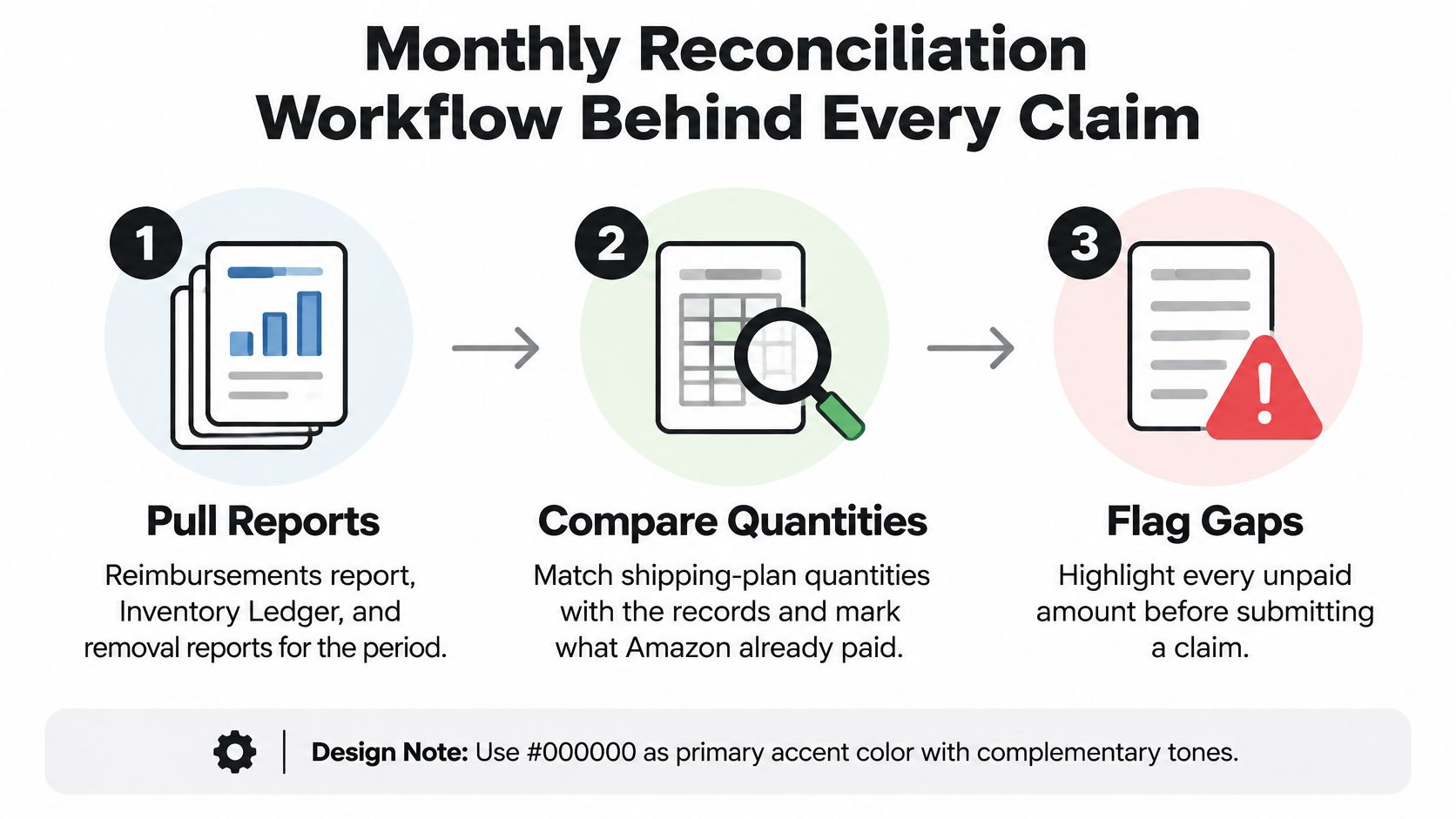
A reimbursement service that relies on hunting credits misses most of the recoverable money. The claim list should fall out of a monthly reconciliation: same datasets, same order, every time. That turns a vague suspicion of lost inventory into a documented case with a date, a quantity and a value Amazon can pay against.
The Six Steps in Order
- Pull the Reimbursements report, Inventory Ledger and removal reports for the period and mark every amount Amazon already paid. A duplicate claim wastes case time and credibility. Keep the matching discipline finance teams use to match card transactions and catch fraud; here the source record is the Inventory Ledger, not a bank statement.
- Compare shipping-plan quantities with received quantities per SKU, not at shipment total. Inbound discrepancies surface here first. A shipment that reconciles at the total can still hide a shortage in the SKU that matters.
- Check each verified delivery date against the nine-month inbound window. Sort oldest first. A variance found after the delivery date ages out is worth nothing.
- Classify each variance as lost, damaged, customer return, removal or fee error, then apply the matching window and valuation basis. Filing a removal variance as a fee error invites a denial you have to unwind. Classification stays with a human reviewer.
- Consolidate discrepancies per shipment and file once. Amazon accepts one claim per shipment, so fragments burn the single claim on a partial quantity. Hold the case until the shipment picture is complete unless a window forces your hand.
- Track each case to resolution and challenge under-valued credits within 60 days of reimbursement issuance. An approved claim paid on a low estimated cost is still a loss. Documented sourcing cost is what supports the challenge.
Step six is also where the confidentiality trade-off lands. Amazon's sourcing-cost valuation makes the cost basis you disclose the ceiling on what a lost unit pays, so supplier invoices become a cash-flow and disclosure decision at the same time. Run the reconciliation first and size exposure per SKU: variance count, unit value and open claim value. A SKU with one lost unit may not justify sharing detailed cost data. A high-value SKU with repeated receiving shortages and removal gaps usually does. That comparison belongs in the monthly pack, before any invoice leaves your files.
Cadence That Keeps Windows Open
Run the full cycle monthly and sweep the 60-day windows weekly. The monthly cycle catches patterns. The weekly sweep stops expirations between cycles. Skipping the aging check loses claims with no denial notice to warn you.
For FBA reimbursement, Online Brand Growth audits months of transaction, inventory and fee data, files documented claims and tracks them to resolution. Ongoing monitoring reruns the cycle and sweeps open windows, because a one-time audit starts decaying the week it finishes.
If your team cannot hold the weekly sweep during peak season, hand that task off first. Peak is when receiving errors and return volumes spike, and when a missed 60-day window is most expensive.
How Reimbursement Providers Work and Price Their Work
Providers differ in software, but the operating sequence should look the same. If a provider can't describe these four steps clearly, you're buying a dashboard, not recovery.
- Access: You grant read access to Seller Central reports or upload exports, plus supplier invoices and 3PL receiving records. That lets the provider match shipping plans to received quantities instead of guessing from ledger adjustments alone.
- Historical audit: The provider reviews past Inventory Ledger events, removals, returns and FBA fee charges, going back as far as account records allow. You get a candidate claim list with the window each claim falls under.
- Filing: Claims go through the Inventory Defect and Reimbursement portal, each case number is tracked to resolution, and under-valued credits are challenged when sourcing cost on file supports more.
- Monitoring: After the audit, the provider reruns the monthly cycle and sweeps open windows so new discrepancies are caught before they expire.
Pricing usually follows two models, a fee tied to recovered value or a fixed monthly retainer plus any setup charge. Ask for the rate and the definition of recovered value. A percentage on claims approved but not yet credited behaves differently from a fee on cash returned, and that difference matters in a slow case queue.
Before signing, confirm what happens when a claim is denied and who owns the audit files when the contract ends. I'd want the claim list, case IDs and supporting documents returned in a usable format, not a PDF summary.
In-House Versus Third-Party Reimbursement Handling
| Criterion | In-house team | Third-party service |
|---|---|---|
| Data pulled each month | Reimbursements, Inventory Ledger and removal reports pulled by staff | Transaction, inventory and fee data audited for months of history |
| Deadline control | Calendar kept by the analyst | Each window tracked to resolution |
| Ongoing discrepancy checks | Only as often as staff runs them | Continuous monitoring for new discrepancies |
| Cost model | Analyst hours plus tooling | Set by contract, quoted before signing |
| Supplier cost data | Stays fully internal | Shared with provider, so confirm terms first |
| Time to first claim | After your first full monthly pull | After the historical audit is complete |
The Verdict by Situation
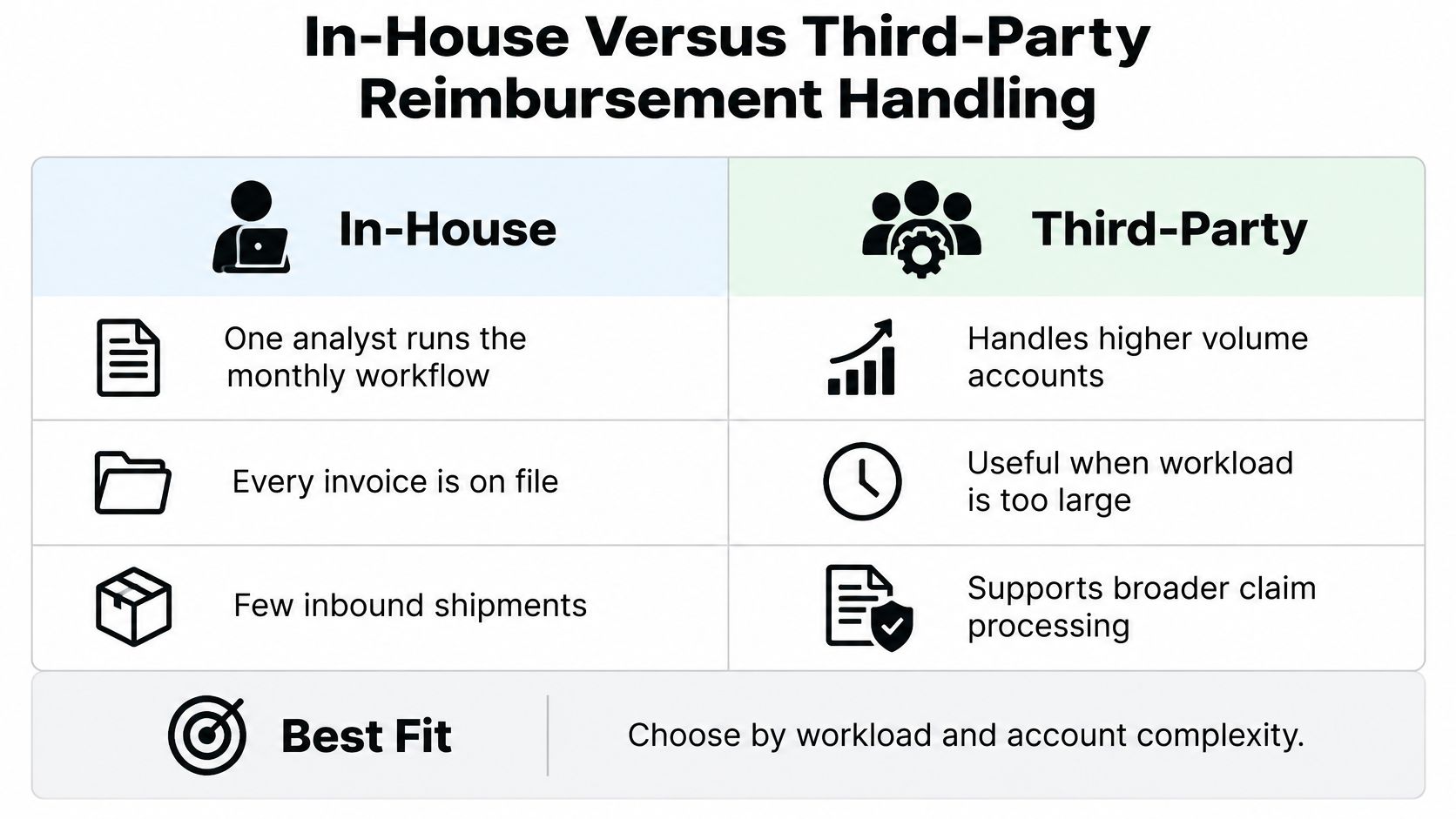
In-house works when one analyst can run the monthly workflow, every invoice is on file, and inbound volume is low. Control stays internal and cost data never leaves the building. The failure mode is quiet, a busy month pushes the sweep and windows close unnoticed.
A third-party service fits when claim volume is high, data is spread across ERP, 3PL and Amazon reports, or windows have already been missed. Say an account ships three inbound plans per week across 500 SKUs. One analyst can cover the monthly reports but not the weekly 60-day sweep on top of replenishment work. That account doesn't need motivation, it needs hours.
The middle option is a standalone recovery audit, a one-time review without ongoing management. Our FBA reimbursement recovery audits the account for lost, damaged, and over-charged units and files the claims, and it's also available as a standalone service. That fits brands that want a baseline number before committing staff or a retainer.
Compare provider cost against recovered value, not against the fee alone. In-house cost is analyst hours plus tooling, which looks cheap until you price the claims that expired while the analyst was fixing listings.
Vendor Checklist Before You Share Cost Data
The core question isn't how to file a claim. It's whether the recovery gain is larger than the cost of revealing margin data to a third party. Answer that first, then use the checklist.
Seven Checks Before Access Is Granted
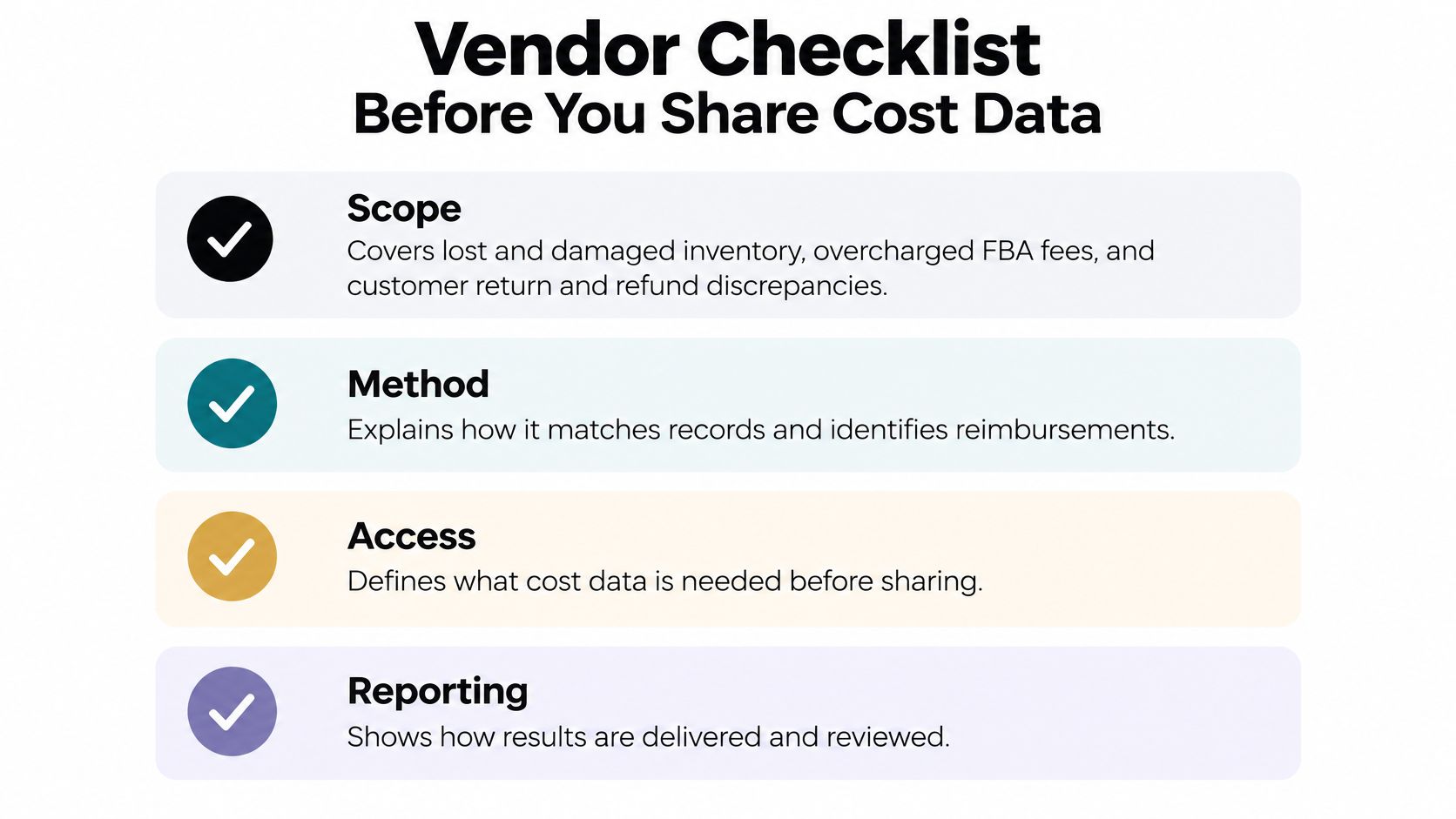
- Scope: The provider covers lost and damaged inventory, overcharged FBA fees, and customer return and refund discrepancies. Partial scope leaves whole claim categories unworked.
- Method: It can explain how it matches shipping plans, invoices and Reimbursements reports to a specific claim. Vague method usually means thin documentation.
- Monitoring: It checks for new discrepancies after the first audit, not only once. A single audit with no follow-up decays immediately.
- Filing standard: It files only legitimate, well-documented claims through Amazon's standard processes, with no automated mass filing. That's our standard too, and I'd hold any provider to it.
- Confidentiality: A written agreement states who sees supplier costs, how long data is kept and how it's deleted. Verbal assurance isn't a control.
- SKU exposure: Ask for a SKU-by-SKU valuation before signing, and share only the cost fields the claim pool needs, redacting the rest. High-margin SKUs carry the most disclosure risk and the most recovery upside.
- Accounting: Reimbursement credits are reconciled against landed-cost accounting, so finance books the recovery against the right cost layer.
Amazon's reimbursement portal guidance notes the March 31, 2025 shift to sourcing cost and states submitted sourcing costs are not shared with other sellers or Amazon Retail. Use that as your baseline and compare any provider promise against it. If a provider offers weaker protection than Amazon itself, walk away.
Share cost data in stages. Release the SKUs inside open claim windows first, and expand only after the provider proves its filing standard.
For manufacturers, sourcing cost can reveal strategic pricing to anyone who sees it. Stage the disclosure, log who accessed each file, and set a deletion date in the agreement. If you're also fighting resellers who undercut price, our 360 Brand Protection program for unauthorized seller removal and MAP enforcement protects the margin you're trying to recover.
Start Your First Reimbursement Audit This Month
Start with the 60-day sweep count and turn it into rows you can work.

- Export the Reimbursements report, Inventory Ledger and removal reports for the same 60 days, sorted by event date so every open window has its own row.
- Build a claim calendar from the filing windows and flag anything due within two weeks, earliest dates first.
- Pull sourcing cost invoices for the ten SKUs with the highest lost value and confirm each shows purchase date, product name and quantity.
- Model recovery per SKU, then run the Amazon Profit Calculator to see how each recovered unit changes margin. Check storage exposure on slow SKUs with the FBA storage fee calculator and demand with the sales rank checker.
- Choose in-house or provider handling, write down expected recovery before filing, and measure the audit against it. Use our Amazon account audit checklist to structure the wider review.
The walkthrough below shows the audit sequence end to end.
A complimentary Amazon account audit is included in the free consultation when the brand is a fit. Book a free strategy call and bring your sweep count.
If your sweep shows recoverable claims aging toward closed windows, we can run the audit, file documented claims and monitor for new discrepancies while your team stays on growth work. Visit Online Brand Growth to book a free strategy call and get your first reimbursement baseline before another window closes.