
Third-party sellers generated 66% of Amazon's US$847.35 billion in 2025 GMV, compared with roughly 34% from its first-party business, according to ECDB's Amazon marketplace estimates. Choosing 1P vs 3P isn't a niche account decision. It determines which retail economics you keep, which risks you carry, and how much cash you tie up getting products sold.
The winning model belongs to the ASIN, not necessarily the whole brand. Start with contribution margin and cash conversion, then check whether your team can protect the price and win the sale.
The $30 Unit Bridge for 1P and 3P
A retail selling price isn't comparable to a wholesale receipt. You need to remove the costs attached to each before either number tells you which model works.
The illustrative Feedvisor 1P versus 3P comparison starts with a $30 retail item: Amazon might buy it wholesale for approximately 50% of retail, or $15, while a 3P FBA seller retains the retail sale and pays an illustrative 15% referral fee, or $4.50, plus an estimated $5.50 fulfillment fee. That leaves approximately $20 before product cost, about $5 or 33% more than the wholesale receipt, before the remaining costs below.
$30 retail unit, 1P wholesale versus 3P FBA
| Line | 1P Vendor Central | 3P Seller Central FBA |
|---|---|---|
| Starting amount | $15 wholesale receipt, about 50% of $30 | $30 retail sale kept by the brand |
| Referral fee | Not charged as a seller fee | About 15%, or $4.50 in this example |
| Fulfillment | Amazon fulfills after it takes title | Estimated $5.50 FBA fulfillment fee |
| Amount before product cost | About $15 | About $20 |
| Gap versus 1P receipt | Baseline | About $5, or 33% higher before other costs |
| Still to deduct | Co-op, freight terms, damage allowance, chargebacks | Storage, inbound placement, returns, ads, financing, labor |
That $20 is not profit. It's an intermediate subtotal that makes the operating trade-off visible. Calling it margin without charging the rest of the retail operation is how brands approve migrations that look attractive in a presentation and disappointing in Payments.
Compare the same economic endpoint
For each model, finish at contribution after product cost and channel-specific operating costs. Use the same product-cost basis, comparable demand assumptions, and an explicit treatment of labor. Otherwise, you'll make Seller Central look better because its operating expenses sit elsewhere in the budget.
Build a base case, then stress the assumptions that can change the decision:
- Selling price: Model the price you can sustain, not an unsupported list price.
- Advertising: Use the spend needed to produce the modeled demand, including launch support where relevant.
- Inventory: Charge for the stock you expect to hold, including slow units.
- Execution: Include preparation, inbound handling, account operations, and deductions rather than treating them as free.
Practical rule: Compare the cash each channel leaves behind, not the revenue each channel reports.
Rebuild the example in our Amazon profit calculator using your actual ASIN price, product cost, and fee file. Keep assumptions editable so finance and ecommerce can challenge the same model rather than maintain competing spreadsheets.
If your team uses different definitions of gross profit and contribution profit, settle those definitions first. Our guide to calculating contribution margin gives you a consistent starting point for the channel decision.
Who Owns the Sale in Each Model
Start with the customer. In Vendor Central, Amazon is your customer. In Seller Central, your brand or authorized seller sells to the consumer through Amazon's marketplace.
That distinction explains the operating ownership better than a list of account features. The comparison below separates the wholesale relationship from the retail operation.
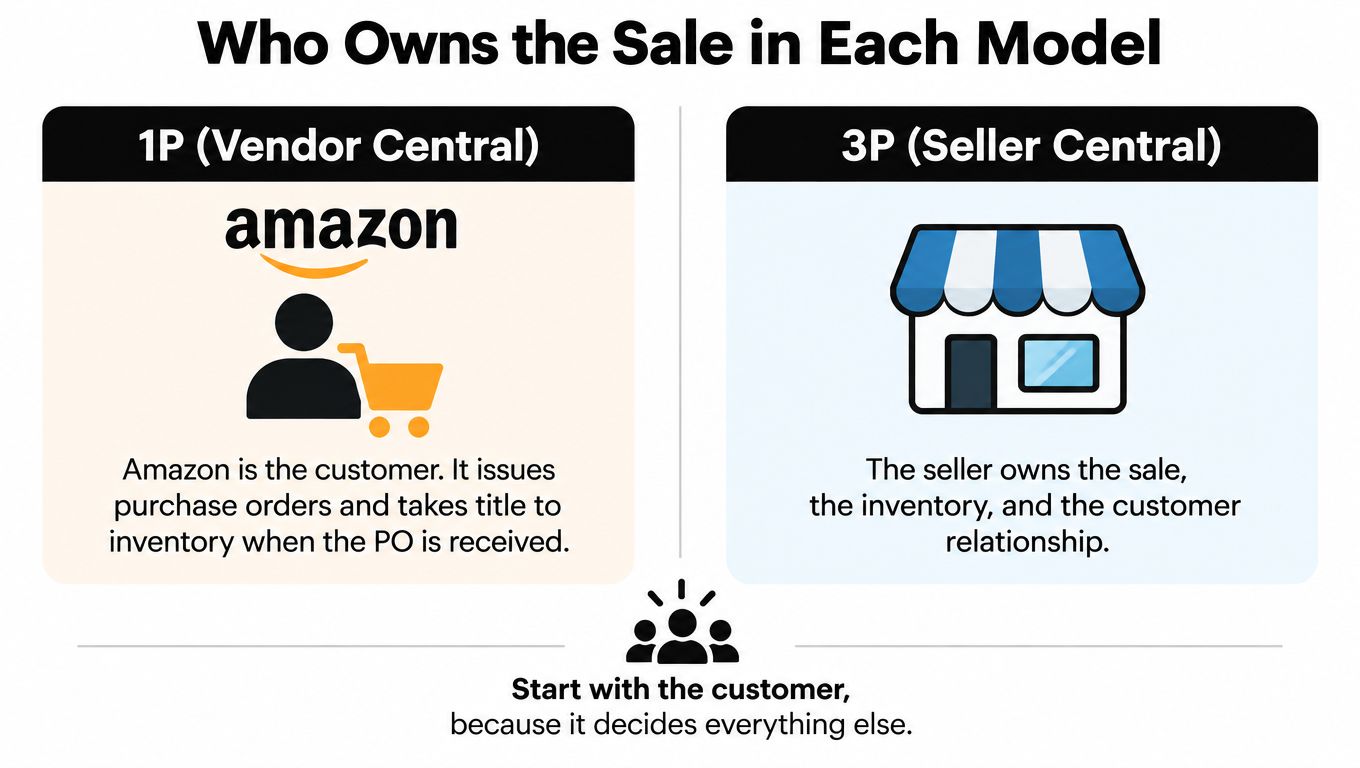
In 1P, Amazon issues purchase orders, takes title under the applicable purchasing terms, generally sets the consumer offer, and handles shopper fulfillment and returns. Your team manages wholesale availability and compliance, including routing, carton labels, shortages, and deductions. Cleo's Vendor Central versus Seller Central comparison describes that division of control and operating risk.
Operating ownership in Vendor Central and Seller Central
| Job | 1P Vendor Central | 3P Seller Central |
|---|---|---|
| Customer | Amazon, via purchase orders | The consumer on the listing |
| Inventory title | Transfers to Amazon under the PO terms | Stays with the brand until sale |
| Retail price | Generally set by Amazon | Set by the brand's offer |
| Account | Vendor Central | Seller Central, usually Professional at $39.99 per month |
| Fulfillment and returns to the shopper | Amazon after it owns the goods | FBA, merchant fulfilled, or another arrangement the brand chooses |
| Brand's daily work | PO compliance, routing, labeling, deductions | Price, inventory, fees, ads, account health |
Choose the account for the operation
Amazon's U.S. selling FAQ lists Professional at $39.99 per month and Individual at $0.99 per unit, both plus category-specific referral fees, making Individual cheaper on plan fees alone below approximately 40 units monthly. Established brands should evaluate Professional against their operating requirements, not just the subscription arithmetic.
The FAQ also specifies that referral fees apply to the total sales price, including delivery and gift wrap, excluding taxes calculated through Amazon's tax service. Your advertised item price therefore isn't always the complete fee base.
Check the paperwork if your channel structure is unclear. Vendor Central Purchase Orders and co-op invoices indicate a wholesale relationship; Seller Central Payments and Fee Preview expose the seller-side operation. Adbrew's guide to Amazon selling models for consumer brands is a useful companion when aligning finance, marketing, and operations on those responsibilities.
For a visual walkthrough of the model distinction, use this explainer.
Fully Loaded Fees and Margin Rules
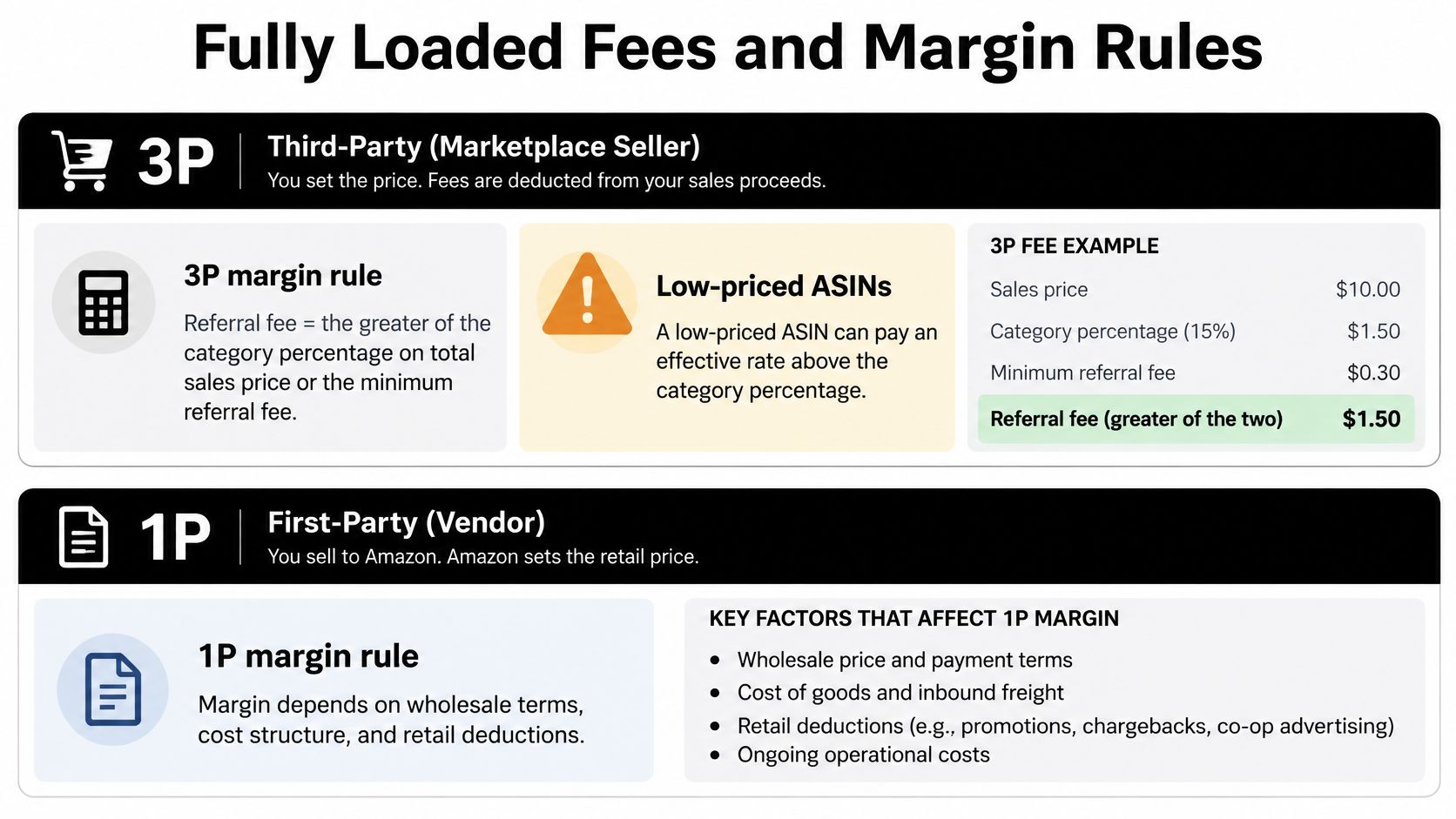
Calculate the referral fee before estimating the remaining margin. Amazon's referral-fee rules charge the greater of the category percentage applied to total sales price or the applicable minimum referral fee. A low-priced ASIN can therefore pay an effective rate above its headline category percentage.
Don't paste a category rate into every spreadsheet row and assume you're finished. Check the minimum, the complete buyer-paid fee base, and the actual fee preview for the offer.
The fee comparison below distinguishes seller fees from wholesale deductions.
Charge for the inventory you actually hold
Amazon's FBA storage guidance bases fulfillment charges on category, size, and weight, with monthly storage charged on daily average cubic-foot volume; it also identifies aged-inventory surcharges for units stored 181 days or longer, using the inventory snapshot taken on the 15th of each month.
Amazon's FBA service guidance explains that the service covers picking, packing, shipping, returns, and customer service, while storage is charged separately and returns processing charges can apply where Amazon provides free return shipping. Outsourcing the physical work doesn't eliminate the need to control its cost.
Per-unit cost lines by model
| Cost line | 1P Vendor Central | 3P Seller Central FBA |
|---|---|---|
| Referral fee | Not charged to brand | Greater of category percentage on total sales price or category minimum |
| Fulfillment | Amazon bears it after taking title | Per-unit FBA fee by category, size, and weight, about $5.50 in the illustrative retail bridge |
| Storage | Amazon bears it after taking title | Monthly fee on daily average cubic feet, billed separately |
| Aged inventory | Not applicable to Amazon-owned stock as an FBA seller charge | Surcharge on units stored 181 days or longer, measured on the snapshot taken on the 15th |
| Returns | Amazon handles returns to the shopper, subject to vendor terms | Returns processing fee where applicable to free-return orders |
| Plan fee | No Seller Central plan fee | Professional at $39.99 per month, allocated across units |
| Deductions | Co-op, freight terms, damage allowance, shortages, chargebacks | Ads, inbound placement, inventory financing |
Build a reconciled contribution calculation
Use these six lines per ASIN, with landed product cost recorded separately:
- Net receipt: Record the wholesale invoice value or retail proceeds after discounts.
- Referral or allowance: Apply seller fees or contracted vendor allowances without counting them twice.
- Fulfillment or freight: Include FBA, preparation, inbound placement, or vendor freight obligations.
- Storage and aging: Allocate storage to the inventory that creates the charge.
- Returns: Include processing, unrecoverable product cost, and recovery value where relevant.
- Advertising and capital: Add attributable ad spend, inventory financing, allocated plan fees, and operating labor.
Our free FBA storage fee calculator shows monthly storage cost by dimensions. Use it to model cubic-foot exposure, then add aged-stock charges from the applicable Amazon fee schedule rather than assuming storage alone covers aging.
If you're comparing modeling tools, Supply Automate's FBA calculator comparison provides another resource for evaluating your workflow. Whatever tool you choose, reconcile estimates against actual settlements and deductions.
Before replenishing, check Inventory Age and sell-through in Seller Central. Gross sales won't tell you whether the next shipment improves contribution or increases your storage liability.
Price Control, Ads, MAP and the Buy Box
Seller Central access doesn't guarantee commercial control. You can set your offer price and still lose the sale to an unauthorized seller offering the same ASIN below your intended price.
In 1P, Amazon generally controls its retail offer. You can negotiate terms and fund marketing, but you can't treat Amazon's price as a field your ecommerce manager can freely edit. In 3P, your team controls its own offer, coupons, and inventory allocation, while also carrying responsibility for availability and account execution.
Bid against contribution, not a comfortable ACoS
A 3P advertising plan can include Sponsored Products, Sponsored Brands, and, for suitable catalogs, Amazon DSP. Those programs don't share the same job: distinguish demand capture, brand defense, and broader audience activity before assigning budgets.
Our PPC bids are managed ASIN by ASIN against contribution margin targets rather than ACoS figures. A campaign can meet its advertising ratio while leaving too little contribution after fulfillment, returns, and inventory costs. Amazon DSP is available for select clients, not a default requirement for every catalog.
Vendor advertising needs the same economic discipline. Co-op-funded marketing and other advertising investment should be evaluated against the net wholesale outcome, not consumer revenue the brand doesn't receive.
A profitable ad click requires an available, competitive offer that your brand can actually sell.
Establish governance before adding demand
Put ownership against each control rather than leaving brand protection between sales and legal:
- Brand Registry: Enroll eligible trademarks and use the appropriate tools for genuine intellectual-property violations.
- Authorized-seller policy: Document who can sell, where inventory may flow, and which contractual obligations apply.
- Pricing policy: Define MAP consistently with legal advice and distinguish advertised-price policy from resale-price control.
- Offer monitoring: Review Buy Box percentage, seller identities, stock availability, and contribution together.
- Catalog hygiene: Investigate duplicate listings and inconsistent product information before increasing spend.
Brand Registry isn't a general mechanism for removing legitimate resellers, and a MAP violation alone isn't automatically an intellectual-property violation. Our guide to MAP in pricing explains the policy side; our 360 Brand Protection program handles unauthorized seller removal and MAP enforcement using the appropriate grounds and processes.
When building monitoring workflows, Scrappey's guide to compliant price collection for retail teams is a useful reference for collecting competitor-price observations responsibly. Record the seller and fulfillment method alongside the observed price so the team can investigate the actual offer.
Use our sales rank checker as a demand-screening input before committing catalog resources. Rank alone isn't a sales forecast, but it can help prioritize which ASINs deserve deeper review.
Which SKUs Belong in 1P or 3P
Ask a specific question: Which channel maximizes contribution margin and cash conversion for this SKU under realistic demand? A brand-wide preference won't answer it.
The AIMS360 Vendor Central versus Seller Central guide identifies the relevant trade-offs across wholesale deductions, retail fees, inventory ownership, and operational burden. Weight, return rate, sell-through, advertising intensity, inventory velocity, and working-capital cost can change the answer between neighboring products.
Use inventory turnover as a screening input, not a stand-alone routing rule.
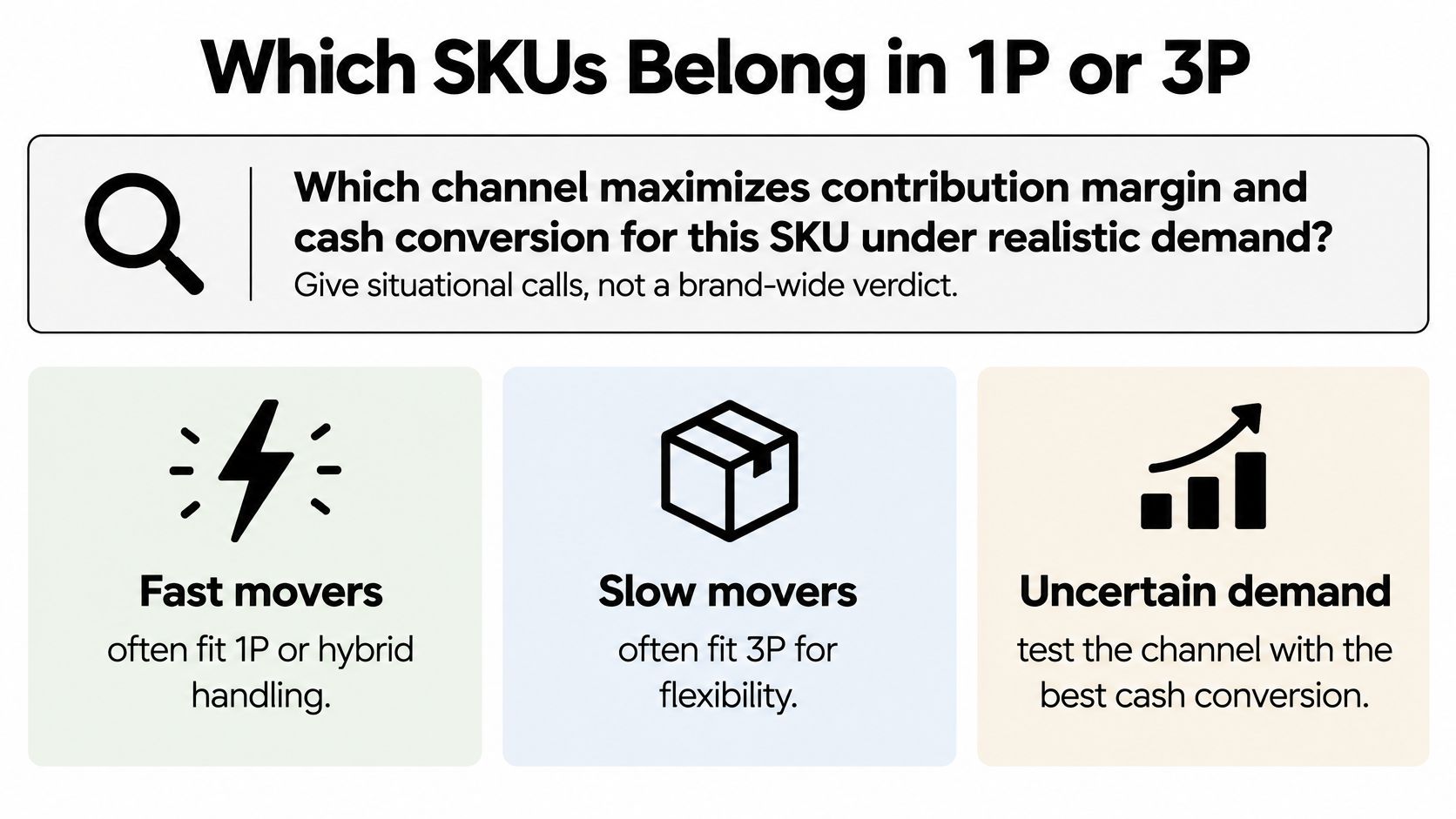
Make situational calls
SKU situations and the model that usually fits
| Situation | Lean toward | Why |
|---|---|---|
| Fast hero ASIN, MAP matters | 3P | Brand keeps control of its price, promotions, and retail economics |
| New launch that needs price tests | 3P | Offer-level elasticity tests and listing work sit with the brand |
| Bulky or heavy, slow turn | 1P | Amazon holds retail inventory and fulfillment risk after purchase |
| High return rate or complex ops | 1P | Brand reduces day-to-day returns and customer-experience workload |
| Long-tail breadth the team will not staff | 1P or distribution | Wholesale scale can beat thinly staffed retail operations |
| Catalog already split by unauthorized sellers | Fix 3P governance before expanding | Buy Box competition can prevent the brand from capturing the modeled sales |
A lightweight replenishable consumable with dependable sell-through is a strong 3P candidate, provided its post-advertising contribution supports the operation. Regular replenishment can let the brand capture retail economics without holding excessive stock.
For a contrasting hypothetical, consider a seasonal oversized item with returns above 20%. That's a scenario assumption, not a category benchmark: test whether a wholesale offer becomes more attractive once you charge 3P for return handling, unsellable stock, and storage through the off-season.
Separate margin from cash conversion
A purchase order can turn shipped inventory into a wholesale receivable, but the brand still needs to collect it and resolve shortages or deductions. A retail offer can produce stronger per-unit contribution while requiring the brand to fund stock for longer.
Model when suppliers get paid, when inventory becomes available, and when proceeds become usable cash. Apply your own financing assumptions to that timeline. Don't let a higher modeled contribution hide a cash requirement your team can't support.
Decision check: A SKU can be attractive on margin and still be the wrong inventory commitment.
A deliberate hybrid might keep strategic heroes and controlled launches in Seller Central while leaving operationally burdensome assortment in Vendor Central or distribution. Before assigning every retail candidate to FBA, compare Amazon FBA versus FBM to see whether your fulfillment method changes the channel result.
Score Each ASIN and Lock the Model
Build an ASIN decision register that finance, ecommerce, and operations can use together. Give every recommendation an owner, a documented assumption set, and a condition that would trigger review.
Use the workflow below to turn channel preferences into operating decisions.
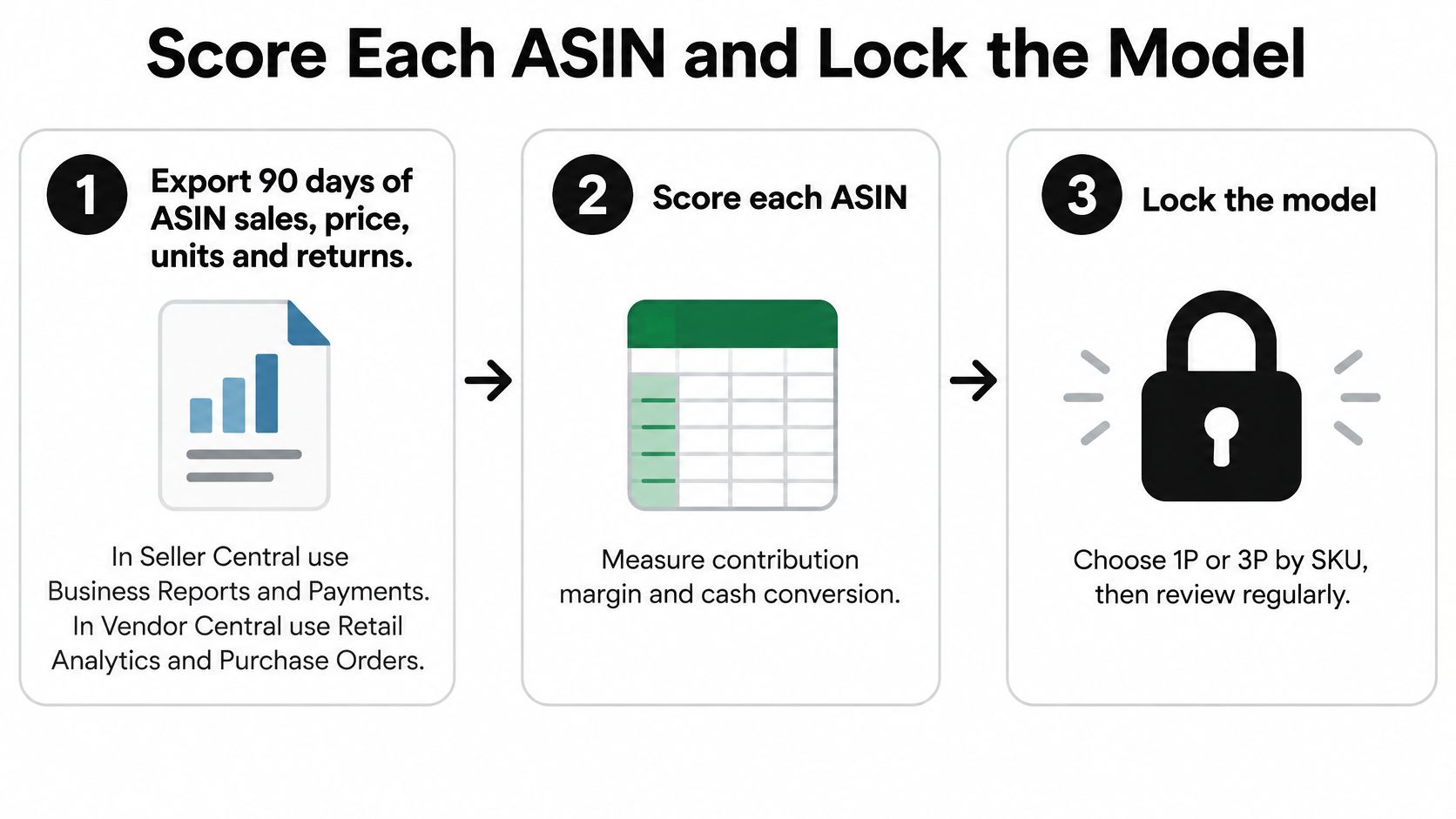
Work through the decision in order
Export a comparable trading window. I'd start with the most recent ninety days of ASIN sales, price, units, and returns, extending the window for seasonal products. Use Seller Central Business Reports and Payments, supported by returns reports, or Vendor Central Retail Analytics and Purchase Orders. Keep ordered, shipped, and settled activity distinct.
Build the contribution calculation. Join the transaction exports to product costs, fee previews, advertising reports, and vendor deductions. Add a cost-of-capital charge based on inventory holding time. Separate observed costs from assumptions so reviewers know what still needs testing.
Check inventory before adding units. Open FBA Inventory Age or the corresponding age view in FBA Inventory. Review units approaching an aged-stock charge before the monthly snapshot, and account for inbound shipments that haven't become available.
Measure whether you own the offer. Record the Featured Offer percentage, often called Buy Box percentage, from Business Reports where available. Count unauthorized offers on the live detail page and record seller identities. A high retail-margin estimate means little if another seller captures the orders.
Assign a channel decision. Mark each ASIN stay 1P, move to 3P, or deliberate hybrid. Include the reason and the constraint, such as working capital, offer competition, or warehouse capacity. Avoid an unexplained overall score that hides the decisive weakness.
Prepare a controlled 3P test. Clean or open the Professional account, enroll eligible brands in Brand Registry, and set your offer consistently with your pricing policy. Send a controlled FBA quantity rather than the full forecast. We can recommend prep and 3PL partners when execution capacity is the blocker.
Protect the retained 1P business. Audit routing, carton labeling, shipment accuracy, and chargeback causes. Assign recurring deductions to an operational owner instead of treating them as an unavoidable finance adjustment.
Review contribution and cash weekly. Track actual results against the approved assumptions, including available inventory and offer performance. Our Seller Central Account Growth (3P) partnership works alongside the brand's in-house team to continually increase Seller Central sales and profit.
Lock the model, not the assumptions
Our Vendor vs. Seller Central service helps brands choose 1P, 3P, or a deliberate hybrid. The decision should remain revisable when costs, demand, or operating capacity change.
Keep an ASIN in 1P when Amazon's purchasing and logistics absorb risk you can't economically carry. Move it to 3P when pricing authority and fully loaded unit economics justify retaining the inventory. Don't scale that retail commitment until Brand Registry, MAP governance, and Buy Box performance support it.
Online Brand Growth helps brands choose and operate an ASIN-level 1P, 3P, or hybrid strategy around contribution margin and cash conversion. Book a free strategy call and bring your ASIN contribution bridge, aged-inventory view, and Buy Box share.