
MAP stands for Minimum Advertised Price, the lowest price a retailer may publicly advertise for a product, not the price it must charge at checkout. If your policy controls the displayed price, why does a reseller who looks compliant still win your customers with a cheaper landed offer? That gap between the advertised number and the full offer is where most Amazon MAP programs fail, and it's the gap you have to close yourself.
What MAP Stands For and Where Else the Acronym Appears
In retail, MAP is set by the manufacturer or distributor and often tied to access to cooperative advertising funds. The FTC analysis of minimum advertised price programs reports that major music distributors introduced MAP programs in 1992 and 1993 in the U.S. recorded music market. It's an established policy tool, not marketplace slang.
Search "what does MAP stand for" and you'll hit three unrelated meanings. In clinical physiology, the CV Physiology guide to mean arterial pressure estimates MAP as diastolic pressure plus one third of pulse pressure, giving approximately 93 mmHg for a blood pressure of 120/80 mmHg. The table below separates the uses.
| Meaning | Field | What It Measures | Typical Reference Value |
|---|---|---|---|
| Minimum Advertised Price | Retail and Amazon brand policy | Lowest price a reseller may publicly advertise | Set by the brand, no fixed value |
| Mean Arterial Pressure | Clinical physiology | Average pressure driving blood through tissues | Approximately 93 mmHg at 120/80 mmHg |
| Mean Average Precision | Machine learning, object detection | Average precision across classes and IoU thresholds | Scored from 0 to 1 |
| MAP Growth | K-12 assessment (NWEA) | Adaptive test score tracking over time | Reported as RIT scores |
From here on, MAP means the retail policy. That's the version that governs your listings, reseller pricing, and enforcement, and it's distinct from a suggested price, a distinction covered in the comparison of MAP and MSRP.
Quick test: if the source discusses listings, resellers, co-op funds, or the Buy Box, use the retail meaning. If it discusses blood, detection models, or test scores, don't.
How a MAP Policy Governs Advertised Prices
Think shelf tag versus register. The advertised price is the number a shopper sees in ads, search results, social posts, and product pages. The checkout price is what they pay. Your policy governs the first one.
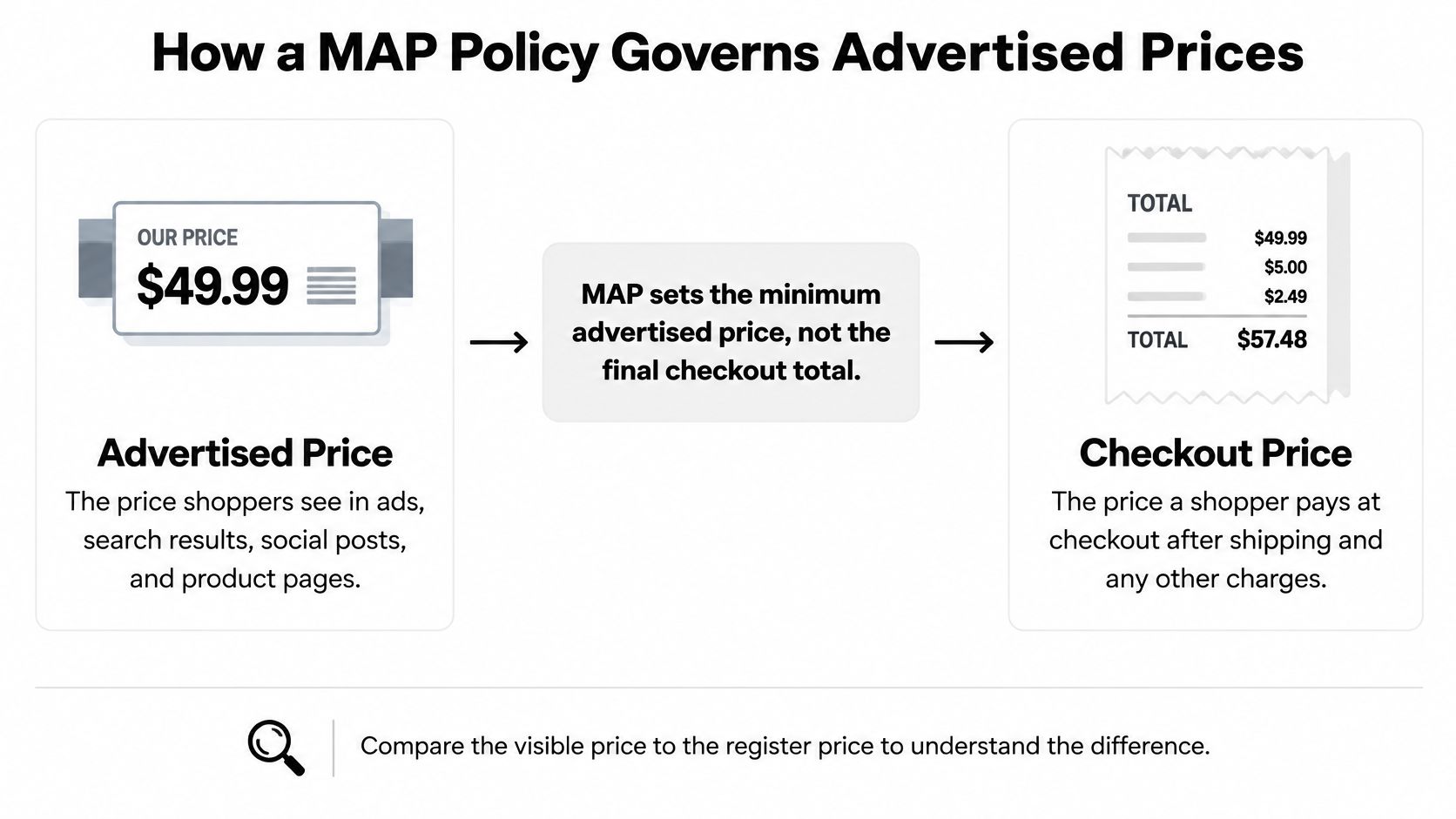
Say you set MAP at $49.00. A reseller can't advertise the item at $44.00, but it can offer a $5 coupon or a cart-level discount at checkout, provided the advertised product price stays compliant. The FTC presentation on MAP policy design frames MAP as a floor on advertised prices, not necessarily on transaction prices, and notes funding suspensions of typically 60 to 90 days in challenged programs.
What a Working Policy Defines
- Covered ASINs or SKUs: every product the floor applies to, listed explicitly.
- Approved advertising channels: product detail pages, Sponsored Products ads, social media, email, and storefronts.
- Permitted discount mechanics: coupons and cart-level discounts that don't change the advertised price.
- Evidence standards: what proof counts, from dated screenshots to offer captures.
- Escalation steps and sanctions: proportionate, written in advance, applied consistently.
A jewelry brand that publishes stainless steel care tips from JewelryBuyDirect faces the same drafting question you do. Content that supports the product is fine. Advertising that undercuts the floor is not.
The boundary is clear. A policy that dictates the actual checkout price, or penalizes promotions the reseller pays for alone, stops being advertising control and becomes resale price control. That's where legal risk starts.
Three-question test: Does your draft restrict only advertised price? Does it define what counts as advertising? Does it explain how a violation is proven? If any answer is no, rewrite before you send it.
Why MAP Breaks Down on Amazon's Featured Offer
A compliant displayed price doesn't mean a compliant listing. That's the assumption Amazon breaks.
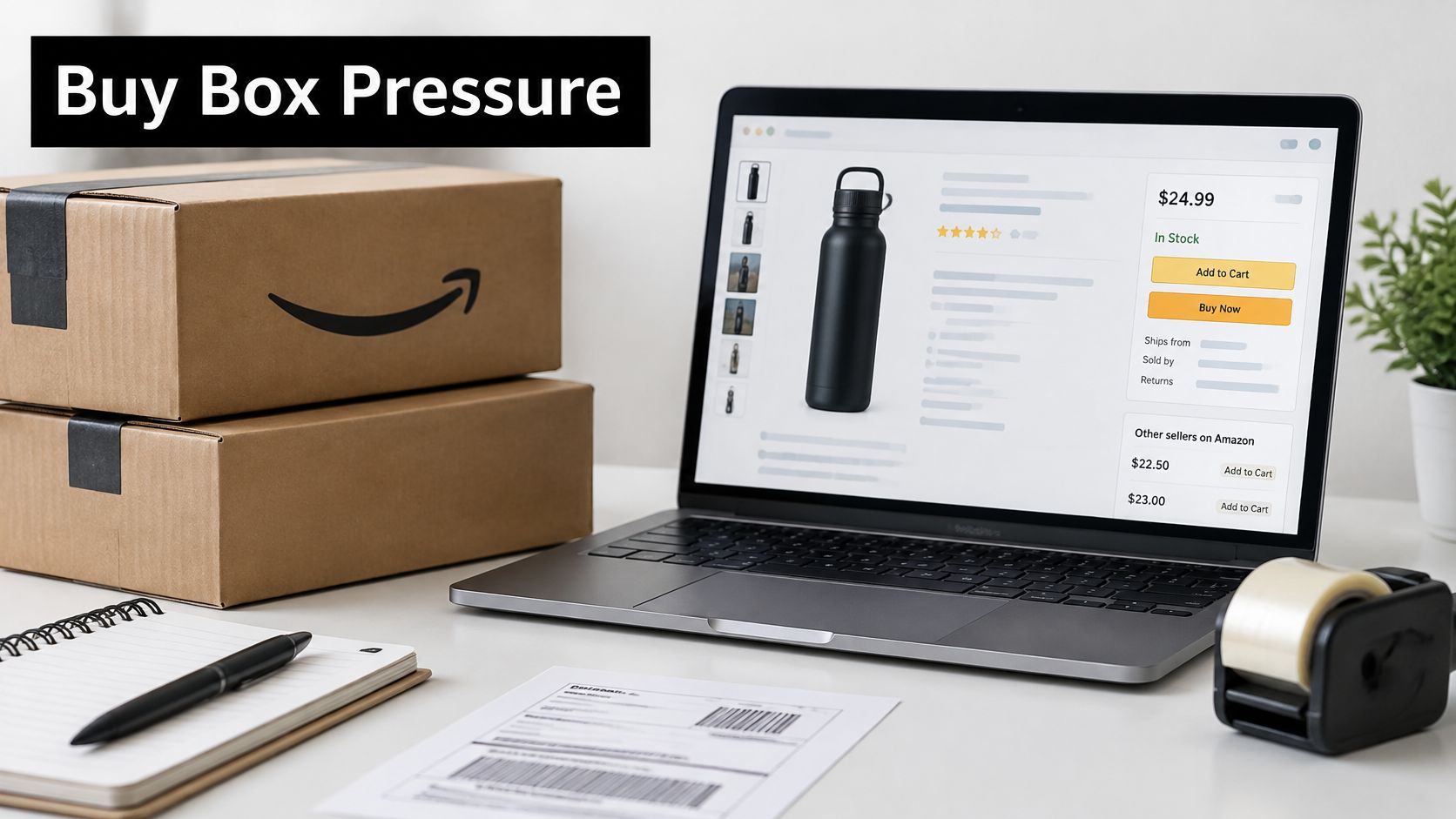
Amazon evaluates the Featured Offer, the offer behind the Buy Box, using total customer price including shipping, not the item price alone. Amazon's guide to the Featured Offer states that offers with fast, free shipping and more certain delivery dates are more likely to be featured, and an offer can't be featured while the item is out of stock. So a reseller can show your MAP price and still undercut the channel with free shipping, a coupon, or another landed price combination.
The Four Seller Central Checks
- Open Manage All Inventory and read the Price and shipping costs column for the ASIN.
- Open Pricing Health to see whether the listing has pricing issues.
- Check the Pricing Opportunities tab for offers you're not winning.
- Compare each seller's landed price on the listing against your MAP floor.
The video below walks through how the Featured Offer mechanics interact with your price floor in practice.
The Buy Box rotates between authorized and unauthorized sellers, so one snapshot can miss a violation entirely. Review the full customer offer on each priority ASIN daily, and use the guide to winning the Amazon Buy Box to separate price problems from delivery and stock problems.
Sample MAP Policy Language and the Clauses to Avoid
A MAP clause should set an advertised-price floor without controlling the checkout price. Use language that defines the products and channels covered, states the floor, and explains how violations are handled.
Scope. “This policy applies to the ASINs and SKUs listed in Schedule A, in the marketplaces and advertising channels specified there.” A schedule makes the coverage clear and easier to update.
Price floor. “Authorized resellers may not advertise the Products below the Minimum Advertised Price listed in Schedule A. This applies to product listings, search ads, social media, email, and in-store signage where the reseller has agreed to this policy.” Specify covered channels rather than relying on a broad phrase such as “all advertising.”
Checkout freedom. “Nothing in this policy restricts the price at which a reseller sells a Product to a customer, including discounts applied at checkout.” Keep the policy focused on the advertised price, not the final transaction price.
Notice and cure. “For a suspected violation, the Brand will provide written notice and supporting documentation. The reseller will have five business days to correct the advertised price.” A defined process gives the reseller notice and a clear opportunity to respond.
Why the Risky Wording Matters
An FTC analysis of manufacturer pricing policies describes distributors tying promotional funding to compliance, including retailer-funded advertising and in-store displays. It also describes funds being withheld for periods of 60 to 90 days. Those examples show why a policy should define which promotions it covers and what consequences apply.
Keep penalties tied to the advertised price. Limit rules on retailer-funded promotions to channels the reseller has agreed to cover, and do not treat the checkout price as a MAP violation.
| Clause Element | What It Should Cover | Wording to Avoid |
|---|---|---|
| Scope | ASINs, marketplaces, and advertising channels listed in a schedule | Blanket coverage of every product a reseller sells |
| MAP definition | An advertised-price floor for each ASIN | Any rule that sets the checkout price |
| Checkout freedom | Confirmation that discounts applied at checkout are permitted | Silence that could make the policy read like a resale-price rule |
| Retailer-funded ads | Ads funded by the brand or covered co-op program | Penalties for ads the reseller pays for alone |
| Notice and cure | Written notice, supporting evidence, and a correction period | Immediate suspension without notice |
Where Amazon's Pricing Tools Leave MAP Unprotected
Amazon's pricing tools do not enforce a brand's MAP floor. Automate Pricing applies its own minimum-price guardrail, which is separate from a private MAP policy. Sellers can also set prices manually through Manage Pricing or feeds, outside Automate Pricing rules, as the Seller Central price-validation help page explains.
That leaves the brand responsible for checking the full landed offer, including the displayed price and shipping. Amazon is not a party to the MAP agreement, and its pricing guardrails will not apply the brand's floor.
| Enforcement Option | Best For | Main Limit |
|---|---|---|
| Brand Registry report | Listings that misuse your brand content or trademark | Does not address a price-only violation |
| Written MAP notice | Resellers who accepted the policy | Applies only to parties bound by the policy |
| Distributor audit and supply review | Tracing inventory through your distribution channel | Depends on supply-chain visibility and control |
If the seller accepted your policy, use its written notice process. For a seller who did not, assess whether the listing raises a separate brand-content, intellectual-property, or authenticity issue; those routes do not enforce MAP by themselves.
Clearance pressure can contribute to advertised-price cuts. Retailers who explore the luxury mattress outlet model can see how outlet economics relate to discounting. Storage costs may also affect a reseller's decision to liquidate inventory. The FBA storage fee calculator and Amazon profit calculator can help assess those pressures, but neither tool enforces a MAP floor.
How to Document and Escalate a MAP Violation
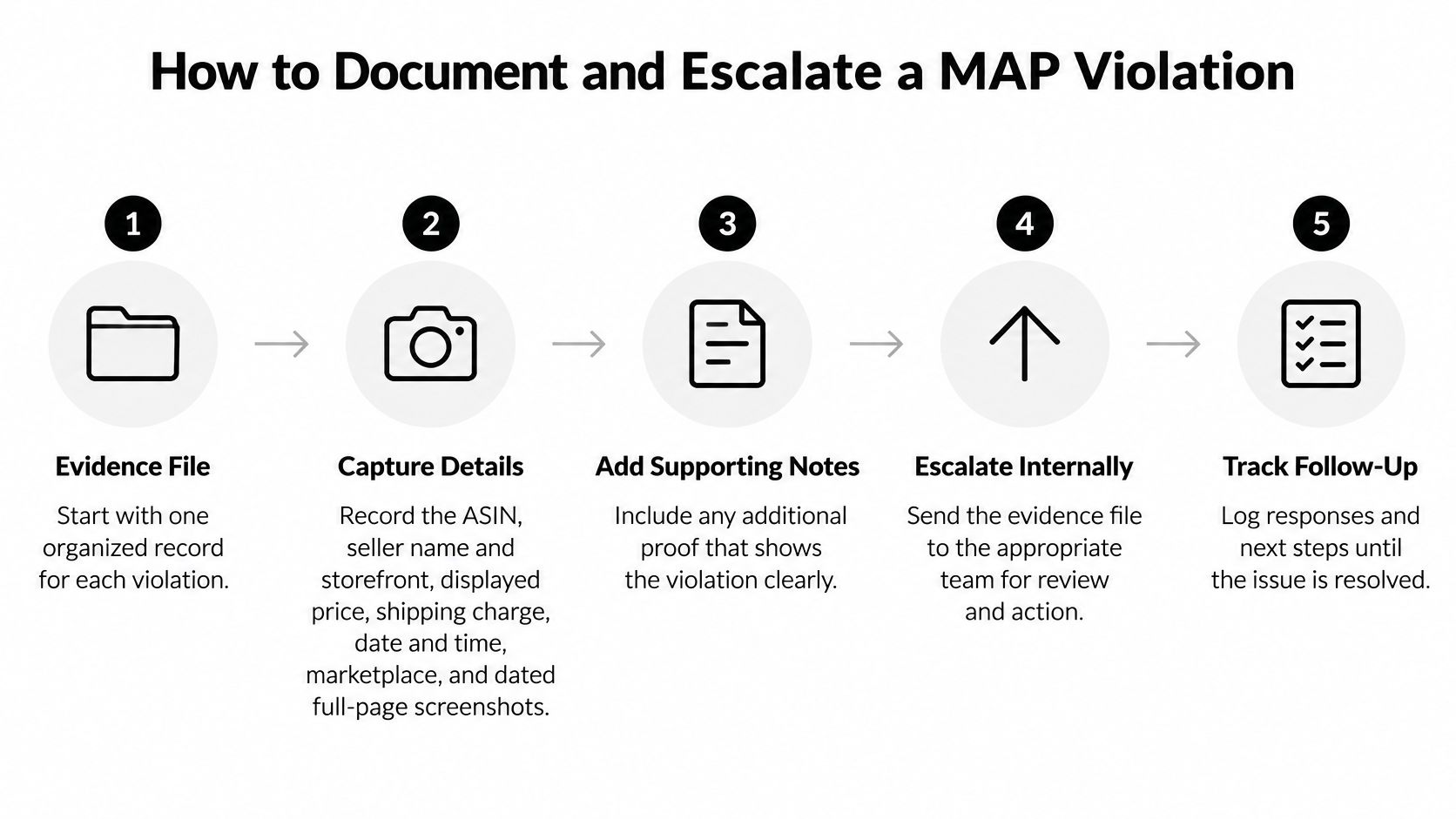
Build the evidence file first. For every violation, capture the ASIN, seller name and storefront, displayed price, shipping charge, date and time, marketplace, dated full-page screenshots, and any coupon or promotion that applies. One screenshot is weaker than three dated captures taken over several days, so build a pattern before you escalate.
In one FTC matter, a single MAP violation could eliminate all MAP funds for a retailer's stores for 60 to 90 days, according to the FTC analysis of the minimum advertised price case. That's why sanctions should be proportionate and written in advance, not decided in the moment. The same source distinguishes restricting an advertised price from an explicit or implied agreement that the retailer will sell at a minimum price, which is where a policy becomes legally problematic.
| Stage | Trigger | Action | Timing |
|---|---|---|---|
| 1. First documented violation | One dated capture confirmed against the MAP schedule | Written notice with screenshots and the MAP clause | Send within 1 business day of confirmation |
| 2. Repeat violation | Second dated capture within 30 days of the first notice | Formal notice with a correction deadline | 5 business days to correct |
| 3. Persistent violation | Third capture or no correction after notice | Suspend co-op funds or authorized status | As set in the reseller agreement |
| 4. Unauthorized seller | No signed agreement in place | Brand Registry or IP report, authenticity complaint, referral to 360 Brand Protection | File within 2 business days of confirming no agreement |
Use a short, fixed notice. "Our records show ASIN [ASIN] advertised at [price] on [date], with screenshots on file, below the Minimum Advertised Price of [MAP] in Schedule A. Please correct the advertised price within five business days. Checkout pricing is not affected by this notice." The MAP violation notice template for Amazon sellers gives you the full wording.
Check top ASINs weekly, log each capture in one shared sheet, and send every notice from the same template. Consistent process is what makes each case enforceable.
Audit Your MAP Policy Before the Next Violation
Does your MAP policy give the team a clear way to check each offer and decide what to do when a violation appears? Audit the controls before another screenshot lands in your inbox.
- List every ASIN with its MAP and effective date in one sheet.
- Confirm signatures: record which resellers have signed the policy and which have not.
- Review landed prices for your top ASINs, including discounts, coupons, and shipping. Flag offers that fall below your floor.
- Check the escalation stages against the sanctions and timing you enforce.
- Review your clauses against current reseller agreements and remove wording that sets a checkout price.
The Unauthorized Seller Playbook from Online Brand Growth is free and details how to identify, document, and remove unauthorized resellers and MAP violators from listings. For repeat cases, Online Brand Growth handles enforcement against unauthorized resellers, including Amazon Brand Registry enforcement, to protect MAP and the Buy Box. Use Amazon's profit calculator to test whether your discount floor leaves enough room for reseller margin. If you want a second review of your policy and monitoring setup, book a free strategy call.
If your MAP floor is leaking through coupons, shipping, or offers from sellers who never signed a policy, review the policy, monitoring, and escalation process together. Visit Online Brand Growth to book a free strategy call and discuss your ASINs and enforcement setup.