
You wake up and find your flagship ASIN advertising below MAP. The seller is authorized, the price is visible on the View Offer Page, the Buy Box has rotated, and a third-party offer is now taking the orders you expected to own. By the time your team sends a generic warning, the reseller may already have changed the price, removed the coupon, or blamed Amazon's repricing system.
A useful MAP violation notice template for Amazon sellers isn't a one-shot legal letter. It is the first record in a controlled workflow that separates your contractual rights from Amazon's pricing, authenticity, and intellectual-property processes. The brands that recover control fastest capture the right evidence, send a precise cure notice, and escalate through the correct channel instead of asking Amazon to enforce a private agreement.
Why MAP Breaches on Amazon Hit Different
At a traditional retailer, a below-MAP price may sit in a weekly circular or on a shelf until someone notices it. Amazon changes the operating conditions. Customers can open the View Offer Page, compare sellers immediately, and see shipping promises, conditions, coupons, and fulfillment options in the same buying session.
A small advertised-price breach can therefore become a Buy Box and margin problem quickly. Subscribe & Save discounts, coupons, bundles, and Prime shipping can make the customer-facing offer look lower than the underlying unit economics. A reseller may also use repricing software that responds to another seller or to a price Amazon sees elsewhere, which means the visible breach doesn't always prove deliberate misconduct.
The first mistake is treating every low price as the same event. A seller can advertise below MAP, an Amazon repricer can adjust an offer, a coupon can reduce the checkout price while leaving the displayed price compliant, or a bundle can make a per-unit price appear lower than the page total suggests. Your notice needs to identify which event took place.
Operator's rule: A low Amazon price is an observation. It becomes a MAP violation only after you connect the price to the seller, the applicable agreement, and the advertised-price rule.
Three reasons Amazon magnifies the problem
Transparency changes the speed of competition. Sellers and customers can inspect competing offers directly, while price-history services such as camelcamelcamel make historical changes easier to identify. Your reseller doesn't need to call a sales representative to discover a lower offer. They can match it automatically.
Buy Box eligibility creates an immediate commercial incentive. Any seller competing on the same detail page can adjust its offer to pursue the Featured Offer. If the violating offer wins that placement, the issue affects more than policy compliance. It can redirect sales, change conversion signals, and pressure other authorized sellers to follow the lower advertised price.
Amazon evaluates price competitiveness independently. Amazon's Marketplace Fair Pricing Policy considers pricing that is significantly higher than recent prices on or off Amazon, misleading reference prices, and excessive shipping fees. Possible platform consequences include removal of the Featured Offer, offer removal, listing restrictions, or seller-account sanctions, but a private MAP breach isn't automatically an Amazon policy violation. Amazon's Seller Code of Conduct and marketplace policy guidance distinguishes marketplace behavior from a brand's private contractual rules.
That distinction is the foundation of what MAP means in pricing. A strong map violation notice template for amazon sellers gives your team a daily operating tool. It records what happened, identifies who can cure it, preserves the evidence, and tells the recipient what follows if the agreement remains unresolved.
The Building Blocks of a MAP Violation Notice
A reseller who has received a hundred generic notices will ignore another vague warning. Specificity gets attention because it gives the recipient a verifiable event, a contractual reference, and a deadline that someone can act on.
Start with identity and authority
Open with the brand's legal entity, business address, and the sender's role. State that the sender is authorized to administer the brand's reseller or MAP policy. If a distributor administers the agreement, identify that relationship instead of implying that an individual employee owns the policy.
Then identify the recipient using the seller's business name from the Amazon storefront or available public seller information. Don't rely only on a storefront nickname. Record the seller's business identity, storefront URL, marketplace country, and the contact route used for the notice.
Identify one offer precisely
The notice should identify the ASIN, product title, SKU where available, listing URL, seller, marketplace, currency, and timestamp. Quote the advertised price exactly as displayed, including whether the offer included shipping, a coupon, a promotion, or a bundle.
A useful factual paragraph looks like this:
On [date and time zone], [brand legal entity] observed that [seller legal or storefront name] advertised [product title], ASIN [ASIN], on [Amazon marketplace] at [currency and price]. The applicable MAP price for this product is [currency and price] under the agreement identified below. Screenshots and the offer-page URL are attached.
Don't write that Amazon found a violation. Unless Amazon issued a policy notice, the brand is reporting its own contractual observation.
Cite the executed agreement
Name the agreement, effective date, and exact clause or section number. Attach or reference the signed version held in your records. The notice should distinguish an advertised-price requirement from a requirement controlling the reseller's actual transaction price.
That distinction matters because MAP generally concerns what a reseller advertises, while resale-price maintenance concerns the price at which the reseller completes the sale. Keep the policy unilateral, apply it consistently, and avoid language that tells the reseller it must sell at a fixed price.
State the cure action and consequence
Tell the seller exactly what you need. Depending on the policy and facts, that may mean correcting the advertised offer, removing a listing, explaining a coupon or bundle, or confirming in writing that the offer now complies. Don't demand that the seller surrender its general freedom to set transaction prices.
Set a clear deadline with a time zone. A notice without a cure date becomes an open customer-service ticket. A consequence should tie back to the agreement, such as suspension from the authorized reseller program, withholding future supply, or another contractual remedy that the brand is entitled to apply.
The following firm paragraph is adaptable:
Please correct or remove the identified advertisement and confirm compliance by [date, time, and time zone]. If the offer remains noncompliant after that deadline, [brand] may apply the remedies available under section [clause], including [specific contractual consequence]. This notice concerns the MAP agreement and does not assert an Amazon intellectual-property violation.
For a trusted partner's first event, use a cooperative version:
We identified an apparent MAP issue on the offer listed above. Please review the price, coupon, bundle, and repricing settings, then confirm the cause and corrective action by [date]. If Amazon or a promotion created the displayed price, send the relevant details so we can separate an automated pricing event from a policy breach.
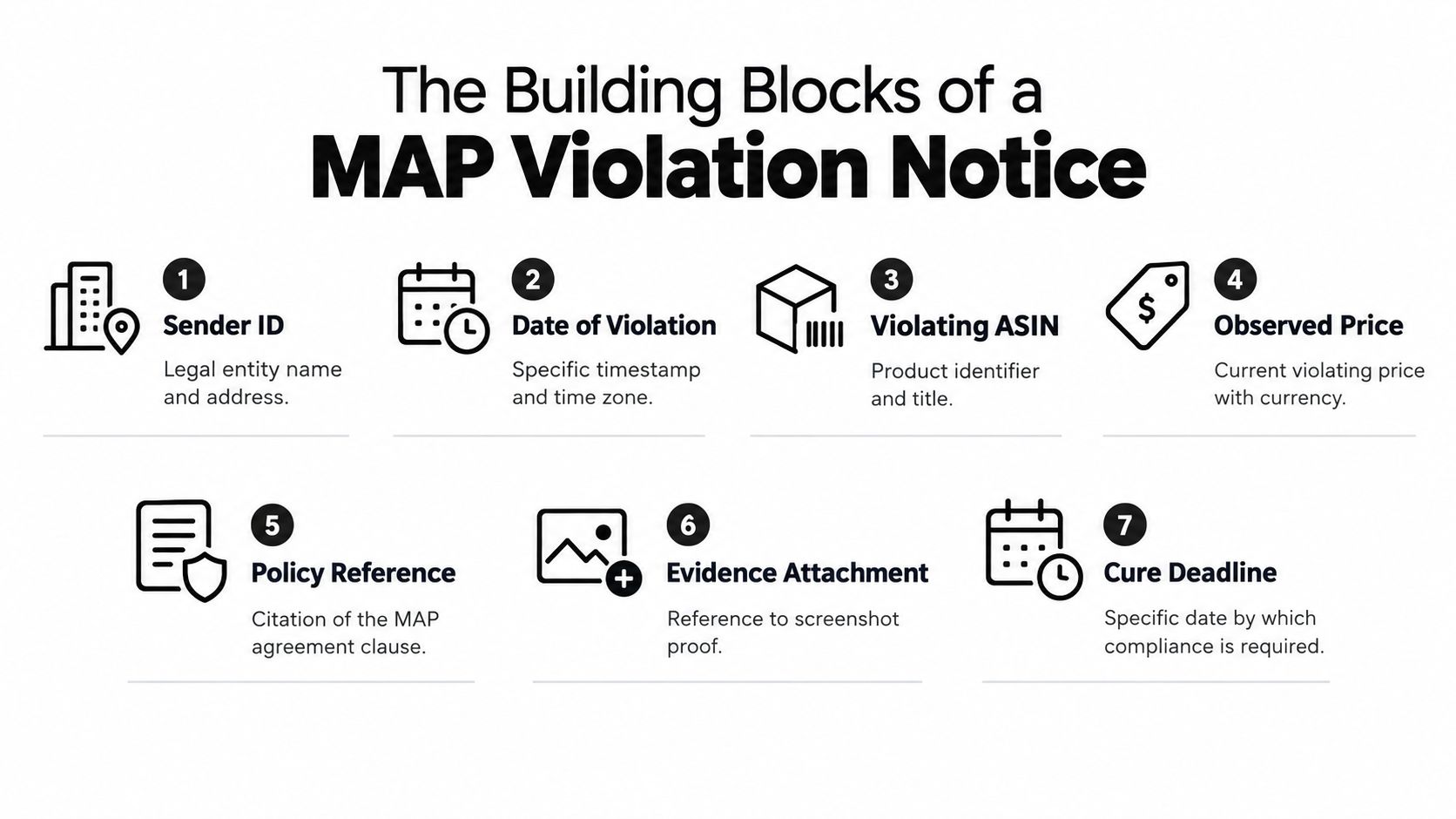
The blocks operators most often skip are the ASIN-specific price quote and the cure deadline. Those two details survive contact with a reseller, a distributor, counsel, or an Amazon support case. A general statement that the seller is “undercutting the brand” does not.
Capturing Amazon-Specific Evidence Before You Send
Amazon pages change throughout the day, so capture the offer before contacting the seller. A notice built from a later page may show a compliant price and leave you arguing about what existed earlier.
Open the full View Offer Page and capture the seller list, advertised prices, condition notes, delivery promises, fulfillment method, coupons, promotions, and shipping charges. Preserve the page URL and the timestamp, including the time zone. If the offer is a multipack, kit, or bundle, record the quantity and product configuration rather than treating the total page price as a single-unit price.
Build the evidence stack
Use a repeatable capture sequence:
Save the offer view. Take a screenshot that includes the relevant seller names, prices, product condition, and shipping information. Capture the product detail page as well if the Buy Box and seller list appear separately.
Record the ASIN and Buy Box state. Note the current Featured Offer or Buy Box seller, the observed offer owner, and the time at which ownership changed. A tracker such as Keepa can help preserve price and Buy Box history, while Helium 10 can support recurring catalog checks.
Identify the seller. Open the storefront and record the public business name, seller profile URL, marketplace, and any available contact information. Don't use only the display name shown beside the offer if the storefront provides a more complete business identity.
Preserve an independent timestamp. Where the page is accessible, save a cached version through the Wayback Machine. It may not capture every dynamic Amazon element, but it adds an independent record alongside your own dated screenshot.
Use a controlled test purchase when the source matters. A low-cost test buy can preserve the invoice, packing slip, ship-from address, product condition, and fulfillment details. It may reveal whether the seller is sourcing through an unauthorized channel, but it doesn't by itself prove that a low advertised price is counterfeit.

The test purchase should answer a defined question. If you're checking channel status, preserve the source documents. If you're checking authenticity, preserve the product and packaging in the condition received. If you're checking only MAP, don't turn a pricing dispute into an unsupported counterfeit allegation.
Create a folder for each ASIN using a consistent naming convention such as ASIN-date-breach-type. Store the screenshots, offer URL, seller storefront link, agreement clause, test-buy documents, notice, response, and cure status together. The operating principles behind minimum advertised price monitoring are simple: capture the event first, classify it correctly, then send the narrowest defensible notice.
Private MAP Notice vs Amazon Marketplace Policy
A MAP notice is primarily a contractual compliance document between a brand and a reseller. Amazon's own processes are separate. Amazon may act on marketplace pricing behavior, authenticity problems, counterfeit reports, or intellectual-property infringement, but it doesn't automatically enforce every private MAP agreement.
That means routing matters. A brand that sends a MAP letter and waits for Amazon to remove the seller has usually created paperwork, not real pressure. The brand should file through an Amazon surface only when the facts support that surface's policy.
Match the complaint to the channel
| Complaint Type | Best Amazon Tool | Typical Response Time | Evidence Required |
|---|---|---|---|
| Private MAP breach | Brand or reseller agreement, direct cure notice | Brand-controlled deadline | ASIN, seller, displayed price, timestamp, agreement clause, screenshots |
| Amazon pricing-policy concern | Seller Central support or the relevant pricing-policy route | Amazon-controlled and variable | Offer URL, seller, price, shipping, coupon or promotion, comparison evidence |
| Trademark, copyright, or patent infringement | Brand Registry Report a Violation or Amazon's infringement workflow | Amazon-controlled and variable | IP right, infringement type, ASINs and URLs, affected seller, supporting material |
| Counterfeit or authenticity concern | Report abuse, Report a Violation, or applicable authenticity workflow | Amazon-controlled and variable | Seller identity, ASIN, order ID where available, receipts, test-buy material, product evidence |
| Seller conduct or policy abuse | Seller Central Report abuse | Amazon-controlled and variable | Order ID or ASIN, seller store or business name, Amazon store, concise policy explanation |
Amazon's Report abuse workflow expects a structured submission. It asks for a violation type and relevant order ID or ASIN, then details such as the seller's store or business name, product title, Amazon store, explanation, and supporting evidence. A general complaint that a reseller is “bad for the brand” won't replace those fields.
Brand Registry's Report a Violation route is for a qualifying IP theory, not for enforcing an unauthorized-distribution agreement. Amazon seller guidance also distinguishes contractual disputes from trademark infringement. Use the IP workflow when the evidence supports trademark, copyright, patent, or counterfeit conduct. Use the agreement for MAP.
The same separation applies to authenticity. Amazon says non-authentic products can lead to loss of selling privileges, withheld funds, and disposal of inventory held in its fulfillment centers, but a low price alone isn't proof of counterfeit goods. The Amazon anti-counterfeiting policy supports an authenticity report when the evidence concerns the product or its authenticity, not merely the price.
Escalation Sequence for Repeat MAP Violators
Escalation works best when every step has a trigger and a record. The schedule below is an operating cadence, not an Amazon response guarantee. Adjust it to the agreement, the seller relationship, the marketplace, and the seriousness of the conduct.
Day 0 through day 7
Day 0, capture and classify. Save the View Offer Page, seller identity, ASIN, offer price, currency, shipping, coupon status, Buy Box owner, and applicable agreement clause. Decide whether the event is an apparent MAP breach, an ambiguous repricing event, an IP concern, an authenticity concern, or a combination requiring separate files.
Day 1, send the first notice. Send the cure notice through the approved reseller or partner channel and by certified email where the agreement or internal process supports it. The message should request correction or an explanation by the stated deadline. Don't call it an Amazon violation unless Amazon has issued that finding.
Day 7, check the offer. Revisit the page, record whether the price changed, confirm the seller remains attached to the offer, and log any response. If the price is compliant but the seller hasn't explained the event, mark the case as cured pending documentation rather than assuming misconduct.
The first notice should make compliance easy. The second notice should make the consequence unavoidable.
Day 14 through day 30
Day 14, send the second notice if the breach continues. Reference the first notice, its delivery date, the original ASIN and price, the continued observation, and the missed cure deadline. A useful tone is:
Our records show that the offer identified in our notice dated [date] remains below the MAP requirement in section [clause]. The cure period has expired. Please correct the offer and confirm compliance by [new deadline]. Continued noncompliance may result in [contractual remedy] under the reseller agreement.
Day 30, notify the authorized distributor about a supply hold. Use factual language and attach the evidence record. For example:
Please place future replenishment to [seller] on hold under the applicable distribution controls while the documented MAP issue remains unresolved. This request concerns the reseller's contractual status and is supported by the attached notices, offer records, and agreement clause.
Don't skip the cure window and jump directly to Amazon reporting. That approach can weaken the contractual record, especially when the seller can show a coupon, bundle, repricing event, or Amazon adjustment created the apparent price.
Day 45 through day 60
Day 45, file a parallel Amazon report only where justified. If the saved evidence supports an actual IP, authenticity, or Amazon policy issue, use the relevant Brand Registry, Report abuse, or Seller Central route. Identify the exact ASIN or URL, the seller, the Amazon store, the policy theory, and the supporting material. Don't report an entire ASIN when only a specific seller's offer is implicated.
Day 60, review account-level escalation. If the conduct continues and the evidence supports an Amazon policy violation, submit a focused account-impact request through the appropriate Amazon channel. A MAP breach by itself doesn't establish grounds for account suspension. Your request should explain the independent policy issue, not ask Amazon to enforce the private MAP agreement.
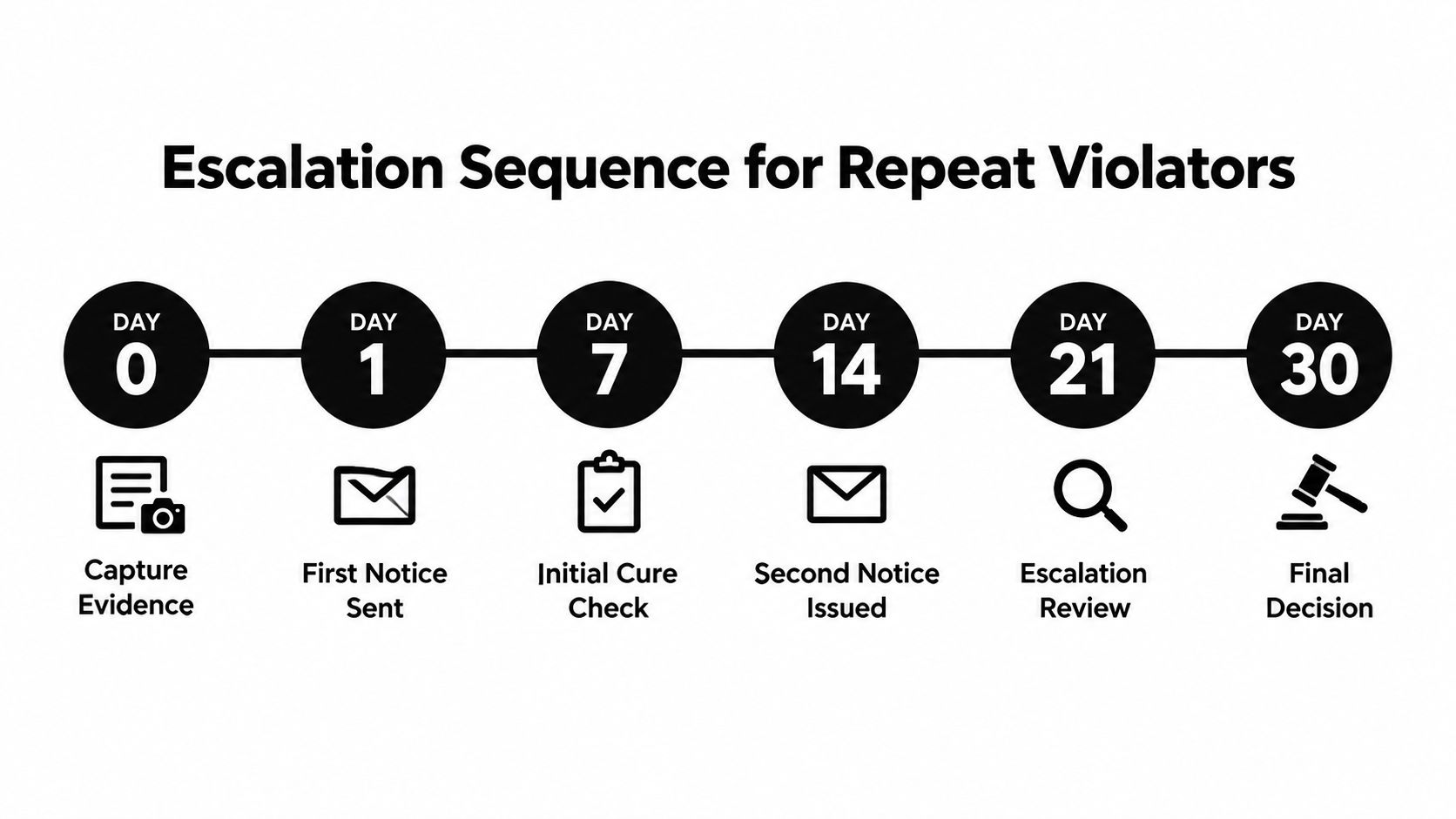
Keep the sequence logged as notice, response, cure status, and sanction. If the seller claims Amazon caused the price, ask for repricing records or an explanation before converting an ambiguous case into a formal breach.
Running MAP Enforcement as a Repeatable System
Ad hoc enforcement fails because the evidence lives in inboxes and the policy lives in a PDF nobody opens until a distributor dispute starts. A defensible program gives every ASIN and seller a history that another operator can understand without reconstructing the case.
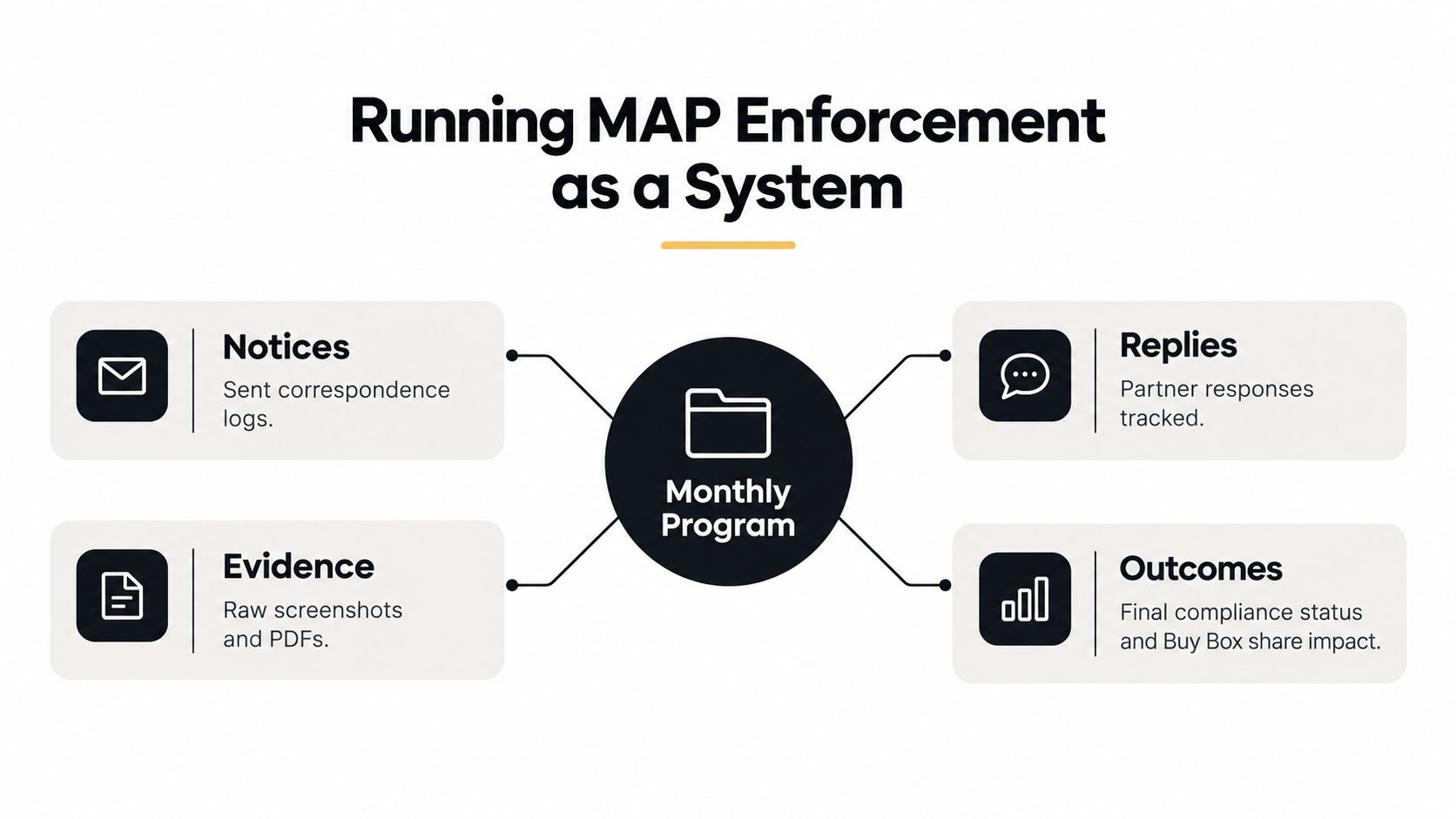
Use a shared drive or digital asset management system with four top-level folders:
- Notices: Store sent correspondence, delivery records, deadlines, and the policy clause cited.
- Evidence: Keep raw screenshots, offer URLs, seller storefront links, price history, receipts, invoices, and test-buy files.
- Replies: Record seller explanations, distributor messages, Amazon case responses, and internal decisions.
- Outcomes: Mark compliant, unresolved, supply restriction, seller removal request, or closed after investigation. Record the resulting Buy Box status separately from the contractual outcome.
The monitoring log should include the ASIN, seller ID or storefront identity, observed price, required MAP price, marketplace and currency, breach count, first-observed date, latest evidence date, last action date, response, and cure status. Add fields for coupon, bundle, fulfillment method, and Buy Box ownership so operators can distinguish a genuine advertised-price event from an offer-page complication.
Review the system on a fixed rhythm
Run a weekly offer and Buy Box check using tools such as Helium 10 or Keepa, then review exceptions manually. A recurring check should flag new sellers, repeated sellers, price changes, Buy Box changes, and offers that need unit-level bundle analysis.
At the monthly review, compare the MAP breach log with the Buy Box winner history. The point isn't to claim that every Buy Box change comes from a MAP issue. The point is to identify patterns, such as a repeat seller appearing whenever the Featured Offer changes or an authorized partner creating repeated price pressure.
Every record should contain:
- Dated screenshots: Preserve the visible offer details and time zone.
- Offer URLs: Save the exact listing and offer-page paths used in the notice.
- Seller storefront link: Identify the business behind the display name.
- Signed MAP policy: Keep the executed agreement tied to the seller record.
- Action history: Record every notice, response, cure check, and decision.
Online Brand Growth offers MAP price-violation reporting and a 360 Brand Protection program that supports unauthorized seller removal and MAP enforcement. Brands can also use the Amazon profit calculator at onlinebrandgrowth.com/calculator, the FBA storage fee calculator at onlinebrandgrowth.com/tools/storage-fee-calculator, and the Amazon sales rank checker when evaluating the financial and operational impact of a seller problem.
Putting It All Together and Protecting the Buy Box
MAP enforcement on Amazon is a connected loop. Monitor the offer, verify the seller and price, send a notice grounded in the agreement, preserve the response, and use Amazon's own channels only when a separate policy or IP theory exists. The Buy Box outcome is the commercial signal that tells you whether the issue remains active, but it shouldn't replace the underlying evidence.
A monthly dashboard should track:
- Offer-list price compliance rate, separated by ASIN, marketplace, and seller type.
- Authorized-reseller Buy Box win rate, so you can see whether compliant sellers are winning the offer.
- Repeat violator count, with separate treatment for authorized and unauthorized sellers.
- Average days from first notice to compliance, based on your logged dates.
- Amazon-side actions filed versus acted on by Seller Support, categorized by pricing, authenticity, IP, and seller conduct.
Don't let the policy become stale. Review pricing tiers, shipping allowances, promotion treatment, bundle rules, and the list of authorized Amazon sellers each quarter. A policy that doesn't explain coupons, cart pricing, multipacks, damaged inventory, liquidation stock, or marketplace currency differences creates avoidable disputes and makes a notice harder to defend.
The practical test: Pick the ten highest-revenue ASINs, identify the worst current offer, and ask whether another operator could reproduce your evidence and decision without calling you.
Build one master notice with conditional language for a first-time partner and a repeat violator. Capture the worst offender's evidence, verify the agreement clause, and send the first notice within seven days. That small operating discipline is more useful than sending broad complaints to Amazon that confuse a private MAP rule with marketplace enforcement.
Online Brand Growth can help monitor reseller offers, document MAP breaches, and coordinate unauthorized seller removal through its 360 Brand Protection program. Visit Online Brand Growth to discuss your Amazon seller-control workflow and book a free strategy call at /#book-call.