
Most full-service Amazon agencies charge $2,500 to $12,000 per month or 8% to 15% of managed ad spend. The right number for any brand depends on contribution margin after Amazon's own fees, not the quoted percentage.
Why the Cheapest Amazon Agency Fee Is Often the Most Expensive
A low agency fee can be the most expensive decision on the table when it pushes the account toward the wrong behavior. A team paid on ad spend has a built-in reason to protect budget and keep scaling spend, while a team paid on revenue has every reason to chase top-line growth even when the margin math is thin. In both cases, the quoted price can look attractive while the operating result gets worse.
The first filter I use is simple, if the proposal doesn't show how the agency gets paid relative to incremental contribution margin, the fee discussion is incomplete. Amazon already takes its cut through referral fees, fulfillment, storage, and advertising, so a cheap-looking retainer can still leave you with less profit than a higher fee that is tied to the right outcome. That's why the key question isn't whether the retainer is low, it's whether the contract rewards profitable actions.
Three commercial structures dominate real proposals
The market usually breaks into monthly retainers, percentage-of-ad-spend agreements, and project or hourly consulting. Hybrid contracts sit on top of that, with a fixed base fee plus a variable kicker, and those become more common as accounts get bigger and more operationally messy.
Practical rule: if the agency can't explain how it makes money when you make more profit, the fee model is probably built to optimize its own P&L first.
For a quick read on what's normal in broader account-management work, the agentcentral Amazon account management overview is useful because it frames the scope differences that drive cost, not just the headline fee.
The Four Fee Models Every Brand Owner Should Recognize
A flat monthly retainer pays the agency a fixed amount no matter what happens with spend or sales. That model is easy to budget and works best when the work is scope-heavy and repetitive, things like catalog updates, listing cleanup, account-health tickets, and reporting. The weakness is obvious, if the scope isn't locked down, the agency can protect itself by narrowing what it does.
A percentage of ad spend pays the agency on media managed, which usually lands around 8% to 15% in published benchmarks and can run higher in some proposals. The incentive is to manage spend, not to police every incremental dollar against profitability, so this model can be fine for disciplined PPC work and less helpful when you need inventory, content, and profitability decisions to move together. If you're comparing a management proposal against the larger pricing discussion in this article, the Amazon PPC agency pricing breakdown is a useful companion read.
A percentage of revenue pays the agency on sales, which sounds aligned until you remember that revenue is not profit. Brands get burned, because growth can look impressive while the agency's incentives stay blind to referral fees, FBA, returns, and discounts.
A commission on contribution margin pays the agency on the number the brand cares about, profit left after Amazon's costs and media. That's the cleanest incentive alignment when the account is mature enough to support it. A hybrid model, fixed base plus variable component, can work too, but only when the base covers the operating load and the kicker is tied to the right metric.
| Fee Model | Paid On | Typical Range | Agency Incentive |
|---|---|---|---|
| Flat Retainer | Time, scope, or deliverables | $1,500 to $25,000+ per month | Efficient execution, scope control |
| Percentage of Ad Spend | Managed advertising spend | 8% to 15% or 10% to 20% depending on proposal style | More managed spend, steadier media activity |
| Percentage of Revenue | Total Amazon sales | Commonly used in hybrid proposals, often with a base fee | Top-line growth, not necessarily profit |
| Contribution Margin Share | Incremental contribution margin | Usually custom | Profit alignment |
If you're reading a proposal and it doesn't clearly fit one of those buckets, it's probably a hybrid. That isn't automatically bad, but it does mean you need to inspect the base fee, the variable trigger, and the cap, if there is one.
Real Price Ranges by Service Level and Brand Size
The right benchmark depends on what the agency is doing. A PPC-only engagement can be relatively light, while a full-service operator covering catalog, ads, account health, inventory, and brand protection sits in a very different cost bucket. Public benchmarks put full-service Amazon agencies at roughly $2,500 to $12,000 per month, while another marketplace benchmark places full-service retainers at roughly $3,000 to $15,000 per month and notes that some agencies add 10% to 15% of ad spend on top of a base retainer.
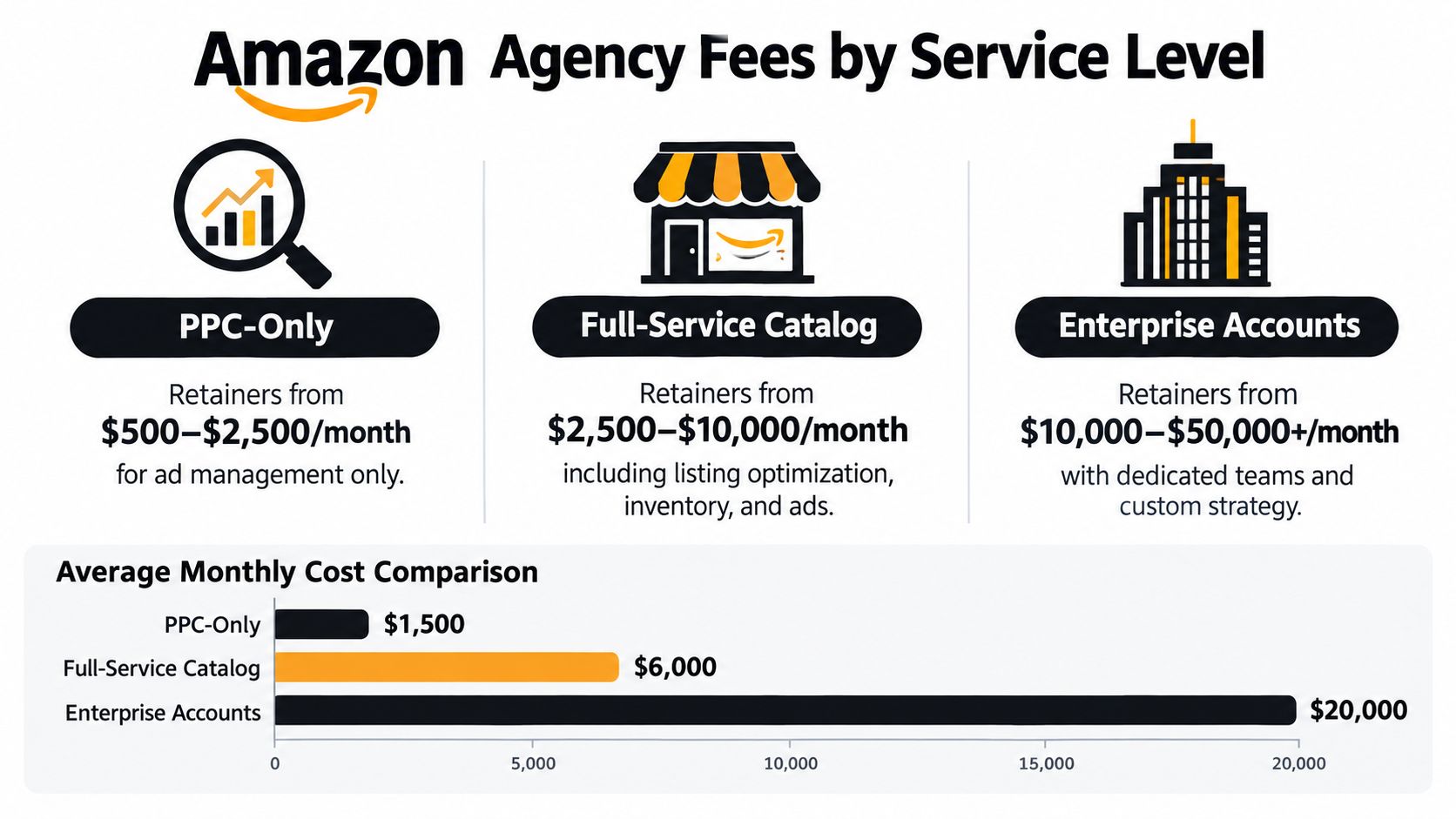
A brand spending $50,000 per month on Amazon advertising could pay $4,000 to $7,500 under an 8% to 15% management model before any fixed retainer is added. At $100,000 in monthly ad spend, the variable fee alone rises to $8,000 to $15,000. That's why two proposals can look similar on paper and still land miles apart in total monthly cost.
Strategy-only work is priced differently
Consulting benchmarks cite $150 to $400 per hour or $2,500 to $15,000 for a defined project. That matters if you're buying a listing audit, an account review, or a short-term diagnostic instead of ongoing management. It also means a large brand should not pay full-service retainer pricing for work that should clearly be scoped as a project.
For a parallel outside-Amazon benchmark, the fractional CFO pricing guide from AmbitionCFO is useful because it shows the same pattern, ongoing advisory and project work shouldn't be priced like permanent operating coverage.
A retainer only makes sense when the agency is replacing real operating capacity, not just sending reports.
The practical takeaway is simple. A $3,000 retainer and a 15% ad-spend fee can both be fair or both be wrong, depending on scope, catalog size, and whether the work includes PPC only or the larger operational stack.
The Contribution Margin Math Behind the Headline Rate
The fastest way to see through a proposal is to build the economics at the ASIN level. Amazon's own fees hit the sale before the agency even enters the picture, so you need a model that starts with the buyer's payment and then subtracts marketplace costs, media, and the agency fee in the same worksheet. Amazon's fee pages make clear that referral fees are charged on the total sales price and that advertising spend is tracked separately, which is exactly why the fee conversation has to be built on contribution math, not the headline rate alone.
Take a $100 sale in a category with a 15% referral fee. That leaves $85 before fulfillment, advertising, agency compensation, product cost, inbound freight, storage, and returns. If FBA costs $12, advertising costs $15, and the agency charges 10% of sales, another $10 comes off the top, leaving $48 before product cost and the rest of the operating stack.
Why this matters in practice
That single example shows the problem with revenue-based and ad-spend-based pricing. The agency gets paid even when the margin left for the brand is thin, and the fee can consume a large share of the incremental profit on low-priced or bulky ASINs. If the category is already pressure-heavy, the agency's percentage may be the difference between a workable contribution line and a channel that looks busy but adds little cash.
For a deeper explanation of the metric itself, the contribution margin walkthrough is useful because it helps separate gross sales from the money left after real operating costs. The break-even ROAS formula is also worth reviewing when you're pressure-testing ad spend against margin on a per-product basis.
Don't forget storage creep
Storage often gets ignored until it becomes material. That's why it helps to keep a separate view in the FBA storage fee calculator, because inventory overhang can make a supposedly acceptable agency fee look a lot worse once carrying costs show up.
If the proposal doesn't survive an ASIN-level profit sheet, it isn't a growth plan, it's a spending plan.
The cleanest habit is to run every proposal through the Amazon profit calculator before you sign. If the fee structure still looks rational after referral fees, FBA, ad spend, storage, and agency compensation, then you've got a real business case.
Matching Fee Structure to Agency Incentives
A fee model should push the agency toward the same decisions your finance team would make. If the work is mostly fixed-scope, like listing rebuilds, catalog cleanup, and reporting, a flat retainer can be the cleanest setup because it pays for execution rather than volume. If the work is heavy on ongoing media management, a percentage-of-spend model may be acceptable, but it still rewards managed spend, not necessarily better profit.
A contribution-margin share is different. It ties the agency to the same number your board cares about, so bid changes, budget shifts, and promo decisions all get judged against margin left after Amazon's charges. That alignment matters when the account needs daily judgment calls, not just campaign maintenance.
Where hybrid structures fit
Hybrid pricing works when both sides need predictability. The base fee covers the operational load, then the variable piece gives the agency an upside if the account performs. The danger is sloppy design, because a vague kicker can still reward revenue growth that doesn't improve economics.
Online Brand Growth uses a contribution-margin-based compensation model for some engagements, and that makes sense for brands that want the agency to think like a profit operator rather than a media buyer. In contrast, work such as unauthorized seller removal and MAP enforcement is usually cleaner as a separately scoped program, including the 360 Brand Protection program rather than bundled into a generic retainer.
What the daily incentives look like
- Flat retainer: The agency is motivated to control scope and keep work efficient.
- Percentage of ad spend: The agency is motivated to manage more media, so budget discipline becomes your responsibility.
- Contribution margin share: The agency is motivated to improve profitable sales, which usually means tighter bid control, better assortment decisions, and faster pruning of weak ASINs.
If you're still comparing structures, remember this. A cheap fee can still be the wrong fee if it pays the agency to do more of the thing that erodes your margin.
Questions to Ask, Red Flags to Walk Away From, and How to Negotiate
The first questions should be operational, not commercial. Ask how often you'll get reporting, what attribution window the agency uses, whether there's an ad-spend minimum, and exactly what's included versus extra. If they manage creative, ask who owns the assets. If they touch account health, ask how they handle support cases and whether Seller Central access stays in your hands.
Then push on fee mechanics. Ask what happens when Amazon changes FBA fees, whether the retainer changes with catalog size, and whether there's a floor or a cap on the variable component. If they can't answer those questions cleanly, they probably haven't modeled your account properly.
Red flag: any agency that guarantees sales numbers without showing the economics underneath is asking you to buy optimism, not management.
Walk away when you see these patterns
- No written reporting cadence: If performance updates are vague, accountability will be too.
- Opaque media buying: If you can't see spend, CPC, attributed sales, and ACoS separately, you're flying blind.
- Scope creep hidden in “full service”: Brand protection, creative production, and inventory support should be spelled out, not implied.
- Pressure to sign immediately: Good operators don't need to force urgency on a clean proposal.
Negotiation works best when you trade clarity for commitment. Push for a minimum term only if the scope and exit language are clear, ask for tiered percentages if spend will change materially over time, and consider performance bonuses only when the metrics are tied to margin, not raw sales. If the agency is serious, it should be willing to discuss a 90-day proof period, a clean exit clause, and monthly business reviews.
If you want a broader view of what a full-service partner usually covers, the Amazon marketing agency overview helps frame which items belong in scope and which should be separate line items. Keep your own internal readout on the catalog too, and use a sales rank checker so underperformance shows up before the account drifts.
Your Next Step and a Free Strategy Call
Pick the fee structure that pays the agency on the same number your brand is paid on, which is contribution margin. If a proposal can't prove it improves profit after Amazon's referral, FBA, and ad costs, the headline rate doesn't matter much.
Bring your current contract, your fee sheet, and a few top ASINs into the conversation. The fastest path to a better decision is a margin-first review of what you're already paying, what the agency is doing, and where the incentives are misaligned.
Online Brand Growth helps Amazon brands evaluate pricing, model contribution margin, and structure management around profitable growth instead of vanity metrics. If you want a second opinion on an existing proposal or a margin-share structure built around your catalog, visit Online Brand Growth.