
You wake up, check your newest Amazon listing, and find a retailer selling below your MAP. The offer has Prime shipping, a damaged-looking box, and enough price distance to pull the Buy Box away from your authorized channel. Your sales team says the retailer wasn't approved. Your marketplace team opens Seller Central and discovers that Amazon doesn't have a simple button labeled “remove this seller.”
That situation is common because distribution control and Amazon enforcement are separate operating systems. Contracts determine who may acquire and resell your products. Seller Central and Amazon Brand Registry provide reporting and diagnostic tools. Neither system works well when the other one is missing.
Stopping retailers from selling your products on Amazon requires a written channel policy, clean authorization records, continuous monitoring, and a documented escalation path. MAP alone won't remove an offer, and a trademark complaint shouldn't be used as a substitute for a distribution dispute. The brands that keep control treat enforcement as daily channel operations, not an emergency task after the Buy Box has already moved.
Why Your Products Keep Showing Up on Amazon
A retailer can enter your Amazon channel through several routes. An authorized distributor may sell inventory to a sub-distributor, a physical retailer may liquidate excess stock online, or a buyer may acquire genuine products through a trade account that never included Amazon resale rights. By the time the offer appears on an ASIN, the original transaction can be buried under invoices, transfers, and marketplace accounts.
The brand usually sees only the final symptom: a seller name and a low price. Amazon sees an offer attached to an existing product detail page. Amazon's own listing guidance explains that product pages can carry multiple seller offers, with each offer including pricing and shipping information. That structure is convenient for customers, but it means your brand can lose control of the sales environment without losing control of the detail page itself.
Operational reality: A genuine product can still be an unauthorized offer.
The gap between MAP and marketplace control
A MAP policy sets the advertised price your participating retailers must follow. It doesn't automatically prevent a retailer from listing, and it doesn't give Amazon authority to enforce your private pricing rules. Amazon does not enforce MAP as a platform policy, so MAP enforcement remains the brand owner's responsibility and depends on a written policy plus authorized reseller agreements. The practical distinction is explained in this Amazon brand protection overview.
That distinction changes how you respond. A low price by itself is generally a commercial policy violation, not an intellectual property violation. Amazon's reporting tools are appropriate for trademark misuse, counterfeit products, policy violations, and certain compliance concerns. They aren't a general-purpose method for forcing Amazon to honor your preferred price floor.
The system that actually works
You need two controls operating together:
- Legal control: Define approved territories, customer types, channels, and resale conditions in signed agreements.
- Marketplace control: Enroll the brand, monitor every relevant ASIN, record seller evidence, and route each incident through the correct Seller Central or Brand Registry path.
- Commercial control: Decide whether the seller should be corrected, restricted, bought out, or terminated under your agreements.
- Inventory control: Trace the first authorized account that supplied the product and stop leakage upstream.
If you only file complaints, the same inventory can reappear through another account. If you only write contracts, you may discover the violation after the seller has taken the Buy Box. The fix is a closed loop from authorization to detection, evidence, escalation, and supply restriction.
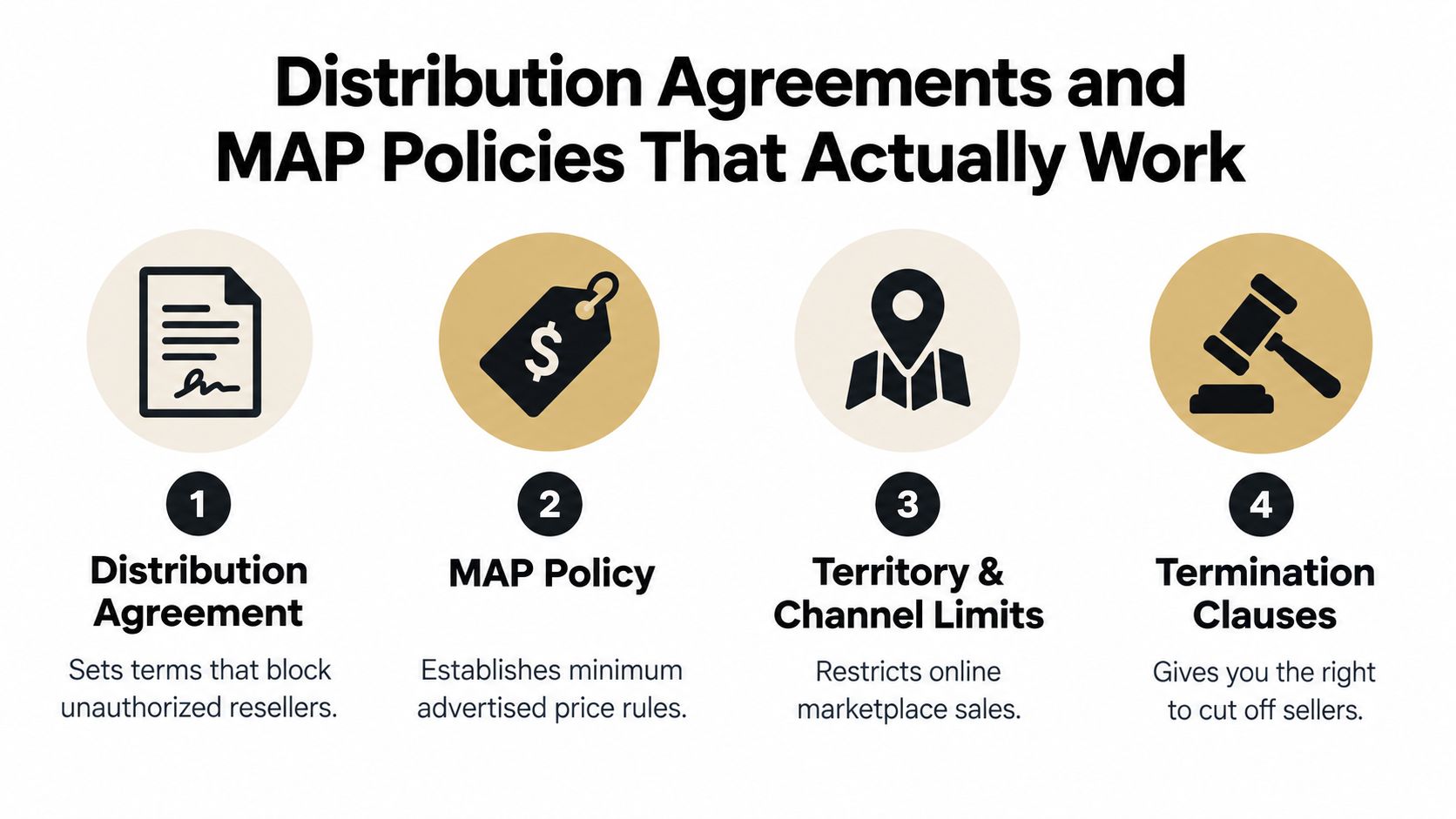
Distribution Agreements and MAP Policies That Actually Work
Before you report a seller, establish that the seller violated a rule you can prove. A distributor agreement should do more than describe wholesale pricing and payment terms. It should define where the buyer may sell, which customers it may serve, and whether Amazon is an approved channel.
Have counsel review the language for your markets, especially where resale and competition rules apply. A useful primer on the relationship between distribution restrictions and channel conflict is this distribution agreement legal guide.
Build the agreement around channel permissions
Use a schedule or annex that names approved channels and keeps them easy to update. The agreement should address:
- Marketplace authorization: State whether Amazon is permitted, prohibited, or allowed only through named seller accounts.
- Territory: Define the geographic territory and prohibit exports or cross-border transfers that bypass your channel plan.
- Customer tier: Separate distributors, retailers, dealers, liquidators, and end customers. A retailer shouldn't be able to claim that a wholesale purchase created unrestricted marketplace rights.
- Product scope: Identify covered brands, product families, bundles, and replacement parts. Ambiguous scope creates avoidable disputes.
- Account disclosure: Require the reseller to identify marketplace storefronts and related entities used to sell your products.
- Transfer controls: Prohibit resale to unknown dealers, brokers, or other intermediaries unless you approve them in writing.
- Evidence and audit: Require invoices, purchase records, and downstream customer information when you investigate leakage.
- Termination: Define material breaches, cure periods where appropriate, suspension rights, and the process for ending supply.
The agreement should also say what happens after termination. Address remaining inventory, marketplace listings, use of brand assets, customer service obligations, and the return or destruction of confidential materials. A termination clause that says only “either party may terminate” gives you little power to pressure a seller who keeps listing your products after the relationship ends.
Make MAP operational, not decorative
Your MAP policy should identify the covered products, the prohibited advertising conduct, the monitoring method, and the consequences of noncompliance. Avoid vague language such as “maintain premium pricing.” Define the observable event, such as an advertised product price below the stated floor, and explain how promotions, coupons, bundles, shipping charges, and marketplace discounts are treated.
Tie the policy to a consistent response matrix. A first breach might trigger written notice, while repeated breaches can lead to suspension, loss of discounts, chargebacks where legally and contractually appropriate, or termination. Apply the same process across comparable accounts. Selective enforcement weakens credibility and creates unnecessary arguments.
Keep an authorized reseller list with the legal entity, account name, storefront URL, territory, approved channels, agreement dates, and status. Update it whenever an account changes ownership or loses authorization. Amazon teams need current proof of your relationship when you submit a complaint, and your own operations team needs the same record when tracing inventory.
For a deeper operating framework, use this guide to build a minimum advertised price policy. The document should support the workflow, not sit unused in a shared folder.
Using Amazon Brand Registry to Remove Unauthorized Sellers
Amazon Brand Registry is the foundational enforcement tool for brand owners. Amazon says the program launched in 2017, is free for brand owners even if they don't sell in the store, and supports reporting suspected intellectual property infringement, policy violations, and compliance issues from one place. It also gives you a verified brand identity that makes evidence easier to organize and reports easier to route.
Start with an active trademark that matches the brand information on your product packaging and listings. Complete the enrollment, verify the rights holder, and add the product catalog. The account should be controlled by the brand owner or an authorized employee, not by a temporary contractor whose access may disappear during a dispute.
This guide to what Amazon Brand Registry is provides useful context for brands setting up the program across multiple channels.
Choose the complaint path carefully
When you find an offer, identify what is wrong before submitting a report.
- Trademark issue: Use the intellectual property reporting path when a seller uses your protected mark improperly, misrepresents the product, or creates a misleading brand association.
- Counterfeit issue: Use the counterfeit route when the item isn't genuine. Preserve the test purchase, packaging, serial information, and comparison evidence.
- Patent or design issue: Use the applicable patent reporting path only when you have a valid, relevant right and can document the alleged infringement.
- Unauthorized distribution: Treat a genuine product sold without permission as a channel and contract problem unless the seller's conduct also violates an Amazon policy. Use your agreements, supply records, and commercial escalation process rather than mislabeling a MAP dispute as counterfeit.
- Compliance issue: Report safety, regulatory, or product documentation concerns through the relevant Amazon workflow when those concerns are real and supported.
Amazon's protection system depends heavily on verification and documentation. In its 2023 brand protection report, Amazon said it stopped more than 700,000 bad actor attempts to create new selling accounts before a product was listed, and identified, seized, and disposed of more than 7 million counterfeit products worldwide. The same report explains that sellers appealing enforcement actions are typically expected to provide invoices or letters of authorization, which is why your own authorization records must be complete before a dispute starts. See the Amazon brand protection report for the platform's stated approach.
Amazon says brands enrolled in Brand Registry reported 99% fewer suspected infringements than before launch, and that more than 95% of potential infringement notices received from Brand Registry were acted on within eight hours. Those figures support a practical lesson, trademark-based enrollment and clean evidence improve the speed and consistency of legitimate reports. They don't mean every unauthorized seller will disappear from a listing after one submission.
Keep a case file for every seller
Capture the storefront name, seller ID, ASIN, offer price, condition, fulfillment method, product images, and the date and time of observation. Add your authorization list, relevant agreement, invoices, test-buy results, trademark details, and prior case IDs. Write the complaint around verifiable facts and identify the exact policy or right involved.
Log Amazon's response and the seller's next appearance. A complaint without a case history becomes a repeated manual task. A case history lets your team recognize linked accounts, show repeated conduct, and escalate with a coherent record. Use this Amazon Brand Registry takedown process as a reference, but keep the report tied to the evidence you possess.
Protecting the Buy Box When Resellers Undercut You
The Buy Box is where a reseller becomes a revenue problem instead of a name in a monitoring report. Amazon can present a competing offer on the same detail page, and the customer may never know that your authorized seller exists. Price, availability, condition, and fulfillment differences can change which offer receives the most prominent placement.
Don't judge the impact by looking only at the current seller list. Measure the effect at the ASIN level, then compare the timing of seller appearances with changes in conversion, units, and offer conditions. A low-price seller with poor availability may have little impact. A consistently available FBA offer can alter the competitive picture much more sharply.
Find the correct metric
Amazon reports the metric as Buy Box Percentage, defined as the percentage of page views where an offer appeared in the Buy Box. The navigation path is:
- Open Reports in Seller Central.
- Select Business Reports.
- Open Detail Page Sales and Traffic by Child Item.
- Review Buy Box Percentage for the relevant child ASIN.
The metric is reported at the child ASIN level, not the SKU level. That distinction matters when multiple SKUs map to one ASIN, such as FBA and FBM offers on the same listing. If your team reviews only SKU data, it can miss the fact that several fulfillment offers are competing for the same detail-page traffic. The metric definition and navigation are documented in this Seller Central Business Reports discussion.
Diagnose before changing price
Separate the problem into three questions:
| Question | What to inspect | Likely action |
|---|---|---|
| Who is winning the offer? | Seller identity, price, condition, fulfillment | Match the seller to the authorization list |
| Why can the offer compete? | Inventory source, FBA or FBM status, shipping promise | Trace supply and verify channel permissions |
| What rule was breached? | MAP, trademark, counterfeit, or compliance evidence | Use the corresponding commercial or Amazon path |
Don't respond to every undercut by lowering your own price. That can reward leakage, compress authorized-retailer margins, and teach the seller that your brand will absorb the cost of its violation. First determine whether the product is genuine, whether the seller has permission, and whether the offer creates a material Buy Box impact.
Amazon can provide listing and offer controls in some categories, and a brand may be asked to obtain approval before certain sellers or products can be listed. Those controls are useful when available, but they aren't a replacement for distribution agreements. The durable fix is to stop supplying unauthorized accounts and use the appropriate Amazon report when the seller crosses into an actual platform or intellectual property violation.
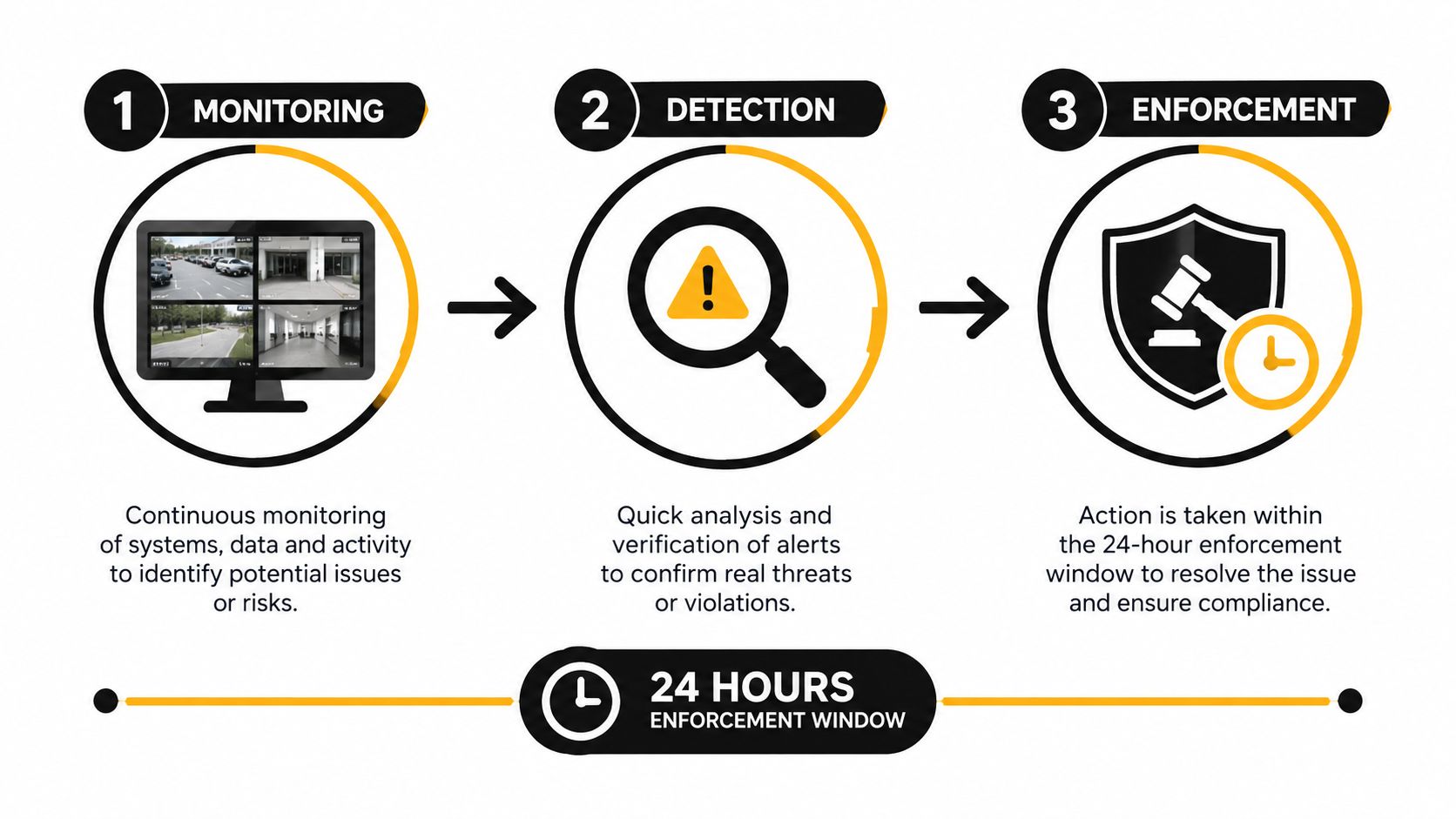
Monitoring, Detection, and the Twenty-Four-Hour Enforcement Window
A reseller can change its price, fulfillment method, or offer status before your team finishes a weekly review. A spreadsheet that records only the seller name will not explain whether the offer is authorized, where the inventory came from, or how much pressure it places on the Buy Box. Set up monitoring that captures the commercial facts and creates a case with a named owner.
Start with priority ASINs, new launches, products with narrow margins, and listings where another offer has taken the Buy Box before. Record the seller name and ID, price, condition, fulfillment method, shipping promise, offer status, and time of evidence capture. Add screenshots or other supporting files to the incident record. An alert has operational value only when someone must review it, classify it, and act.
Use an Amazon reseller monitoring playbook to define the scan frequency, alert rules, evidence fields, and ownership model before an incident occurs.
Segment the threat instead of treating every seller equally
Seller identity and distribution breadth should determine how quickly your team responds. Independent industry reporting summarized by Jungle Scout indicates that unauthorized retailers violate MAP around 50% of the time, compared with about 20% for authorized resellers, and associates wider distribution with higher MAP violation rates. Review the reseller monitoring analysis for the underlying channel-risk discussion.
Apply a working classification:
- Authorized and compliant: Keep the account on the approved list. Record the observation if the price reflects an approved promotion.
- Authorized and noncompliant: Preserve the evidence, send the breach notice, and follow the written cure or consequence process.
- Unknown but genuine: Trace the invoice chain and identify the authorized account that supplied the inventory.
- Unknown and suspicious: Prioritize a test purchase and authenticity review. Use the relevant Amazon reporting path when the evidence supports it.
- Repeated or high-impact seller: Involve commercial, legal, and marketplace owners. Repeating the same isolated email rarely changes the supply route.
Prioritize the seller combining questionable authorization, reliable availability, repeated violations, and a strong ability to win the Buy Box. The lowest price alone does not establish the highest enforcement priority.
Run the twenty-four-hour workflow
When an alert fires, assign an owner immediately. Confirm the seller and ASIN, capture the offer page, compare the account with the authorization list, and classify the incident before contacting the seller or supplier. Then notify the relevant distributor or retailer, open the appropriate Seller Central case when the conduct involves a platform or intellectual property violation, and set a follow-up date.
Independent brand-protection reporting found that brands responding within 24 hours recovered 91% of authorized-retailer pricing compliance, while delays of 7 or more days reduced recovery to 34%. The same source supports combining continuous MAP monitoring with Amazon Brand Registry and rapid action. See the MAP enforcement workflow for those benchmarks.
Speed helps your team identify the inventory source while records remain available, correct an authorized account before the breach spreads, and protect the Buy Box before an offer becomes established. It does not justify threatening every seller at the first observation. Match the response to the evidence: commercial correction for a MAP breach, supply investigation for leakage, and an Amazon report for a supported platform violation.
Use the LA Law Group APLC guide for sellers when your team needs to align marketplace evidence with a broader legal escalation process.
Measure whether the channel is staying clean
Track open incidents, repeat sellers, time to evidence capture, time to first action, source accounts, and Buy Box Percentage at the child-ASIN level. Review whether each action corrected the seller, pushed the seller to another account, or exposed a wider distribution leak.
For example, a brand tracking 40 priority ASINs cut repeat offenders from 12 to 3 in one quarter by logging source accounts beside each incident. That record turned isolated complaints into two distributor conversations and gave the team a measurable basis for restricting supply or escalating further.
Your Complete Amazon Distribution Playbook
Put the process in one operating document and give each step an owner. The playbook should be short enough to use during a live incident, but detailed enough that a new operator can follow it without guessing.
Prepare the control layer
Maintain the signed distributor and reseller agreements, current MAP policy, authorized seller list, trademark information, approved ASIN list, and escalation contacts in one controlled location. For every account, record the territory, permitted channels, customer tier, agreement status, and termination or suspension history.
Review the document whenever you add a product, distributor, marketplace, or territory. A new ASIN should never launch before someone confirms which accounts may acquire it and where they may sell it.
Triage the marketplace layer
For each alert, create a record containing:
- Identity: Seller name, seller ID, storefront, ASIN, and linked account information where available.
- Offer facts: Price, condition, fulfillment method, shipping promise, and observation time.
- Authorization status: Approved, expired, unknown, suspended, or terminated.
- Evidence: Screenshots, test-purchase materials, invoices, packaging comparisons, and relevant correspondence.
- Impact: Buy Box Percentage at the child ASIN level, offer persistence, and effect on authorized sellers.
- Action: Commercial notice, supply investigation, Brand Registry report, Seller Central case, legal escalation, or observation.
Use complaint language that is factual and narrow:
“We are the enrolled rights owner for this brand. Seller [name] is offering ASIN [identifier]. Our authorization records show no permission for this seller to list or resell the product on Amazon. Attached are the seller evidence, relevant authorization records, and documentation supporting the specific policy or intellectual property concern.”
Don't call a genuine product counterfeit because the price is low. Don't submit a trademark complaint when the only issue is MAP. Those shortcuts create weak cases and can damage the credibility of legitimate future reports.
Make the commercial decision
Negotiate when the seller is identifiable, the inventory appears genuine, and the agreement provides a clear correction path. Restrict or terminate when the seller refuses to comply, repeatedly violates the policy, conceals its account identity, or supplies other unauthorized sellers. Escalate when the evidence suggests counterfeit goods, trademark misuse, or a safety concern.
During cleanup, use the Amazon profit calculator, the FBA storage fee calculator, and the Amazon sales rank checker to separate channel enforcement decisions from product economics. Online Brand Growth also offers a 360 Brand Protection program covering unauthorized seller removal and MAP enforcement, which can fit brands that need an operating team for monitoring, evidence, and escalation.

The final test is simple. Can your team identify who is authorized, prove what happened, choose the correct enforcement path, and act before the offer changes? If not, the problem isn't one rogue retailer. It's an unfinished distribution control system.
Book a free strategy call at Online Brand Growth to review your unauthorized seller, MAP, and Buy Box issues. The team can help you connect distribution agreements, Brand Registry evidence, monitoring, and enforcement into one practical workflow.