
The most popular advice about Amazon agencies is to pick the team with the biggest growth case study. That's a weak way to protect your margin. A 30x sales headline tells you little without the starting point, inventory investment, advertising costs, and profit left after fees.
Most agency rankings are marketing copy. Read them against the documents that rarely appear beside the testimonials: account ownership terms, fee definitions, staffing commitments, and the actual reporting template. A polished dashboard isn't evidence that someone reconciles returns, watches stranded inventory, or stops campaigns when replenishment slips.
This ranking of the best Amazon account management agencies prioritizes contribution margin, operational accountability, and evidence you can interrogate. It's an editorial order, not a claim that every agency has undergone an independent financial audit. Published results remain claims to verify against your category and starting position.
Start with your own economics. Model your current contribution margin with our Amazon profit calculator before an agency call. Otherwise, you're comparing someone else's revenue story with an unknown baseline.
Creative research has its place. Resources such as the ad research tool recommendations from AdLibrarySpy can help teams investigate advertising approaches, but creative intelligence doesn't replace catalog ownership or profit reporting. The useful question is who connects those activities inside your account, and who takes responsibility when they stop working together.
1. Online Brand Growth
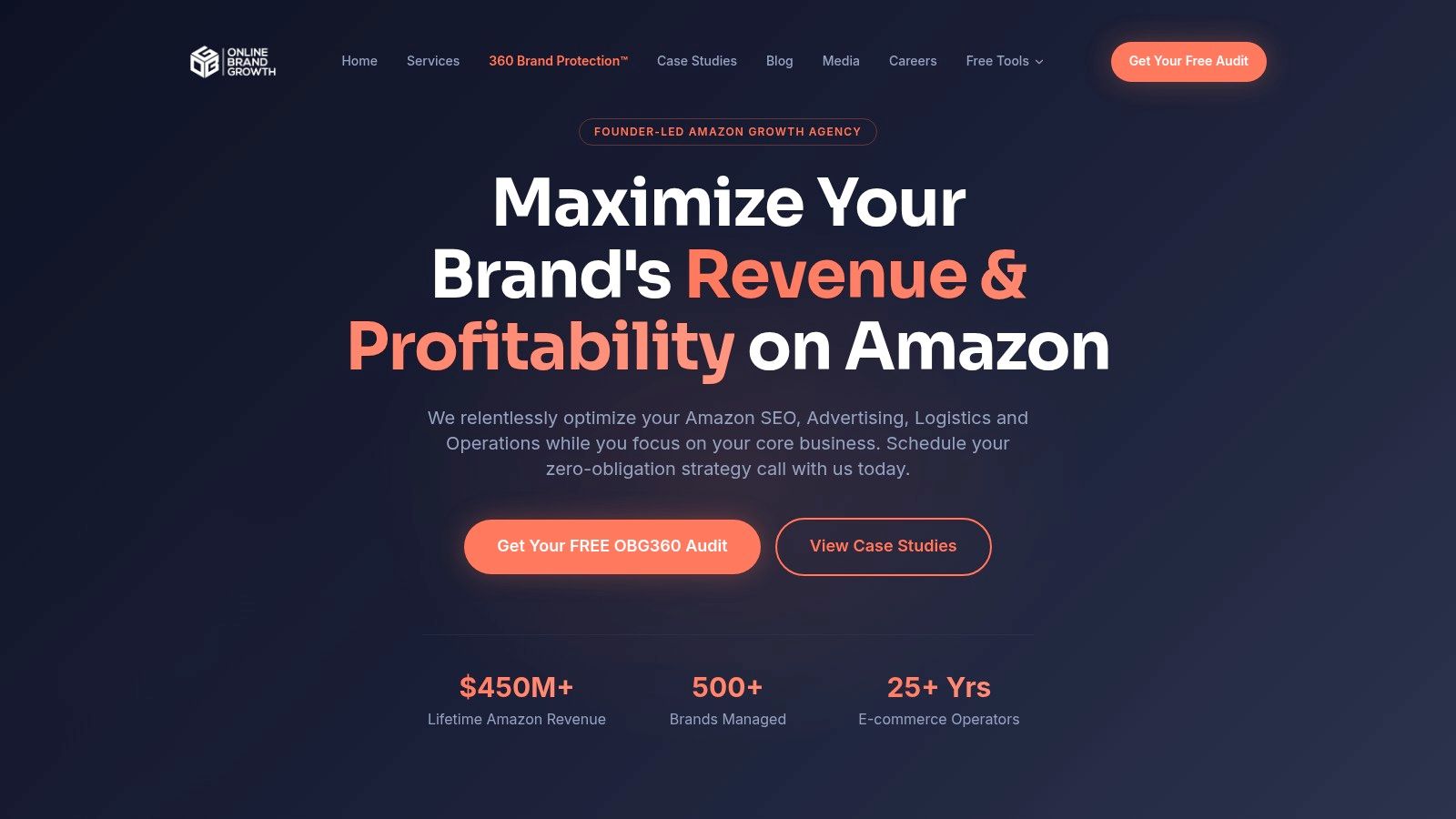
An agency fee tied to contribution margin can align incentives, but only if both sides agree on the calculation. Online Brand Growth is a founder-led Amazon agency offering full account management for brands that want one partner responsible for advertising, listings, operations, and protection.
The Amazon account and brand remain yours. OBG employees work inside the account, with no client services outsourced to third parties. Its co-founders own and operate Amazon brands and are directly involved in client strategy and execution.
Full account management includes advertising, SEO and listing optimization, FBA operations, brand protection, and account-health management. Fees are based on a percentage of channel contribution margin, with exact terms depending on account size and scope. Before signing, define included costs, adjustments, and whether agency fees are deducted in the calculation.
What the operating model includes
A dedicated North American account strategist coordinates the work. Full management includes weekly check-ins and monthly executive reporting focused on contribution margin. Advertising covers Sponsored Products, Sponsored Brands, and Sponsored Display; Amazon DSP is available for select clients.
Operations include catalog management, FBA inventory management, reimbursement claims, Seller Support cases, and account-health management. OBG's Amazon brand management approach brings these responsibilities together with advertising and listing work.
- Main advantage: One partner owns advertising, SEO, operations, and brand protection, rather than leaving the connections between those functions to the brand team.
- Commercial advantage: A contribution-margin-based fee rewards improved profitability, not higher ad spend by itself.
- Poor fit: OBG does not work with resellers. Its model suits manufacturers and brands with an existing Amazon business, brands with a proven track record in other channels, and well-funded startups.
- Transparency limit: Pricing is not published. The complimentary account audit and strategic roadmap can clarify scope, but the contract should specify the fee calculation and decision rights.
Questions worth putting in writing
Request an ASIN-level contribution statement and a line-by-line definition of the costs used to calculate the fee. Ask who approves changes to bids, prices, promotions, and inventory plans. The audit should identify specific account issues and recommended actions, not rely on a general promise to grow sales.
For unauthorized sellers, OBG handles enforcement against unauthorized resellers to protect MAP and the Buy Box. Ask how it distinguishes distribution-policy issues from intellectual-property complaints; a low advertised price alone does not establish infringement.
OBG can also train internal employees on Amazon tasks the brand wants to bring in-house. That can support a gradual shift in responsibilities rather than making the outside team a permanent requirement.
2. Marketplace Valet
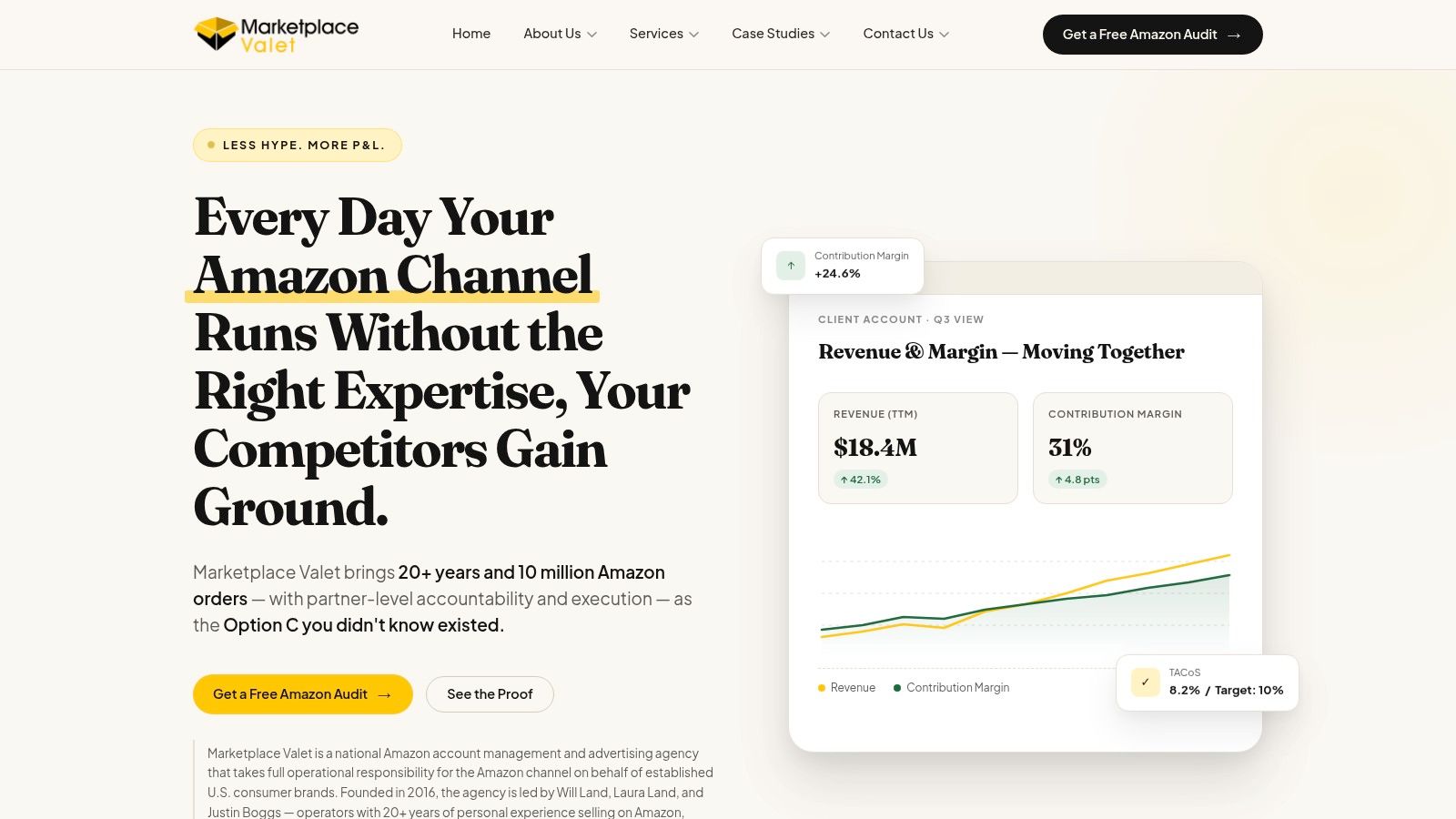
Marketplace Valet merits consideration when the problem extends beyond PPC. Its positioning emphasizes hands-on channel operations for established consumer brands, with contribution margin and profitability central to its stated reporting approach.
Marketplace Valet describes a U.S.-based team with founder seller-side experience, covering account health, advertising, listings, and compliance. Those are useful capabilities when campaigns look acceptable but catalog problems or operational delays keep limiting sales.
The trade-off is commercial visibility. Pricing and engagement terms aren't publicly listed, and a profit-focused message doesn't establish exactly how the agency calculates profit or gets paid.
Test the margin reporting, not the terminology
In Jungle Scout's 2025 seller survey, 32% of respondents considered rising advertising costs a concern. For your account, the practical response is to demand a report that reconciles advertising with fulfillment, storage, promotions, returns, and product costs.
Give Marketplace Valet a specific decision to explain: an ASIN has improving advertising efficiency but declining contribution dollars. Ask what its operators would investigate before increasing spend.
- Fee diligence: Is compensation fixed, revenue-based, spend-based, or linked to another measure? Compare the written proposal with the distinctions in our guide to how much Amazon agencies charge.
- Ownership diligence: Who retains primary Seller Central access, Brand Registry control, and reporting exports?
- Execution diligence: Which named operator owns catalog cases, and who covers that person's absence?
- Proof diligence: Can the agency provide a redacted account-level margin reconciliation and a relevant reference?
Best fit: An established consumer brand seeking operational ownership alongside advertising. Poor fit: A smaller seller needing a narrowly scoped, low-overhead service, or an international business whose required marketplaces fall outside the proposed team's coverage.
Its free audit is useful only if it identifies accountable actions, dependencies, and financial consequences. A list of listing recommendations isn't the same as a channel operating plan.
3. Canopy Management
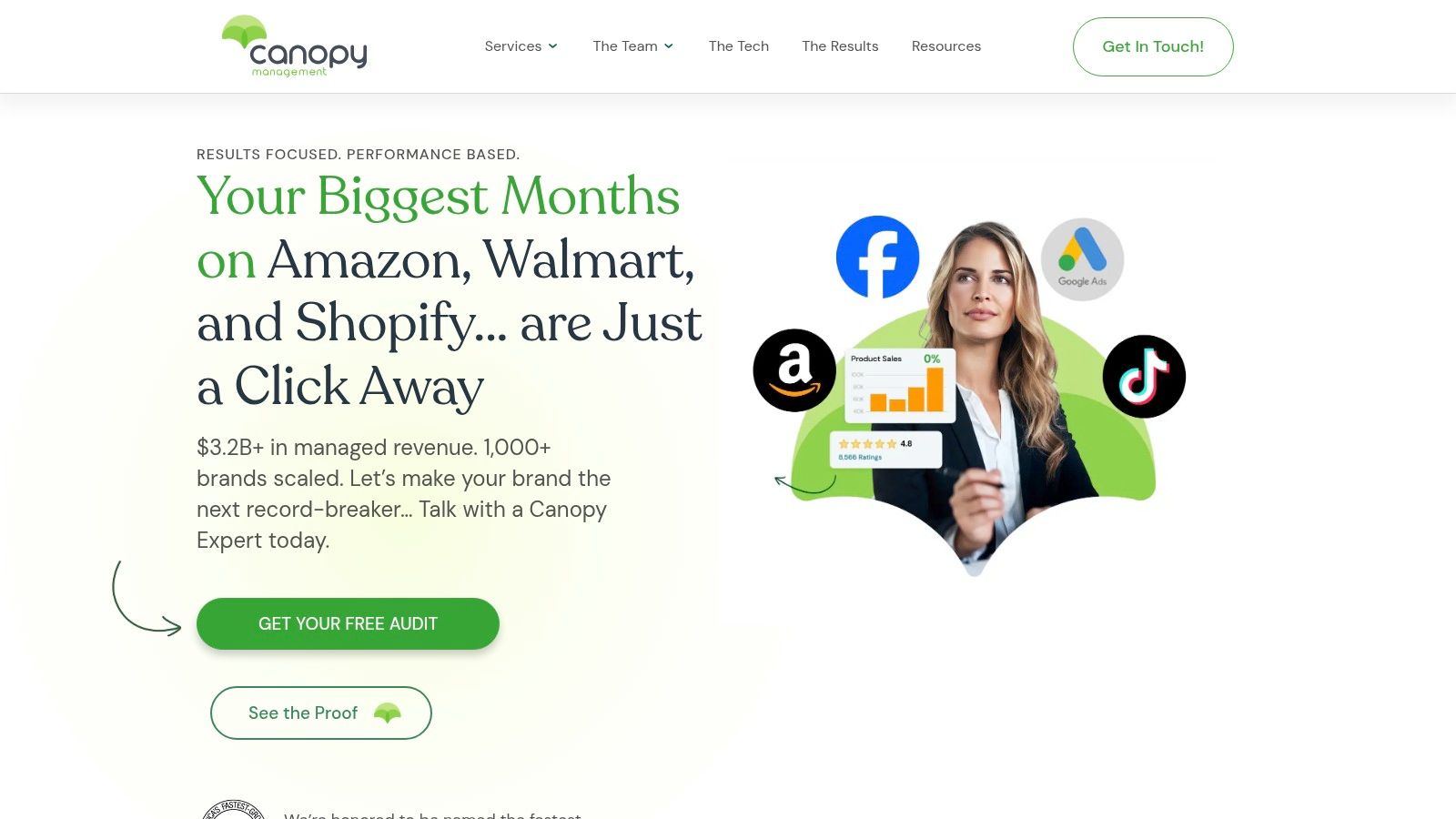
Say your advertising team wants more traffic, your creative team wants new photography, and your operations team wants to reduce replenishment. Canopy's broad scope is relevant because those decisions need a shared commercial owner.
Canopy Management offers Amazon advertising, including PPC and DSP, alongside listing optimization, photography, video, inventory support, customer service, revenue recovery, and reporting. It also supports Walmart and Chewy, which may suit brands extending an existing marketplace operation.
Breadth can reduce handoffs. It can also make responsibility harder to trace if each workstream has a different lead and nobody owns the combined result.
Ask who can stop a campaign because inventory is constrained, not just who can change its bids.
Make integration visible
Jungle Scout's cited 2024 seller data found that 82% of sellers used FBA, while 84% advertised on Amazon, off Amazon, or both. That overlap explains why advertising and inventory shouldn't operate from disconnected plans.
For Canopy, request an example workflow connecting a search-term opportunity to listing changes, creative production, stock coverage, and campaign deployment. The valuable evidence is a decision record showing who approved each step, not separate screenshots from each department.
- What works: Broad creative, advertising, and operational coverage can suit brands that currently coordinate several suppliers.
- Where it's less suitable: A brand with a strong internal creative department may pay for overlapping capabilities unless scope is carefully separated.
- What remains unclear: Pricing is custom, and published testimonials don't establish the staffing or economics of your proposed engagement.
Ask whether customer service, revenue recovery, creative revisions, and additional marketplaces are included or separately charged. Also ask how the agency distinguishes branded-demand capture from incremental customer acquisition.
Our discussion of an Amazon marketing agency's responsibilities is a useful scope reference. Canopy's free audit should make those boundaries explicit and tie each proposed activity to conversion, availability, recoverable costs, or contribution margin.
4. SupplyKick
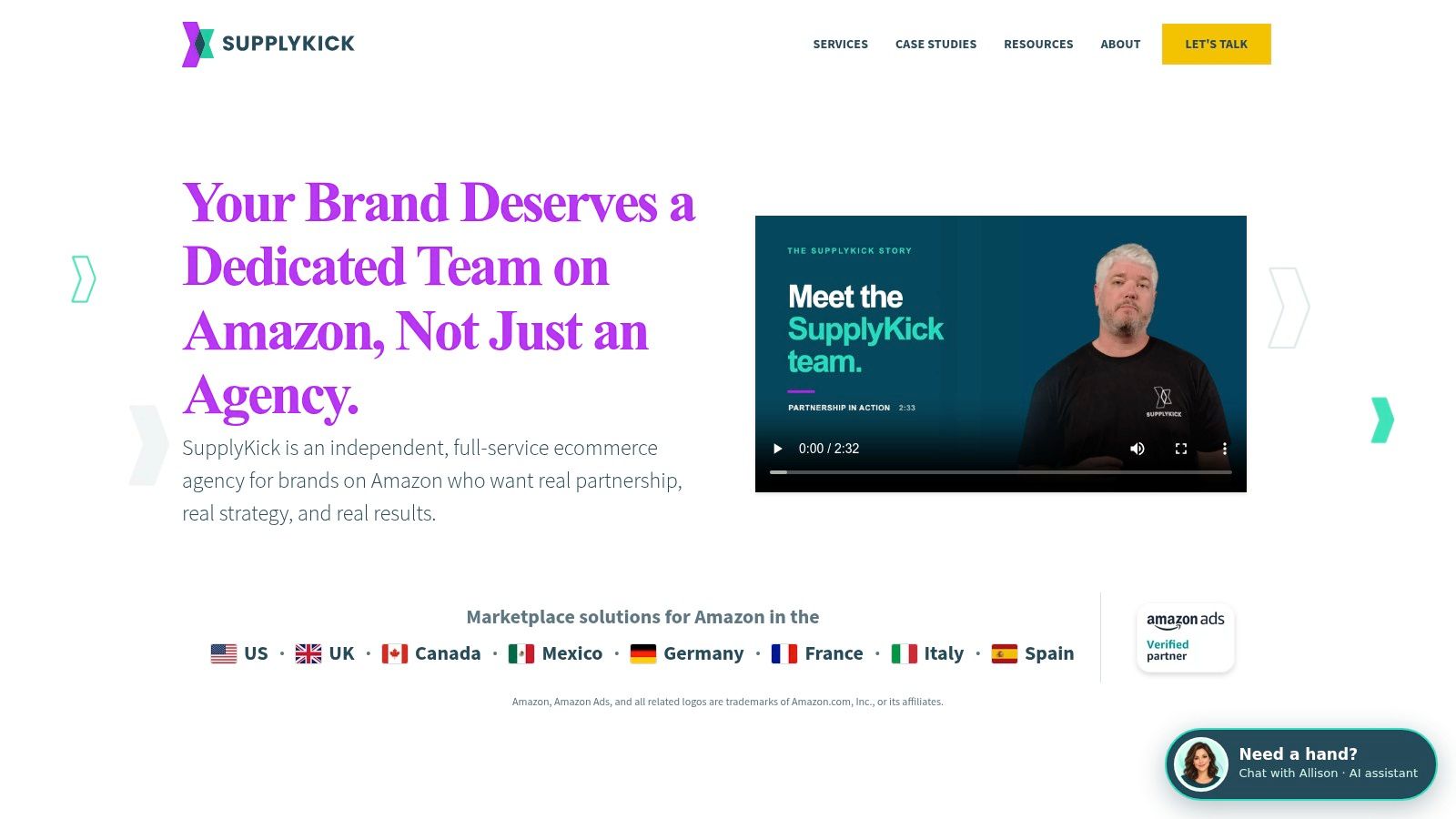
The first SupplyKick question is about the business model, not campaign performance. Managing your brand-owned account and buying inventory to sell through a distribution arrangement create different economics, control rights, and working-capital requirements.
SupplyKick supports Seller Central and Vendor Central, with advertising, creative, reporting, logistics, and customer-service capabilities. Its stated offering also includes help with unauthorized sellers, pricing enforcement, and Brand Registry.
That combination may be useful for a manufacturer considering a Vendor Central-to-Seller Central transition. Seller-operator experience can help with catalog and logistics complexity, but you still need a written explanation of which party owns inventory and controls the customer-facing offer.
Separate account management from distribution
Ask SupplyKick to present the proposed arrangement as a flow of goods, cash, and permissions. Identify who purchases stock, carries storage exposure, sets prices, receives Amazon disbursements, and retains access if the relationship ends.
Its custom pricing is described as not tied to a percentage of advertising spend. That removes one possible incentive conflict, but it doesn't explain the entire fee basis or establish the cheapest total operating model.
- Ownership question: Will the work happen in your Seller Central account or through a separate seller relationship?
- Economics question: What are the management fees, onboarding costs, inventory terms, and exit obligations?
- Protection question: Which unauthorized-seller actions rely on valid IP complaints, and which require distribution or legal remedies?
Amazon's Brand Registry guidance requires an eligible registered trademark or pending application and matching brand information, with the brand name or logo permanently affixed to the product or packaging. Ask how SupplyKick maintains evidence and tracks submissions through Report a Violation and Submission History.
Best fit: Brands comparing wholesale, direct selling, and managed-account options. Poor fit: A brand that wants simple operational assistance but hasn't resolved whether it will retain inventory and account control.
The free audit should clarify that structure before it recommends growth activity.
5. Amify by Cart.com
Amify's strongest use case is an Amazon operation where supply chain, content, and account administration all need attention. A media-only intervention won't fix poor availability or unresolved listing cases.
Amify by Cart.com offers Seller Central setup and management, supply-chain planning, inventory support, loss recovery, listing SEO, Storefronts, A+ Content, PPC, and analytics. It also lists Amazon case management and unauthorized-seller monitoring.
Following its integration into Cart.com, buyers should establish the current contracting entity, delivery team, and escalation route. Don't assume an older testimonial describes the people who would manage your account today.
Put availability ahead of the media forecast
Amazon's Featured Offer guidance explains that an out-of-stock offer can't become the Featured Offer and directs sellers to review total price, including shipping, against relevant competitive prices. That makes Pricing Health, including Pricing Opportunities, a practical account-management checkpoint.
Ask Amify to explain its sequence when an advertised ASIN loses Featured Offer eligibility. A credible response starts with diagnosis: stock status, landed price, fulfillment conditions, and account issues, followed by campaign controls while the problem is investigated.
- Operational advantage: Supply-chain planning and platform administration sit alongside advertising and creative.
- Evidence limitation: Published case studies describe selected outcomes; they don't establish how frequently similar results occur.
- Commercial limitation: Pricing isn't public, and the proposal needs explicit boundaries for recovery work, creative, and escalations.
Request a sample case register showing the affected ASIN, case owner, supporting documents, next action, and internal escalation deadline. Also distinguish unauthorized-seller monitoring from evidence preparation, enforcement submissions, and follow-through.
Best fit: Consumer brands that need coordinated operational and growth work. Poor fit: Teams seeking only campaign optimization, or buyers who need extensive recent independent review evidence before proceeding.
For evaluating assortment progress, our sales rank checker can add context. Sales rank still isn't a substitute for contribution dollars, availability, or cash tied up in inventory.
6. Front Row
Front Row's relevant distinction is its ability to discuss Seller Central, Vendor Central, hybrid operations, and separate distribution options. That matters when your real problem is the account model rather than the advertising structure.
Front Row's Seller Central management offering includes FBA planning, inbound shipment coordination, account monitoring, listing and compliance support, and unauthorized-seller monitoring. It states that brands retain account ownership and visibility while its team executes.
That ownership position is useful. The proposal should still specify primary administrator access, Brand Registry permissions, content files, campaign history, and the handover of unresolved cases.
Challenge the inventory plan
Front Row's inventory and storage-fee support deserves attention if your catalog contains bulky or slow-moving products. Ask the team to show how it reconciles replenishment recommendations with aging stock, demand forecasts, and contribution margin.
For UK accounts, Amazon's FBA storage guidance explains that base storage charges use daily average stored volume and that the storage utilisation surcharge has specific eligibility conditions. Don't let an agency apply a generic storage assumption across marketplaces.
A replenishment recommendation should explain what you expect to sell, what you'll pay to hold the rest, and what happens if demand misses the forecast.
Ask Front Row to distinguish response time from resolution time. Its published routine-issue resolution language shouldn't become a promise that complex Amazon escalations will close on the same schedule.
- Best fit: Brands evaluating direct selling, vendor relationships, hybrid structures, or distribution while needing operational support.
- Poor fit: Amazon-only teams looking for a narrow, uncomplicated service with minimal strategic overhead.
- Fee diligence: Custom pricing should identify how account model, inventory responsibilities, and marketplace scope affect the bill.
- Proof diligence: Request operational examples that isolate availability, storage exposure, or case resolution rather than reporting revenue alone.
For distribution proposals, compare net receipts and control rights with the managed-account option. Those are different commercial arrangements, not interchangeable service packages.
7. Podean
Podean makes the most sense when Amazon is part of a larger international marketplace and retail-media operation. Its scale is more relevant to regional coordination and analytics than to a brand that needs someone to clear a Seller Central backlog.
Podean describes services across marketplace strategy, retail operations, media, content, analytics, logistics, and Amazon Marketing Cloud. It also presents global coverage, proprietary analytics tools, and Advanced Amazon Partner status as part of its offering.
Treat those credentials as a starting point for diligence. They don't establish the seniority of your assigned operators, the integration of acquired teams, or the contribution margin your account could generate.
Demand a financial bridge from analytics to action
Amazon's Brand Analytics guidance states that reporting data is generally available within 72 hours after the reporting period closes. Ask Podean which decisions use recurring analytical reports and which rely on separate operational alerts.
Amazon Marketing Cloud analysis can support more advanced measurement questions, but the agency still needs to connect media findings to commercial decisions. Ask what would make its team reduce spend, change an assortment priority, or delay a launch.
- Analytics question: How does the team distinguish attributed sales from incremental demand, and document attribution limitations?
- Operating question: Who owns catalog, inventory, and account-health execution in each market?
- Integration question: Which legal entities and service teams deliver the contract, and who resolves cross-team disagreements?
- Ownership question: What reporting access, query outputs, campaign data, and working files remain available when the engagement ends?
Best fit: Larger brands coordinating several regions, marketplaces, and retail-media programs. Poor fit: A smaller Amazon-only business seeking direct founder involvement and a tightly scoped operating team.
Pricing is proposal-based. Require a breakdown by geography, media, operations, technology, and creative so you can identify overlap with your internal resources. The strongest proposal won't offer more analysis; it will identify the decisions that analysis changes and the operator accountable for implementing them.
How the Seven Amazon Account Management Agencies Compare on Model, Scope, and Diligence Points
| Item | Pricing Model | Best For | Standout Service | Key Diligence Point |
|---|---|---|---|---|
| Online Brand Growth | Contribution-margin-based; pricing not published | Established brands prioritizing profitable Amazon growth | Founder-led, integrated Amazon management with daily Slack and weekly calls | Confirm fit and fees; selective, does not work with resellers |
| Marketplace Valet | Custom pricing; not public | Established consumer brands seeking hands-on Amazon operations | Contribution-margin-focused reporting and decision-making | Request account-specific examples, references, and engagement terms |
| Canopy Management | Custom pricing; not public | Brands needing broad Amazon support or expansion to Walmart and Chewy | Advertising, creative, operations, and revenue recovery | Confirm workstream owners; published results are not guarantees |
| SupplyKick | Custom pricing; not public; agency says fees are not tied to ad spend | Brands using Seller Central or Vendor Central, including complex logistics needs | Support for unauthorized sellers, pricing enforcement, and Brand Registry | Clarify account ownership, inventory control, fees, and contract terms |
| Amify by Cart.com | Custom pricing; not public | Consumer brands seeking operational, creative, and advertising support | Supply-chain planning combined with account-health and seller monitoring | Confirm current team and escalation path following the Cart.com acquisition |
| Front Row | Custom pricing; audit and discovery required | Brands managing Seller Central, Vendor Central, or hybrid models | FBA operations and brand-protection monitoring | Confirm scope, pricing, and expected timelines for complex escalations |
| Podean | Custom, proposal-based pricing | Larger brands expanding across regions and marketplaces | Global marketplace operations, media, and analytics | Clarify account ownership and service-team integration after acquisitions |
Run the Seven-Point Check Before Any Agency Signs
A useful shortlist becomes a repeatable operating review, not a contest between presentations. Score each agency against the same requirements, using documented, incomplete, or unproven rather than assigning false precision to a polished sales call.
Start with your own account economics. Reconcile net sales with product costs, referral fees, fulfillment, storage, inbound costs, advertising, discounts, and returns, then show contribution both before and after the proposed agency fee.
The seven checks
- Account ownership: Keep primary Seller Central administration, Brand Registry control, and access to financial reports. Specify agency permissions and the process for removing them.
- Fee basis: Define the calculation, included costs, minimums, extras, and treatment of refunds or later adjustments. Model how fees change if sales rise but margin falls.
- Named operators: Record the day-to-day lead, supporting specialists, backup coverage, and subcontracting arrangements. Meet the delivery team, not only the salesperson.
- Operational scope: Assign responsibility for suppressed listings, stranded inventory, reimbursements, pricing eligibility, compliance notices, and advertising access failures.
- Verifiable proof: Request relevant, redacted financial evidence showing the starting condition, actions, timeframe, inventory investment, and resulting contribution.
- Escalation timelines: Agree on acknowledgement targets, communication frequency, incident ownership, and escalation steps. Don't confuse a response commitment with guaranteed Amazon resolution.
- Written audit and handover: Require prioritized findings, dependencies, approval rules, and an exit package covering files, reports, access, and open cases.
Before comparing proposals, use the profit calculator linked above and our FBA storage fee calculator to establish your current baseline. The storage calculator models monthly costs by product dimensions; validate marketplace-specific charges and exposure inside Seller Central before committing to replenishment.
Ask each agency to explain the same account scenario: a profitable ASIN is losing availability while a heavily advertised ASIN is generating sales below its contribution target. The answer should identify what changes first, who approves it, and how the team measures the outcome.
Proof standard: A case study is relevant when you can understand the starting economics, the intervention, and the profit calculation. A large revenue total alone doesn't meet that standard.
General advice on how to hire a search marketing agency can help structure commercial discussions, but Amazon adds inventory, account permissions, fulfillment economics, and enforcement risk. Keep those responsibilities in the agreement rather than assuming full service includes them.
The best operating partner is the one whose people, incentives, and evidence match the work your channel needs. Judge the written plan against your financial baseline, not against another brand's headline result.
Online Brand Growth brings advertising, listings, FBA operations, account health, and brand protection together under contribution-margin-aligned full account management. Book a free strategy call to discuss your account and a complimentary audit focused on profitable growth.