
Amazon does not charge a fee for Brand Registry reporting or Counterfeit Crimes Unit collaboration, so amazon unauthorized seller removal cost is usually test buys, evidence, legal review, and labor. In a simple case, that can stay in the few-hundred-dollar range, while a contested neutral evaluation dispute can tie up roughly $5,000 or more before you've even counted counsel.
That's the part most brand teams miss when they spot a stranger on their ASIN and assume the budget is the complaint fee. The first real invoice usually shows up in your own operations, not in Amazon's checkout flow, and the week you discover the problem often determines whether you spend money once or keep spending it every time the seller comes back.
The Week You Spot a Stranger Selling Your Product
The first sign is usually not a dramatic inbox alert. It's a Buy Box swing, a price drop you didn't authorize, or an angry distributor asking why someone else is undercutting the channel on your ASIN. By Friday, someone on your team has probably already checked Seller Central, pulled up the offer page, and started searching for a path that looks like it will make the problem disappear fast.
That's when the budget gets distorted. A brand owner sees an unauthorized seller and thinks in terms of “removal,” but the actual decision is whether the offer is counterfeit, genuine but diverted, or merely a policy issue that Amazon won't treat as an IP violation. If you need a wider operational lens on identity abuse and impersonation risks alongside marketplace enforcement, detect fake accounts and scam websites is a useful reference point.
The first 72 hours decide the spend
Most of the money goes into triage, not takedown. Someone needs to capture the ASIN, seller store name, screenshots, packaging, order IDs if you test buy, and the exact complaint category before the seller changes tactics or vanishes. If you skip that discipline, you end up paying for rework, and rework is what turns a cheap takedown into a recurring line item.
The seller's behavior also tells you which Amazon page matters next. A policy issue belongs in Performance, then Account Health, then Report abuse, while trademark, copyright, and patent matters belong in Report Infringement. Brand Registry is where you manage the brand-side tooling, but it doesn't solve the underlying evidence problem by itself.
Practical rule: if you can't explain the violation in one sentence and attach the proof to the ASIN, don't file yet.
That's why the dollar number most sellers guess is wrong by an order of magnitude. They price the complaint, when they should be pricing the case file, the test buy, and the chance the seller comes back under a new offer. The smarter question is not how much it costs to remove a seller once, but how much it costs per durable outcome.
What Amazon Charges and What It Does Not
A seller starts paying as soon as the case stops being paperwork and becomes proof. Amazon does not charge a platform fee for Brand Registry, Report a Violation submissions are free, and Counterfeit Crimes Unit coordination is also free at the platform level. Amazon also notes that test buys, legal fees, and litigation can sit on the brand side, and the same cost structure applies to Project Zero, which gives eligible brands self-service counterfeit removal without a program fee.
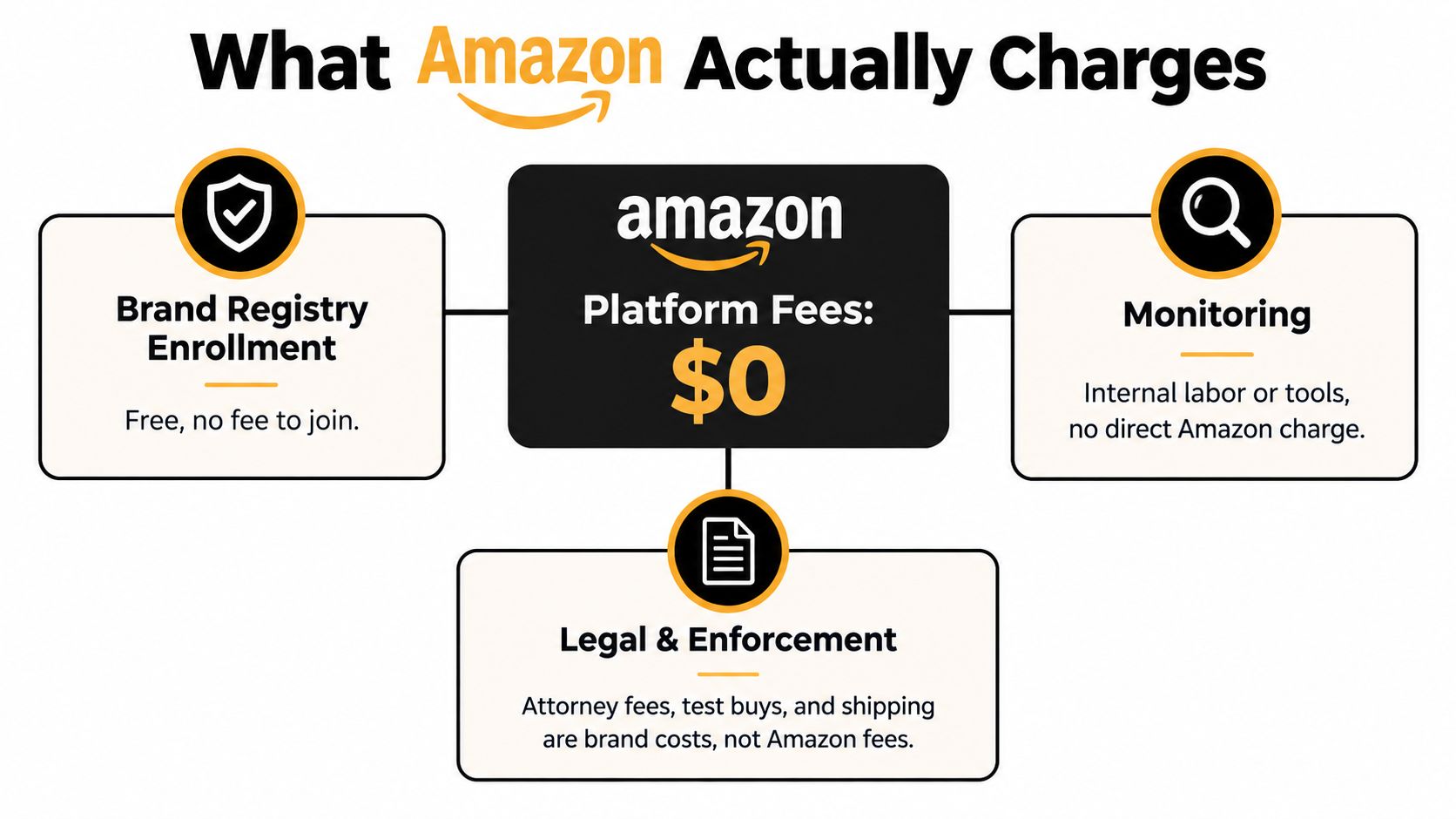
Free platform action, paid operational work
Amazon can give you a free reporting path and still leave you with a real bill. The work often sits in your own team's time, product purchases, shipping, and documentation, especially when the seller's goods are genuine and you need evidence of a qualifying violation rather than a simple claim of “not authorized.” Amazon's seller guidance also makes one limit clear, it generally will not enforce private distribution contracts, reseller agreements, or MAP terms through the ordinary IP complaint process.
That is the line that changes the budget. A counterfeit claim, trademark misuse claim, or materially inaccurate listing issue can move. A genuine reseller with a channel conflict often cannot, even when the commercial damage is real.
For seven-figure brands, the expensive mistake is treating every removal as a platform problem. A contract issue usually needs contract pressure. An IP issue can use Amazon's tools, but only if the evidence matches the violation type.
Where the free routes end
Use Amazon's free channels for clear, documentable violations. If the evidence is thin, the category is wrong, or the problem is a distribution leak, the spend does not disappear, it just shows up as rework, escalations, and lost time.
For budgeting, the core line is not “Amazon fee plus case fee.” It is internal labor, evidence collection, and the cost of proving a durable outcome. For a broader explanation of how Brand Registry changes enforcement, see Amazon Brand Registry benefits. The platform fee may be zero, but the work usually is not.
Bottom line: Amazon can remove the listing without charging you a filing fee, but it will not pay for your proof.
The Four Routes to Remove an Unauthorized Seller
A stranger on your ASIN can drain margin in different ways, and the removal route you choose determines whether you pay for speed, proof, or follow-on control. A trademark misuse case, a counterfeit claim, a policy complaint, and a contract dispute do not belong in the same queue. Senior operators see the same mistake over and over, a team spends money on the wrong path because the seller looks “unauthorized” and nothing else.
| Route | Typical cost range | Evidence burden | Decision timeline | Best for |
|---|---|---|---|---|
| Brand Registry complaint | Internal labor, sometimes a few hundred dollars | Moderate to high, depending on violation | Fast when the evidence is clean | Trademark misuse, counterfeit, listing abuse |
| Seller Central complaint | Usually no Amazon fee, plus internal labor | Moderate | Variable | Policy issues, abuse, listing accuracy problems |
| Cease-and-desist letter | Legal drafting cost, often outside counsel time | High | Depends on response | Distributor leakage and contract pressure |
| Third-party brand protection program | Ongoing service cost | High, but outsourced | Continuous | Repeated enforcement, monitoring, MAP support |
| Transparency | Per-unit program cost | Upfront setup, low per incident later | Preventive, not reactive | Counterfeit-prone catalogs |
What the numbers mean in practice
The patent path is the cleanest example of how expensive a dispute can become. Amazon's Patent Evaluation Express requires both parties to deposit $5,000 with a neutral evaluator, so the case can temporarily tie up $10,000 in combined cash before counsel, testing, or sales loss enter the picture. Amazon says those matters are typically decided in about 30 days, compared with roughly two years to reach trial in a typical U.S. patent lawsuit.
That is a very different spend profile from a basic Brand Registry takedown. If the listing issue is real and your evidence is tight, the cost may stay close to labor and complaint prep. If the evidence is weak, the cost moves into rework, rejected cases, and time spent chasing a result Amazon will not give you.
For brands that want the enforcement layer to do more than react case by case, Amazon Brand Registry benefits is the right starting point. Map each route against the evidence you can attach to the ASIN.
A formal notice can still matter when Amazon is not the only pressure point. For structure on that side of the process, Florida harassment letter template advice is useful, even though an Amazon dispute usually needs tighter product and listing evidence than a generic demand letter.
What to use when
- Brand Registry complaint: Use it when you have a trademark, counterfeit, or materially false listing issue that you can prove.
- Seller Central policy report: Use it when the problem is abusive variations, duplicate ASINs, inaccurate content, condition misrepresentation, or prohibited products.
- Cease-and-desist letter: Use it when the seller sits upstream in your channel and counsel pressure may change behavior faster than platform reports.
- Third-party enforcement: Use it when the issue keeps returning and your internal team cannot watch every listing every week.
- Transparency: Use it when the catalog is counterfeiting-prone and serialization economics make sense.
The practical question is not which route sounds strongest. It is which route gives you a durable outcome at the lowest total cost for that specific violation.
Line-Item Budget for a Real Removal Case
A removal case gets expensive when each step is treated as a one-off instead of a repeatable process. The cheapest cases are the ones where your team already has the ASIN history, seller screenshots, test-buy template, and complaint language ready before the listing turns into a mess.
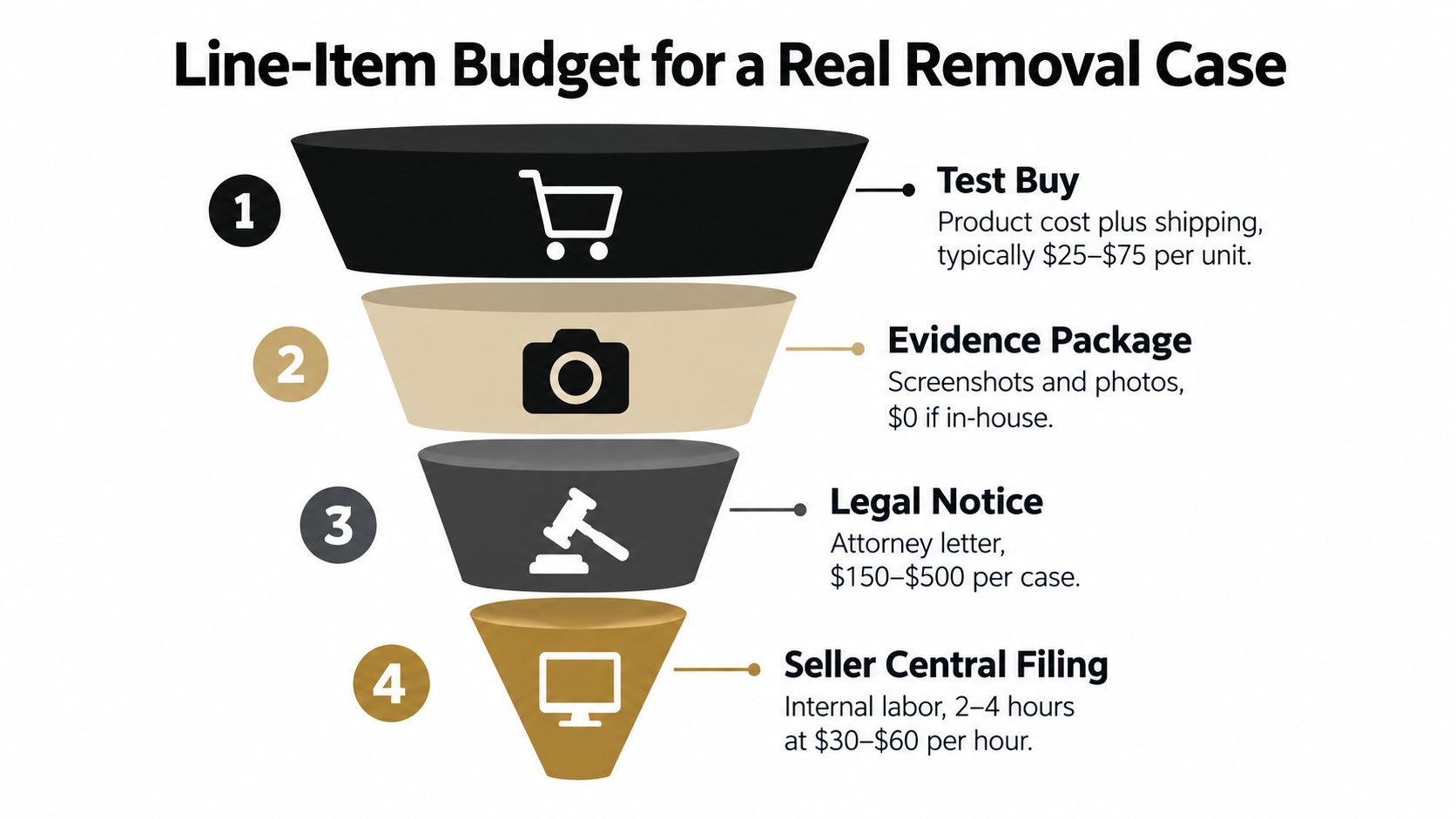
The parts of the bill
A clean case often starts with the test buy. Product cost plus shipping is usually the first real cash outlay, and then someone on your team has to preserve the packaging, photograph the unit, link the order ID to the ASIN, and confirm what exactly is wrong. If you use outside counsel, the cost rises again, because the legal review is no longer just about whether the seller is annoying, it's about whether you have a violation Amazon will act on.
The bookkeeping matters too. If you don't separate purchase cost, shipping, labor, and counsel, you can't tell whether enforcement is worth repeating. That's why finance teams need a case-level view, not just a monthly “brand protection” line.
For a practical accounting lens on that kind of tracking, Book Tech LLC Amazon bookkeeping guide is useful because the same discipline that keeps P&L clean also keeps enforcement spend visible.
A simple budget shape
Use a case sheet with these lines:
- Test buy cost: product plus shipping.
- Evidence package: screenshots, photos, order record, and packaging review.
- Internal labor: monitoring, intake, classification, filing.
- Outside review: counsel or specialist review if the claim is borderline.
- Escalation reserve: possible neutral evaluation or follow-on dispute cost.
If the complaint is straightforward, the case can stay modest. If you drift into a patent dispute or a hard-to-prove authenticity issue, the expense can escalate quickly, and the neutral evaluation deposit alone can become the biggest single line item.
Practical rule: if the removal won't protect margin for long enough to recover the test buy, the labor, and the review time, don't treat it as a win.
For teams building a spreadsheet, the simplest structure is cost to detect, cost to prove, cost to file, and cost to defend. If you need help estimating whether the recovered margin is worth it, Amazon test buy for unauthorized sellers is the right operational companion to the budget model.
When Removal Does Not Protect Revenue
A takedown can feel decisive, but it does not automatically restore revenue. The seller can return, another reseller can take the spot, or the Buy Box can stay unstable after the original listing disappears. If you judge the case only by removal count, you can spend money on activity that does not improve contribution margin.

Measure outcome, not just closure
The better metric is cost per durable outcome, not cost per removal. Track whether the Buy Box returns to an authorized seller, whether the same seller ID comes back, whether conversion improves, and whether incremental contribution margin improves after enforcement. A case that closes quickly but leaves the channel just as leaky as before is not a good use of money.
Amazon's own 2025 enforcement report says its controls proactively blocked more than 99% of suspected infringing listings before brand-owner reports, and that it helped seize and dispose of more than 15 million counterfeit products worldwide. The message is clear, prevention does a lot of the heavy lifting. It also shows why every unauthorized reseller is not equally removable, and why a takedown does not always restore revenue on its own.
Why sellers come back
Unauthorized sellers often return because the root cause sits upstream. Loose distribution, compressed pricing, and arbitrage-friendly inventory create the conditions for repeat listings. Removal fixes the symptom, not the supply path.
Watch recurrence, not just the first takedown. Recurrence tells you whether the spend paid off, because a one-time win means little if the same offer reappears next week.
Removal without channel control is usually a temporary expense, not a revenue fix.
The strongest enforcement teams ask a harder question than “Can Amazon remove this?” They ask “What changes if this seller disappears for a month?” If the answer is nothing durable, the budget belongs upstream, not in another filing.
In-House Playbook to Keep Per-Case Cost Low
The cheapest enforcement teams work from a repeatable process, not improvisation. A small brand team can keep costs down if it monitors the same ASINs on a fixed cadence, uses the same evidence template every time, and files in the right Amazon category the first time.
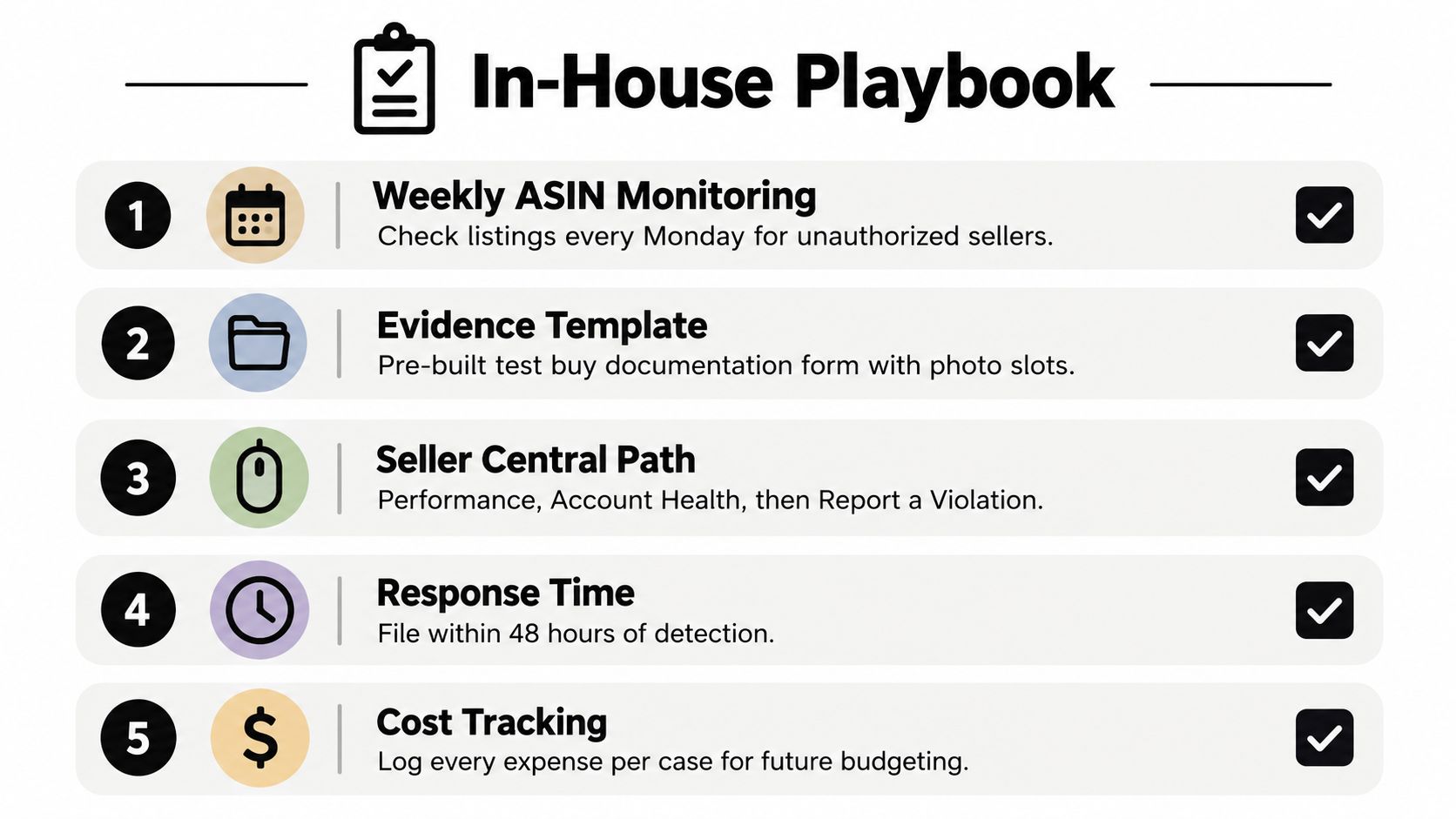
The workflow that saves money
Start in Seller Central under Performance, then Account Health, then Report abuse for policy problems. Use Report Infringement for trademark, copyright, and patent issues. Amazon's own help text separates those routes, and that distinction matters because filing under the wrong form creates rework, slows action, and adds hidden labor.
Then build a simple weekly routine. Check the same ASINs, capture the seller name, record the listing condition, and store screenshots before anything changes. If the case needs a test buy, use a standard intake form so product condition, packaging, seller identity, and order ID all land in one place.
For broader monitoring discipline, Amazon reseller monitoring is the operational side of the same problem, because the cheapest case is the one you catch early.
The intake checklist
Before any complaint goes out, capture:
- ASIN and offer URL: so the complaint is tied to the exact listing.
- Seller store or business name: so you can identify recurrence later.
- Violation type: trademark, counterfeit, listing accuracy, abuse, or policy issue.
- Order ID or test-buy record: when authenticity or condition matters.
- Photos and packaging: especially for counterfeit or material-difference claims.
- Marketplace and date: so your record survives if the offer changes.
Once you've done that, assign the case a value score. If the expected recovered margin is low, the seller is probably not worth the escalation cost. If the seller is repeatedly taking the Buy Box and the evidence is strong, move quickly and keep the file clean.
If you're evaluating prevention economics alongside removal economics, use OBG's free Amazon profit calculator at /calculator and the FBA storage fee calculator at /tools/storage-fee-calculator before you commit to serialization or recurring enforcement. The point is to see the unit economics before you start paying per case.
Prevention Investment vs Enforcement Spend and the CTA
The smartest budget is usually split between prevention and enforcement, not put entirely into either one. Amazon Transparency has no enrollment, subscription, or minimum-volume fee, and its per-code pricing is $0.05 for 1 to 1,000,000 codes, $0.03 for 1,000,001 to 10,000,000, and $0.01 above 10,000,001, with tiers resetting each account anniversary. That makes it a real prevention expense, not a mystery charge.
Where prevention wins
Transparency fits when counterfeits are the recurring pain point and the unit economics still make sense after you model packaging, labeling, and inventory flow. Project Zero fits when you need faster self-service counterfeit removal and you're eligible for it, but it still doesn't solve every unauthorized reseller or MAP issue. For broader unauthorized seller and MAP enforcement, a structured program such as Online Brand Growth's 360 Brand Protection can sit alongside in-house monitoring and seller support case work.
Where enforcement still matters
Keep paying for enforcement when the seller threatens margin, Buy Box stability, or customer trust and the evidence is clean enough to justify action. Stop paying when the case is really a channel design problem, a distribution leak, or a recurring gray-market issue that removal alone won't fix. That's the difference between spending for control and spending for motion.
The best Amazon operators compare three numbers before they act, prevention unit cost, enforcement case cost, and recovered margin after the seller is gone. If prevention wins, serialize. If enforcement wins, file cleanly. If neither wins, fix the channel.
If you want help building that decision model for your catalog, book a free strategy call and we'll map the cheapest path to durable seller control. You can also sanity-check your economics first with the free tools at /calculator, /tools/storage-fee-calculator, and /amazon-sales-rank-checker.
Online Brand Growth helps brands build a tighter Amazon protection plan around unauthorized seller removal, MAP enforcement, and channel control. If you want a practical read on what's worth enforcing and what's just burning budget, book a free strategy call and we'll walk through your listings, evidence, and next move.