
The pattern is familiar. A seller you've never authorized keeps winning the Buy Box on your ASIN, the price sits below your approved channel, and the offer remains active after every obvious attempt to clean it up. You order the product expecting a counterfeit, but the unit arrives genuine. Now the test buy has proved something, just not the thing you first wanted it to prove.
An Amazon test buy for unauthorized sellers works when you treat it as a controlled evidence process. It can identify what was sold, how it was represented, and whether the physical unit matches an authenticated product. It can't, by itself, prove that a seller violated a private distribution agreement or MAP policy.
Why a Test Buy Is an Evidence System, Not a Magic Button
You place a test order from a seller you have been chasing for months. The unit arrives genuine. That does not make the buy useless. It tells you the purchase answered the wrong question.
A test buy is a sampling and evidence system. Its job is to capture what a specific offer looked like at the time of sale, what arrived, and whether the gap between those two facts gives you something Amazon will act on. Used properly, it can document authenticity, condition, packaging integrity, and listing accuracy. It can show that a “new” item arrived opened, that a bundle was missing a stated component, that packaging was materially altered, or that the unit carries lot or serial characteristics that do not match your documented control.
That last point matters because unauthorized status by itself is usually not enough inside Amazon's enforcement flow. Amazon's Project Zero guidance draws the line clearly. A genuine product acquired outside your approved network is not automatically counterfeit. If your only conclusion is “this seller is not on our approved list,” you may have a channel problem, not a counterfeit claim Amazon can validate from the product alone.
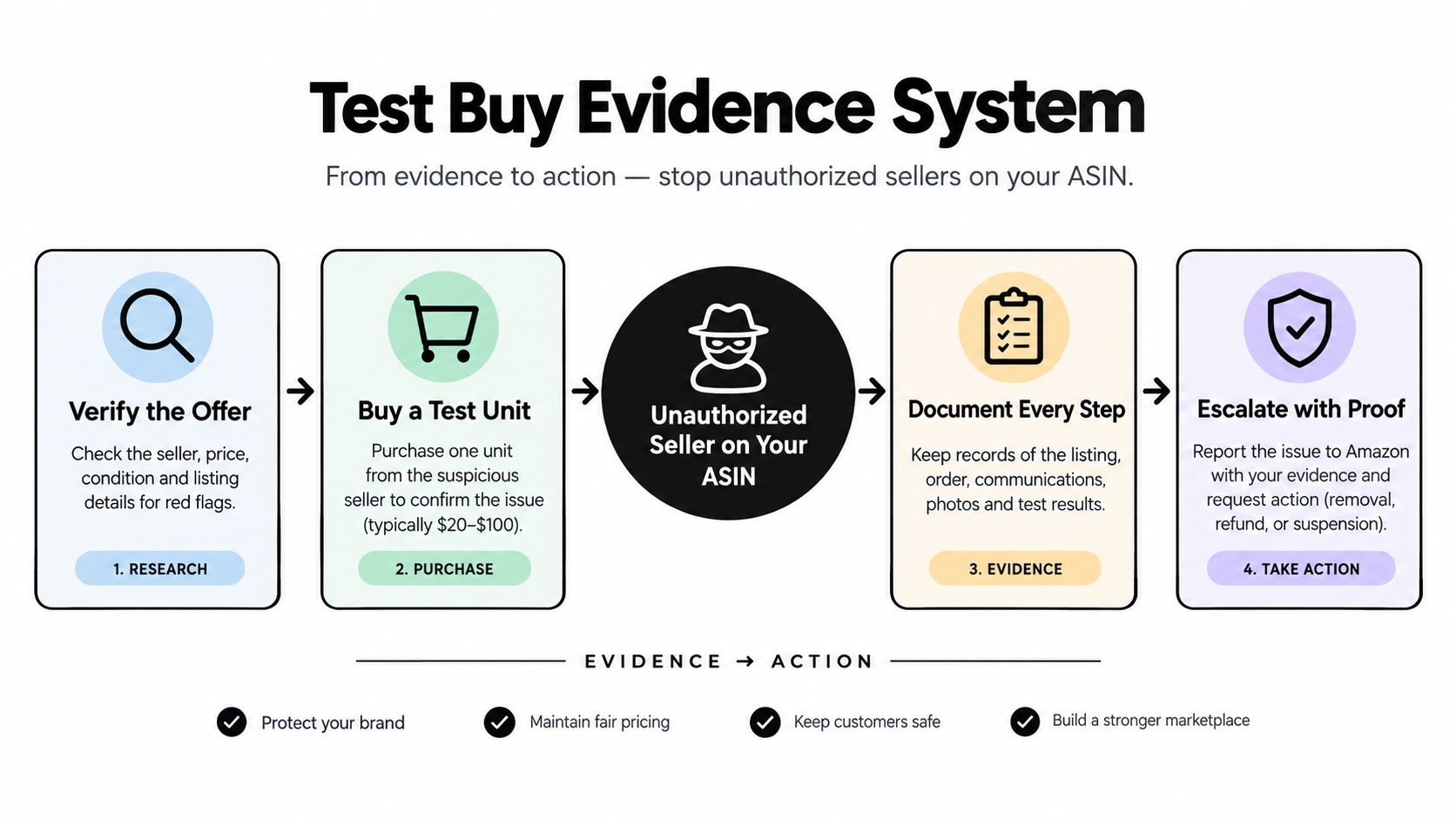
The three jobs of the purchase
A useful test buy does three jobs, and each one feeds a different page or report path in Seller Central.
- Select the correct offer. The order has to attach to the exact seller, ASIN, condition, and price you are investigating. If that mapping is wrong, everything after it gets weaker.
- Preserve the transaction. Keep the offer capture, Order ID, delivery record, shipping materials, retail packaging, and physical unit together. Screenshots alone rarely carry the case.
- Route the finding correctly. Counterfeit indicators may support Project Zero or an anti-counterfeiting report. A detail-page mismatch or rights issue belongs in the relevant infringement workflow. A genuine diverted unit usually pushes you back to distributor controls, account monitoring, and contractual enforcement.
Scale cuts both ways. Amazon reported blocking more than 10 billion suspected bad listings before publication and detecting and seizing more than 2 million counterfeit products sent to fulfillment centers before shipment to customers, according to Amazon's brand protection report. Those numbers show the platform has enforcement machinery. They do not mean your order, by itself, will remove a seller.
Use the buy to answer a question Amazon can evaluate from evidence. “Is this seller unauthorized?” is too loose. “Is this unit counterfeit, materially different, used-sold-as-new, or inconsistent with the listing?” gives you somewhere to send the file.
Building the Target List Before You Buy Anything
Don't start with the cheapest seller you see. Start with a complete offer map for the ASIN, then choose purchases that answer the highest-risk questions.
Use the Brand Registry customer-side view to inspect the live offer set, then crawl each relevant seller storefront manually. Record seller name, storefront URL, price, condition, shipping origin when visible, fulfillment method, and whether the seller is currently holding the Buy Box. A low price is a signal, not proof. Repeated Buy Box wins, inconsistent condition claims, concentrated shipping origins, weak storefront information, and prior customer complaints give you a more useful shortlist.
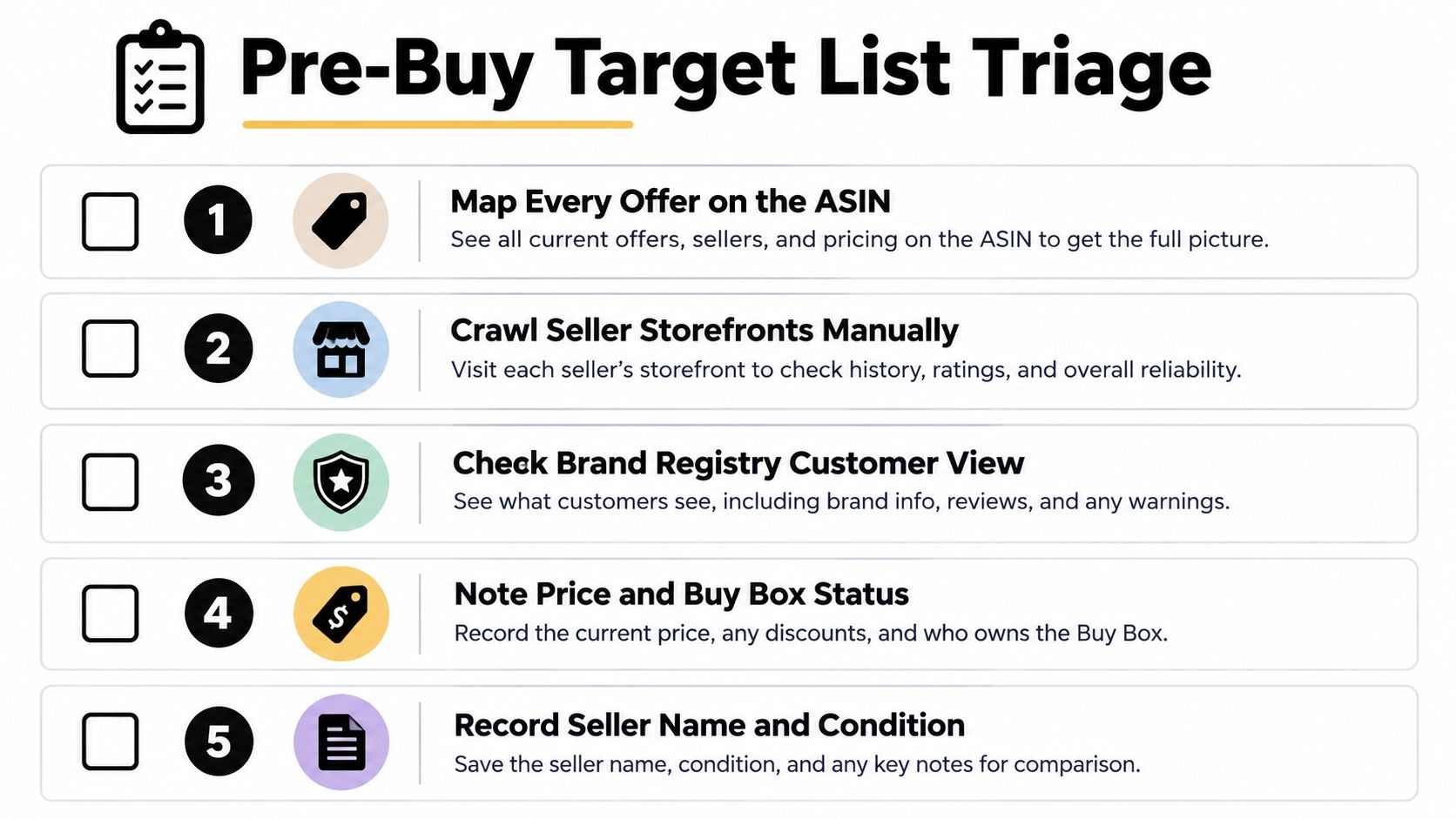
Build the seller-ASIN matrix
Your matrix should be operational, not decorative. Use one row per seller and ASIN combination, even when several sellers share the same detail page.
| Field | What to record |
|---|---|
| ASIN | Exact product detail page |
| Seller | Display name and seller ID |
| Offer | Price, condition, fulfillment, Buy Box status |
| First seen | Date the offer entered monitoring |
| Risk signals | Price pattern, complaints, geography, storefront findings |
| Decision | Buy now, monitor, or exclude |
| Result | Added after the purchase |
The Detail Page Sales report and Brand Analytics Search Query Performance report can add context around demand, offer visibility, and customer discovery. They won't prove where inventory came from, but they can help you distinguish a persistent competitive offer from a short-lived listing. Amazon reported stopping more than 6 million attempted fraudulent selling-account registrations in 2021, while 6% of attempted registrations in the earlier reporting period passed verification and listed products for sale. Amazon's seller-screening report shows why account verification is a filter, not a substitute for offer-level investigation.
Keep the buyer separate
Use an anonymous shopping account, a dedicated company card or prepaid card, and a clean email address. Don't save an address, payment method, or contact detail that identifies the brand unnecessarily. Maintain separate test-buy accounts for each marketplace, and follow applicable legal and marketplace requirements in your jurisdiction.
The Buy Box can change between product-page review and checkout. Capture the ASIN, seller name, price, condition, seller storefront URL, exact offer URL, and Buy Box status immediately before payment, with a timestamp. For broader online investigation methods that complement storefront review, this practical OSINT guide is a useful reference.
Executing the Purchase and Unboxing Protocol
The purchase itself should feel boring. Boring is good. Every action should create a record another operator can follow without relying on your memory.
Before checkout, save the product-page screenshots and the exact offer details. Include the ASIN, seller name, seller ID if available, storefront URL, offer URL, price, condition claim, Buy Box status, shipping promise, and timestamp. Capture the order confirmation immediately after payment, then save the Order ID, delivery address used, payment confirmation, and any seller or Amazon correspondence.
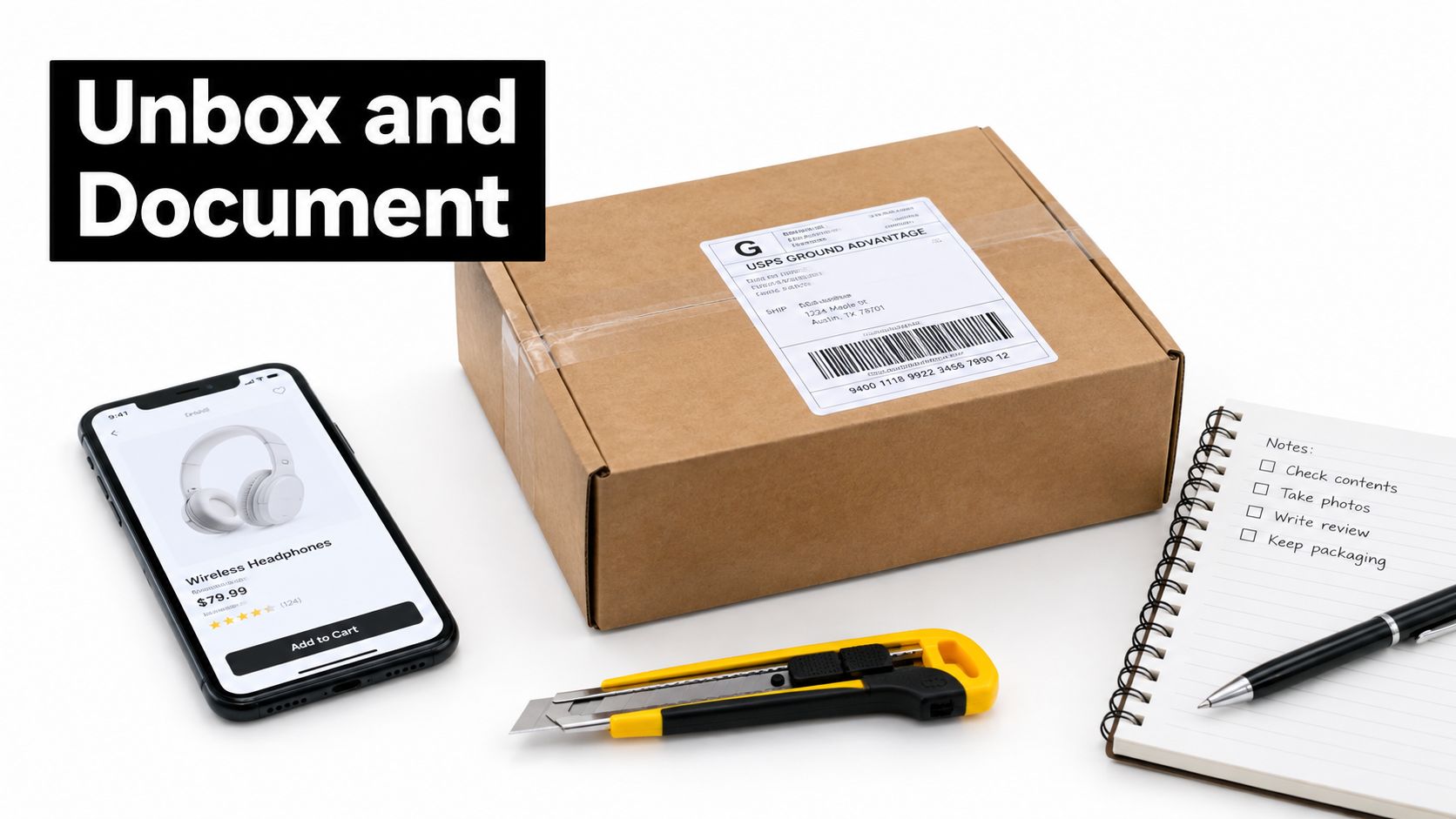
Photograph before opening
When the shipment arrives, don't cut the tape first. Photograph the unopened outer carton from every relevant side, including the carrier label, tracking number, return address, shipping marks, seals, damage, and any fulfillment label. Preserve packing slips, invoices, inserts, and promotional material as separate evidence.
Amazon's Project Zero guidance specifically recommends a test buy to confirm a suspected counterfeit before removing the offer or listing, treating the purchase as an evidence-gathering step before any takedown action. The practical guidance on identifying unauthorized sellers reflects the same operational principle.
Open the package under neutral light on a clean surface. Photograph each layer before moving it, then record:
- Product identity: model, SKU, barcode, serial number, lot or batch code.
- Packaging: artwork, fonts, colors, seals, language, labels, and security marks.
- Contents: accessories, manuals, warranty documents, inserts, and advertised components.
- Condition: factory sealed, opened, used, damaged, refurbished, expired, or otherwise inconsistent with the offer.
- Fulfillment details: return address, packing materials, carrier path, and any invoice information.
Maintain chain of custody
Use high-resolution photos and a written log with timestamps. Assign one person to handle the unit after opening, or record every transfer in a chain-of-custody form signed by the handler. Keep the product and original packaging in a labeled evidence container, separate from ordinary inventory.
Don't use the item, test it in a way that changes its condition, discard packaging, or allow unrecorded handling. If the return address differs from the storefront identity, accessories are missing, or inserts appear in an unexpected language, document those observations as facts. They may be relevant red flags, but they aren't automatically proof of counterfeiting. Guidance on evidence preservation for MSPs offers useful general principles for protecting digital and physical records.
Comparing the Test Unit Against a Documented Control
The work starts once the package is open and you put the test unit beside a known-good unit. I have seen brands win with ordinary photos and a clean comparison log, and lose with dramatic claims because they never proved what was different. The comparison stage is where you separate counterfeit, condition issue, listing mismatch, and gray-market diversion.
Use a control that you can defend. Pull it from your own warehouse, approved distributor stock, or retained production samples. A sealed control is cleaner because it preserves original packaging and inserts, but an opened unit is still usable if its provenance is documented. Log the control source, receipt date, lot or serial details, and who handled it before comparison.
Compare attributes, not impressions
Run the check attribute by attribute. Review packaging artwork, typography, color, dimensions, weight, barcode structure, security features, scent, texture, serial format, lot-code placement, expiration data, and every item in the box. If product testing can be done safely without changing the item, document performance differences too.
Pay close attention to codes. Match the control's lot-code format character by character. A shifted digit position, different separator, inconsistent ink spread, or font substitution in the lot stamp usually carries more weight than a seller's price point or storefront name.
Some differences are noise. Regional packaging revisions, print-run changes, or supplier substitutions can create cosmetic variation. Missing safety labels, altered serials, swapped components, changed formula, or a unit sold as new that arrives used belong in a different category because they support a clearer policy or authenticity claim.
Use a simple rubric:
| Finding Type | What It Proves | Typical Evidence | Best Amazon Report Path |
|---|---|---|---|
| Counterfeit or materially altered | The physical unit is fake, illicitly changed, or materially misrepresented | Side-by-side photos, code discrepancies, packaging differences, qualified authenticity declaration | Brand Registry Report a Violation, Anti-Counterfeiting complaint, or Project Zero if eligible |
| Genuine but diverted | The unit appears authentic but may have moved outside the approved channel | Valid product comparison, lot trace, distributor records, territory or invoice evidence | Channel, distributor, and contractual follow-up |
| Genuine unauthorized resale | The seller lacks brand approval, but the unit itself appears genuine | Authenticity confirmation and seller-offer record | Seller communication, supply-chain action, or MAP process, not automatically a counterfeit report |
Write one line for each attribute and classify it as same, cosmetic difference, or substantive difference. Then note whether it supports authenticity, condition, or listing-accuracy issues. That discipline matters because the report path depends on the classification, not on how frustrated you are with the seller.
Routing the Evidence to the Right Amazon Program
The report path should follow the finding. Sending a genuine diverted product through a counterfeit route weakens the complaint and creates avoidable account risk.
Brand Registry Report a Violation
Use Report a Violation in Brand Registry for supported intellectual-property and listing issues, including trademark, copyright, and other eligible policy violations. Attach the ASIN, seller identity, Order ID, storefront URL, screenshots, product photographs, and a concise comparison statement.
For copyright complaints involving an offer, Amazon's Report Infringement guidance states that a test buy is required to confirm that the product or packaging uses the brand owner's copyrighted work. The rights owner must obtain the physical item, document the relevant artwork, and connect it to the order associated with the offer. A useful primer on the distinction between protected rights and ordinary resale is this IP infringement guide.
Project Zero self-removal
Project Zero is not a general unauthorized-seller button. It requires an active Brand Registry account where the applicant is the rights owner of a registered trademark, and Amazon recommends confirming the suspected counterfeit through a test buy.
For an eligible confirmed counterfeit, open Brand Registry, select Protect, then Project Zero. Remove the individual offer or the entire product listing as appropriate. Amazon records the action under Monitor, then Submission history, and sends a notice of complaint to sellers associated with the removal.
Anti-Counterfeiting complaints
Amazon's Anti-Counterfeiting policy indicates that suspected counterfeit complaints can be viewed on the Account Health page in Seller Central. Use this route when the physical findings support a counterfeit allegation, and include the seller name, seller ID, ASIN, Order ID, photographs, control comparison, and a clear explanation of the product-level discrepancy.
Don't submit only screenshots. Don't argue that a discount proves a fake. Amazon may investigate and take action to protect customers, sellers, and rights holders, but the complaint must connect the transaction to the policy violation.
Genuine unauthorized resale
Amazon treats seller authorization and distribution-policy disputes as matters between the brand and seller. That means invoices, distributor records, territory restrictions, marketplace clauses, MAP language, and supply-chain traceability do the work here. The test buy can show that the unit is genuine, diverted, or materially different, but it can't prove a contractual breach by itself.
The same case file may support different actions over time. Keep the Order ID, storefront URL, physical evidence, and comparison notes together, then identify the exact violation in each submission. For related enforcement context, see this guide to Amazon brand abuse takedown.
Layering Prevention on Top of Test Buys
Test buys are the detective layer. They tell you whether the controls above and below them are working, but they shouldn't carry the entire program.
Amazon Transparency provides a preventive layer for eligible products. Enrolled units receive a unique Transparency code, selling partners must provide valid codes when creating listings, and Amazon verifies the codes before shipment. Units without valid codes can't be listed or shipped through the program. Amazon's Transparency guide states that enrollment requires Brand Registry, verification of brand ownership, a GTIN such as a UPC or EAN, and the ability to apply a unique code to every manufactured unit.
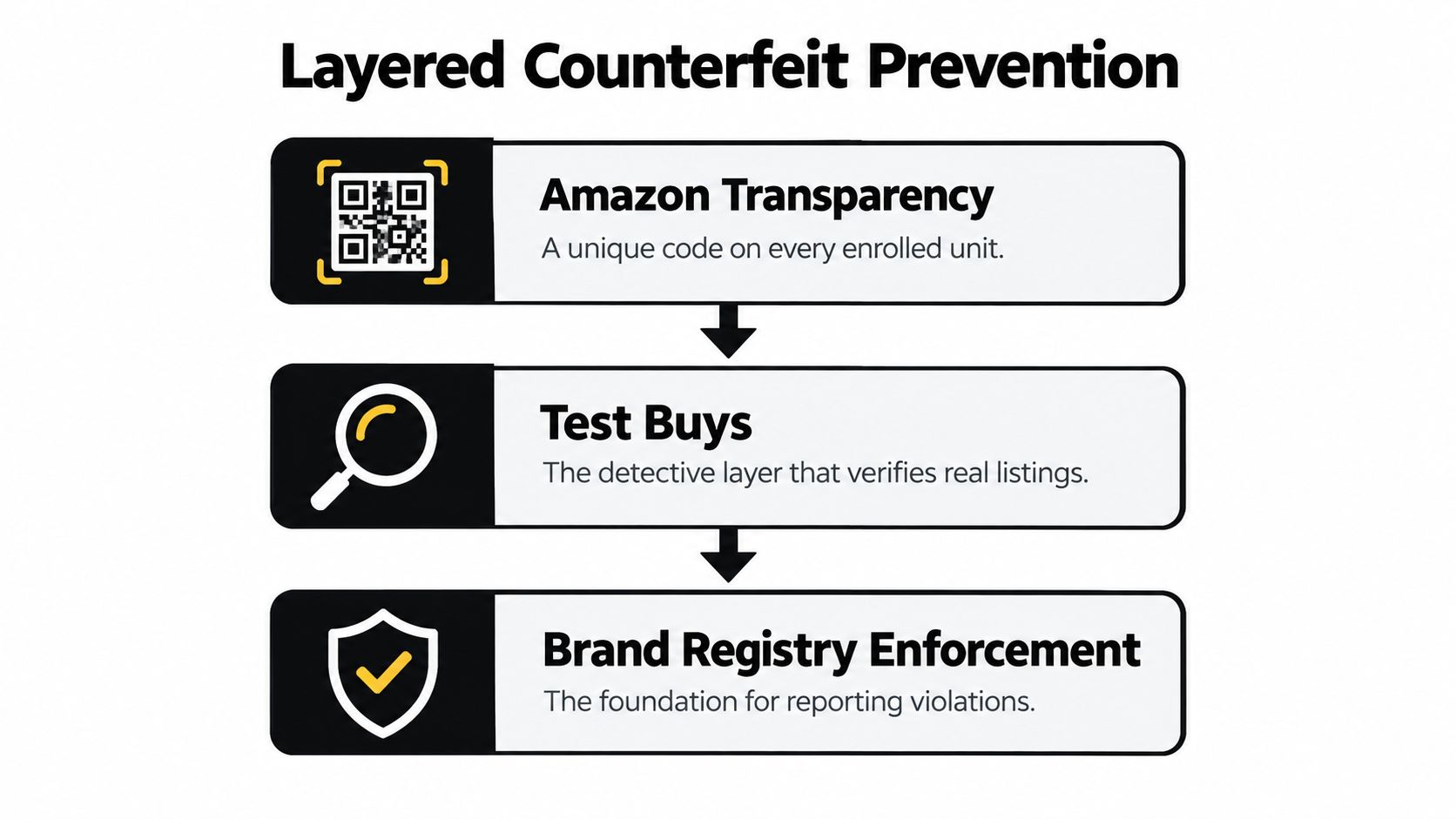
Give each layer a defined job
Brand Registry enforcement is the reporting foundation. It gives the rights owner a structured place to report supported IP and listing violations.
Test buys verify the live offer. They reveal whether monitoring signals correspond to counterfeit, material difference, condition problems, or genuine inventory outside the approved channel.
Transparency helps prevent non-verifiable units from moving through the enrolled process. It doesn't replace distributor controls, and it doesn't automatically prove that a genuine product sold by an unauthorized reseller violates Amazon policy.
Below those layers, tighten the commercial system. Use authorized-seller agreements, MAP language where legally appropriate, distributor audits, territory records, lot tracking, and documented supply paths. A test buy that identifies a lot connected to one distributor is more valuable when the distributor can investigate its records.
Partner services can add monitoring across marketplaces, automated seller outreach, test-buy coordination, legal escalation support, MAP enforcement through distributor audits, and catalog operations. Online Brand Growth's 360 Brand Protection program combines controlled authenticity test buys with unauthorized-seller removal and MAP enforcement as part of its Amazon brand-management work. Keep the seller-ASIN matrix as the measurement layer, and mark whether each recurrence stopped, moved, or returned.
For Amazon-specific workflows, this resource on Project Zero can sit alongside your internal escalation documentation.
Building a Repeatable Brand-Protection SOP
A coordinator should be able to run the process without asking what “suspicious” means. Put the cadence and evidence requirements in writing.
Run a weekly offer scan across priority ASINs. Rotate monthly test buys among the highest-risk seller-ASIN combinations, and conduct a quarterly enforcement review. Add an ad hoc response whenever a new seller appears with a sharp price change, repeated Buy Box wins, a concerning condition claim, or a physical finding that matches a known issue.
Use one tracker for every case
The test-buy tracker should include:
- Offer identity: ASIN, seller ID, storefront URL, price, condition claim, and Buy Box share.
- Transaction proof: Order ID, order date, delivery proof, payment record, and carrier tracking.
- Product evidence: Lot or serial number, packaging differences, product condition, missing components, and control-unit comparison.
- Enforcement record: Reported program, complaint ID, response, removal status, and recurrence flag.
- Commercial follow-up: Distributor connection, MAP incident, sourcing evidence, and contract review status.
The recurring mistakes are predictable. The Buy Box changes during checkout, so the order reaches the wrong seller. Someone photographs the product but discards the shipping carton. The report says “counterfeit” even though the unit is genuine but diverted. The case contains screenshots, but no physical evidence or Order ID. Each failure makes the next escalation harder.
Review the program quarterly
Track unauthorized-offer count, Buy Box win rate on your own listings, repeat-offender sellers, MAP-violation incidents, and the number of test buys that produced a successful removal versus monitored evidence. These measures separate platform enforcement from channel control. A removal can be useful, but a recurring seller or distributor leak tells you the underlying problem remains.
Use the unauthorized seller playbook as a companion reference when formalizing ownership, escalation, and documentation rules. During the broader SOP, Online Brand Growth's free Amazon profit calculator, FBA storage fee calculator, and sales rank checker help quantify the commercial impact around the enforcement work.
Online Brand Growth helps brands investigate unauthorized sellers with controlled test buys, Brand Registry enforcement, reseller removal, and MAP enforcement. If your offers keep recurring after individual takedowns, visit Online Brand Growth to book a free strategy call and map the evidence, supply-chain, and prevention layers.