
Most advice on Amazon brand protection gets this wrong. Amazon Transparency vs Project Zero is not a choice between two substitutes, it's a choice between two different failure points, one at the listing level and one at the unit level. If you treat them as competitors, you'll usually overprotect the wrong SKUs and underprotect the ones that leak margin.
| Program | What it protects | How it works | Best use case | Main limitation |
|---|---|---|---|---|
| Project Zero | Catalog and enforcement workflow | Lets qualifying brands remove suspected counterfeit listings themselves, with automated protections layered on top | Fast action against bad listings on the detail page | Doesn't physically inspect inventory |
| Transparency | Physical product units | Uses unique codes on individual units so Amazon and partners can verify authenticity before shipment | High-risk SKUs, channel leakage, and repeat counterfeiting | Adds packaging and per-unit operational work |
The practical move is selective layering. Use Project Zero to clear the digital shelf quickly, then reserve Transparency for the ASINs where counterfeits, diversion, or gray-market flow justify the extra packaging work.
Why Treating Them as Competitors is a Mistake
Brands usually ask the wrong question first. They ask whether they should “do Project Zero or Transparency,” when the better question is where the failure happens, on the listing, in the warehouse, or inside the physical supply chain. Amazon's own framing supports that distinction, because Project Zero is designed for rapid listing enforcement while Transparency creates unit-level traceability.
Two different control points
Project Zero operates where the catalog breaks. It gives qualified rights owners a self-service way to remove suspected counterfeit listings, and Amazon launched it with automated protections, a self-service removal tool, and optional serialization tied to the program's enforcement model. That makes it useful when a bad offer appears on your ASIN and needs to be removed now.
Transparency operates where the physical product breaks. Every enrolled unit gets a unique code, and Amazon can verify that code before shipment or delivery. Amazon reported that more than 1.6 billion units enrolled in Transparency had been authenticated through code scans across the retail supply chain by 2024, which shows the program's role as a serialized supply-chain control rather than a catalog cleanup tool. Amazon brand protection report
The mistake is trying to make one tool carry both jobs. A bad listing can disappear while counterfeit inventory still exists, and a valid unit can still be protected even if unauthorized offers keep showing up.
Why selective layering wins
For established brands, the highest-value approach is rarely blanket enrollment across every SKU. Serialization adds operational friction, packaging coordination, and code management, so it should go where the exposure is concentrated. Fast listing enforcement covers the products that get copied, while serialization covers the products that get counterfeited in volume or leak through distribution.
That's why the right deployment model is usually catalog enforcement plus selective serialization, not an either-or decision. If the ASIN has low counterfeiting pressure, strong channel discipline, and thin margin, serialization can be hard to justify. If the ASIN is a hero item with repeated hijacks, the combination is much stronger.
Technical and Operational Requirements Explained
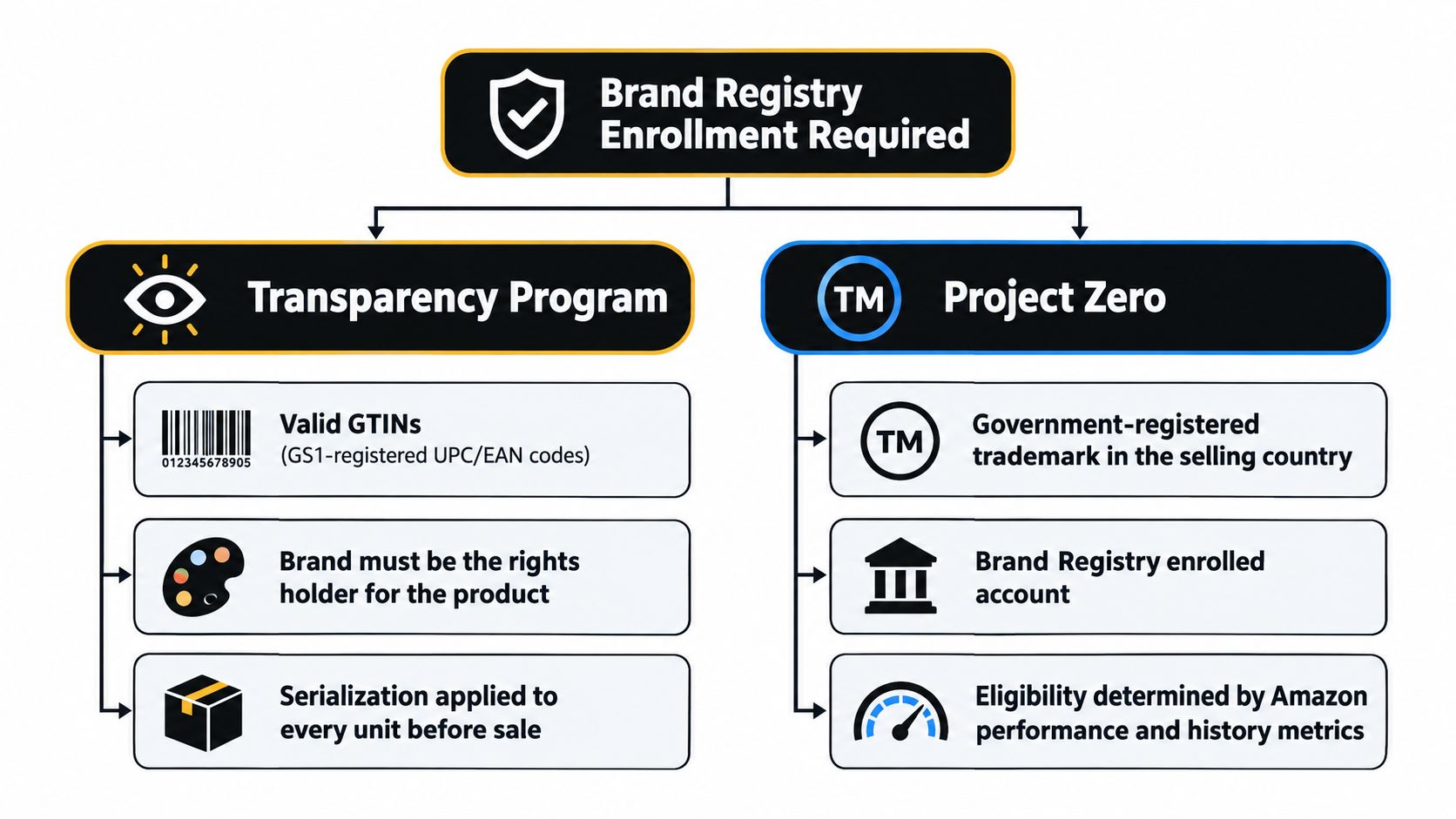
Before anyone clicks into enrollment, the gates matter. Amazon requires Brand Registry, a registered trademark, and product identification through a GTIN such as a UPC or EAN for Transparency. For Project Zero, Amazon also looks at your enforcement history, not just your paperwork.
What Amazon checks first
For Transparency, the operational lift is physical. You need the ability to apply a unique code to 100% of the manufactured units for enrolled GTINs, and selling partners have to provide the code at listing or fulfillment so Amazon can check it before the unit reaches the customer. That means packaging, label application, code procurement, and internal process control all have to line up. Transparency guide
For Project Zero, the gate is governance. Amazon requires a Brand Registry account, rights-owner status, recent use of the Report a Violation tool, and at least a 90% acceptance rate on those reports in the prior six months. Amazon also says misuse can expose the brand to problems if aggressive reporting removes legitimate sellers. Project Zero eligibility
Where teams get into trouble
The common failure isn't technical, it's procedural. Brands push reports against authorized distributors, parallel imports, or gray-market inventory and then wonder why the acceptance rate stalls. They also underestimate how much coordination it takes to make serialization work at the packaging stage.
Practical rule: if the item can be copied on the listing page, start with enforcement. If the issue is that the physical unit itself keeps re-entering the supply chain, serialization earns its place.
For readers building the process in Seller Central, the workflow usually starts in Brand Registry, then moves into Report a Violation for enforcement, and into the Transparency enrollment path for GTINs that justify unit-level control. If you need a deeper walkthrough of the packaging side, the Amazon Transparency Program guide is worth keeping open while you map the workflow.
Side by Side Comparison of Enforcement Capabilities
The cleanest comparison starts with failure point, not feature count. A counterfeit listing, a diverted unit, and an unauthorized offer overlap, but they break differently in Seller Central and in the supply chain. Project Zero is strongest when you need to remove the problem at the catalog level, while Transparency is strongest when you need to stop unverified physical units from passing through the supply chain.
| Threat Vector | Catalog Enforcement | Unit Serialization |
|---|---|---|
| New counterfeit listing on the detail page | Strong, because qualifying brands can remove it through self-service enforcement | Indirect, because the listing may remain visible even if unverified units are blocked |
| Counterfeit inventory already in the channel | Limited, because enforcement is focused on the listing and seller behavior | Stronger, because each unit is checked against its code |
| Gray-market or unauthorized offer | Useful if the offer is infringing or counterfeit | Limited, because a legitimate but unauthorized unit can still be physically real |
| Need for fast response | Strong, because qualified brands can act immediately | Slower to deploy, because packaging and codes have to be built in |
| Need for traceability across retail channels | Limited | Strong, because the code follows the unit beyond Amazon |
What each program does well
Project Zero fits the cases where the immediate pain is a bad listing on Amazon. It lets qualified rights owners act directly inside Brand Registry and Report a Violation, so the catalog issue can be addressed without waiting on a standard review path. That matters when sales are being diverted and the listing keeps pulling traffic.
For a deeper breakdown of the enforcement side, see our Project Zero guide.
Transparency fits the cases where product integrity has to be controlled across manufacturing, FBA, FBM, retail, and DTC. Amazon positions Transparency as a supply-chain control rather than a seller-reporting tool, which is why it can block unverified units even if an unauthorized offer still exists.
How to choose by SKU
The practical decision is often SKU by SKU. High-margin hero ASINs with known counterfeiting pressure can justify both layers, since the catalog needs enforcement and the unit needs verification. Lower-margin or lower-risk SKUs usually only support one layer, and the better choice depends on where the leakage is happening.
If the issue starts with the listing, prioritize enforcement. If the issue starts with the physical unit re-entering the channel, prioritize serialization. Brands that sell through retail, wholesale, and Amazon often need both, but they should not roll them out everywhere at once.
What neither one replaces
Neither program replaces seller surveillance. A counterfeit offer can reappear under a new listing if the marketplace is not watched, and a legitimate but unauthorized seller can still pressure price and Buy Box control. Enforcement and serialization work best inside the same operating model, with clear ownership for catalog actions, supply chain controls, and marketplace monitoring.
Calculating the True Cost and ROI of Serialization
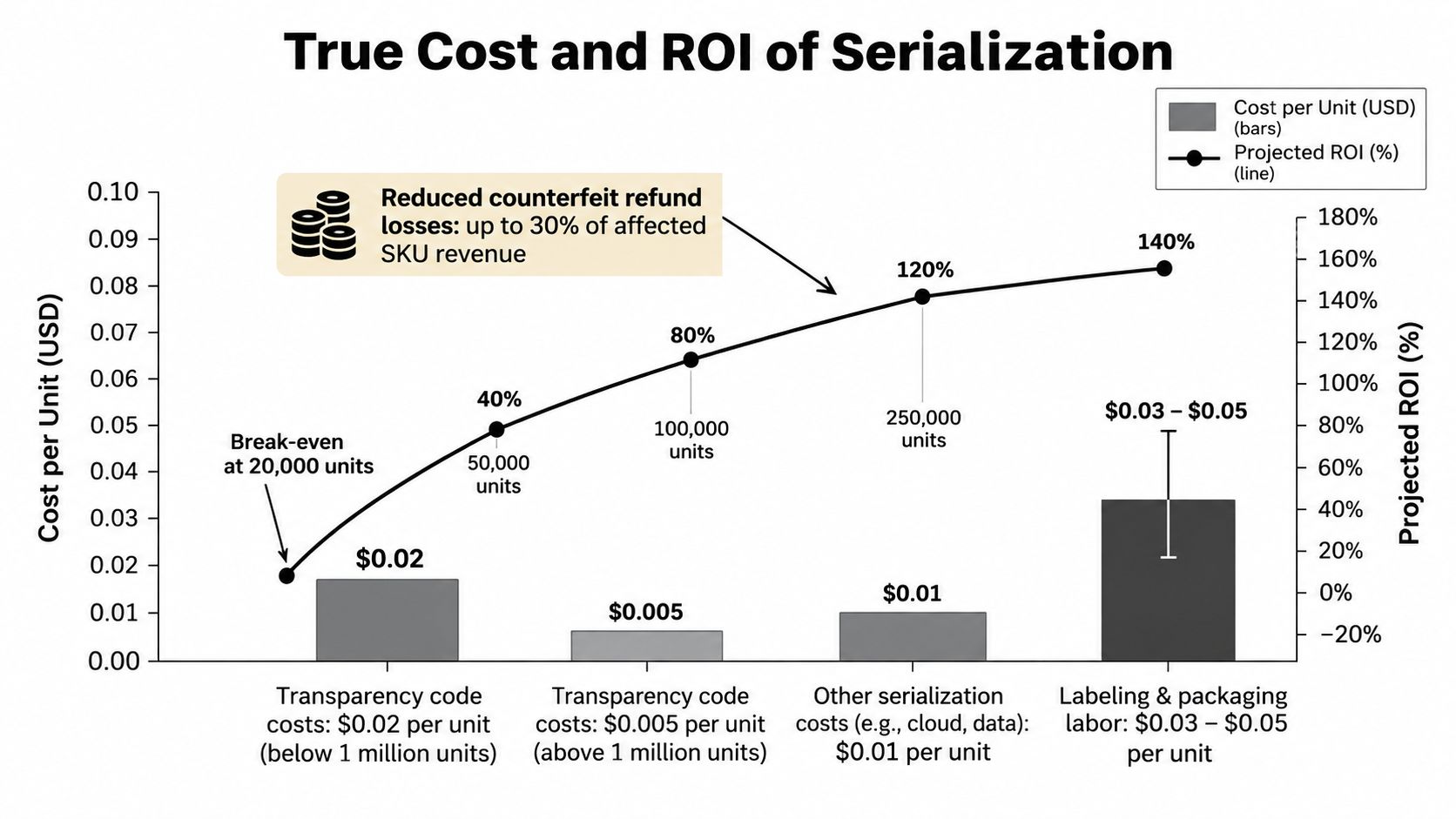
Serialization is a financial decision before it is anything else. Amazon says Transparency has no enrollment fee, subscription fee, product minimum, or charge for adding or removing ASINs, but it does charge for generated codes. In the US, Amazon's published tiers are $0.05 per code for the first 1,000,000 codes, $0.03 from 1,000,001 through 10,000,000, and $0.01 above 10,000,000. Transparency pricing
Build the cost model first
Start with code cost, then add packaging labor, label application, and any packaging redesign. The code charge is easy to see, but the larger miss is often the manufacturing work needed to apply labels or redesign the pack so the code prints cleanly and scans reliably.
Use the Amazon profit calculator to test how much margin you can absorb before serialization starts to crowd out contribution margin. If you are already running close to the edge, even a modest per-unit cost can make low-velocity SKUs hard to justify.
Storage and dimensions matter too. A packaging change can alter the unit's profile in FBA, so the FBA storage fee calculator helps check whether the new pack format pushes the item into a less efficient size or fee tier.
How to judge ROI without guessing
ROI on serialization should be tied to what it prevents, not just what it costs. If counterfeit exposure is driving refunds, review damage, or channel leakage on a high-value SKU, the economics can work. If the SKU rarely gets copied, serialization turns into expensive insurance.
Rule of thumb: calculate serialization only where counterfeit risk, margin, and packaging control all line up. If one of those three is missing, the math weakens fast.
For a quick working estimate, model the SKU three ways. First, with no serialization. Second, with serialization only on the hero ASINs. Third, with full catalog coverage. In most catalogs, the full-coverage version is the least efficient one.
Building a Layered Brand Protection Strategy
The strongest Amazon operators do not force Project Zero and Transparency to do the same job. Project Zero clears visible catalog abuse. Transparency keeps the wrong unit from entering the supply chain in the first place. That split matters most when counterfeit pressure is uneven across the catalog and the leakage source changes by SKU.
Where to layer and where to hold back
Start with the ASINs that carry the most risk, not the most noise. Hero products with repeat hijackers, premium price points, or obvious channel leakage deserve more control than slow movers with clean distribution. For products sold through retail, wholesale, and DTC, the physical trail matters more because the unit can reappear in more than one channel.
The decision comes down to leakage paths. FBA inventory is only one route into Amazon, and it is not the only route counterfeiters or gray-market sellers use. If a product moves through multiple retail channels, Transparency gives you unit-level evidence that travels with the item, while Project Zero still helps clean up the listing where the offer shows up.
For the full playbook on unauthorized sellers and MAP enforcement, see our Amazon brand protection guide. For brands that want this work handled inside a broader operating model, Online Brand Growth's 360 Brand Protection service ties these enforcement layers to counterfeit monitoring and seller activity review.
A simple quarterly review rhythm
A layered program should not stay fixed. Review which ASINs still justify serialization, which listings keep attracting violations, and where channel leakage shows up in pricing or seller behavior. If an ASIN stays clean long enough, it may not need the same level of protection forever.
The Amazon sales rank checker is useful here because it helps identify which products carry demand and which ones may not justify the added serialization work. Tie that to review patterns, unauthorized seller activity, and fulfillment exposure, and the decision gets sharper.
A useful outside resource on how these brand protection layers fit into the wider enforcement stack is defend revenue and trust on Amazon, especially if your team is building governance around Amazon catalog control.
Implementation Checklist for Brand Registry Enrollment
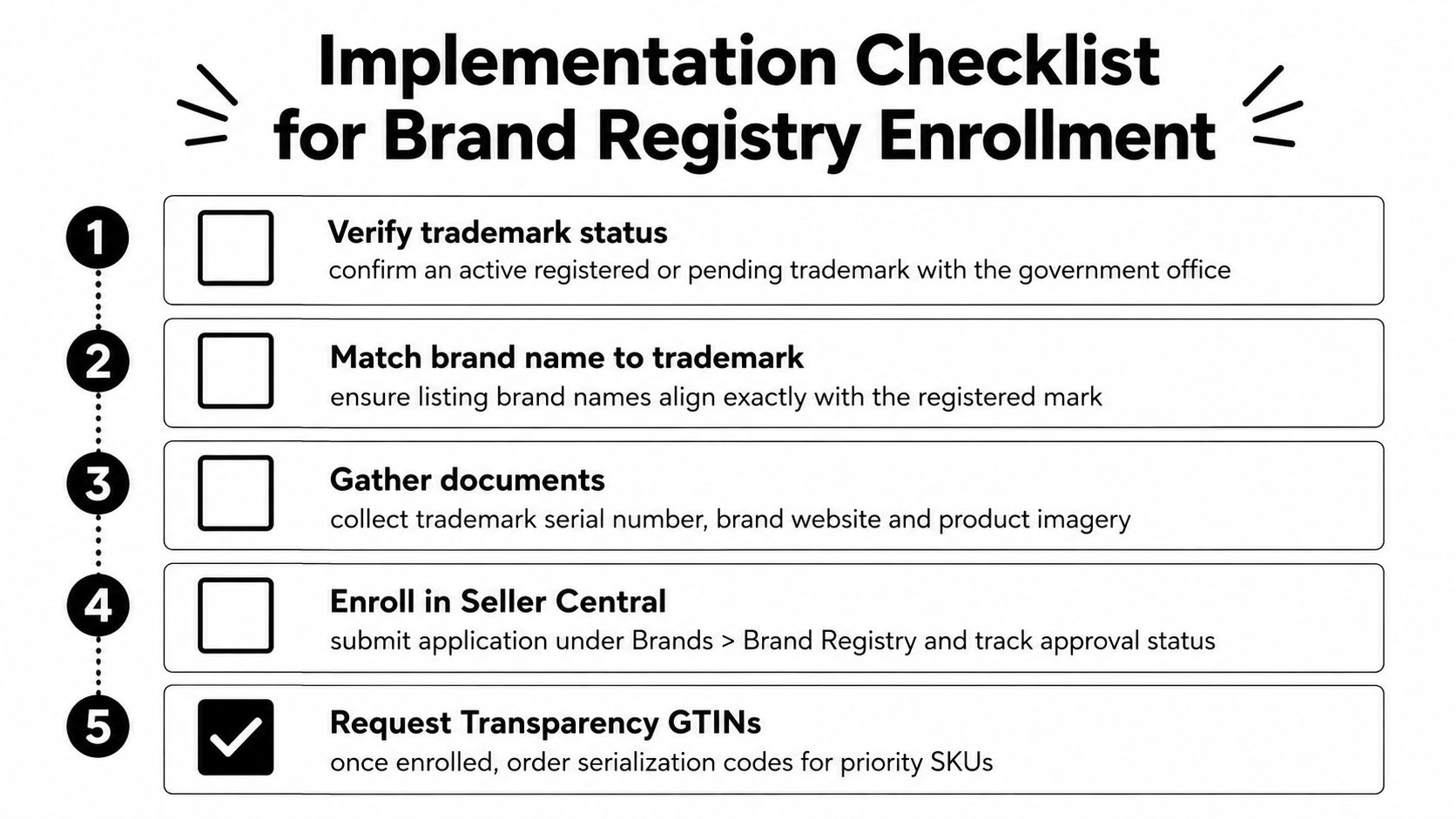
The cleanest rollout starts before enrollment, not after. If the trademark, catalog naming, and enforcement history aren't aligned, the tools slow down fast. The goal is to avoid cleaning up preventable admin issues while you're trying to activate protection.
The enrollment sequence that keeps delays down
- Verify trademark status. Confirm that the mark is registered or pending in the country where you want coverage.
- Match brand name to trademark. Keep the packaging and listing brand name consistent with the registered mark.
- Gather proof up front. Have the trademark serial number, website, and product imagery ready before you submit.
- Enroll in Seller Central. Go through Brands > Brand Registry and track approval status there.
- Prepare priority SKUs for serialization. Once Brand Registry is active, order Transparency codes only for the ASINs that justify the extra control.
What to audit before you apply for Project Zero
Check your Report a Violation history before you rely on self-service takedowns. Amazon's acceptance threshold is strict, and reporting behavior matters because inaccurate submissions can create channel friction or hurt future eligibility. If your brand sells through distributors, resellers, or international partners, separate genuine counterfeits from legitimate but unauthorized inventory before you start filing.
Keep enforcement evidence clean. If a seller has a right to be on the listing, don't use counterfeit tools to solve a distribution problem.
How to brief operations and manufacturing
Your packaging partner needs to know whether a SKU is going into Transparency, because the code has to be applied to every enrolled unit. If the code placement isn't built into the packaging workflow, the brand ends up with rejected units and avoidable delays. That's why coordination between Amazon ops, packaging, and legal matters before launch, not after the first shipment fails.
Recommended Decisions by Brand Profile and Next Steps
If the brand has clean distribution, modest counterfeit pressure, and lower margins, start with Brand Registry and Project Zero. That gives you fast listing enforcement without forcing serialization onto SKUs that don't need it. It's the right path when the problem is a bad offer, not a systemic physical-product issue.
If the brand sells premium, frequently copied, or safety-sensitive products, Transparency belongs on the hero ASINs first. Don't serialize the whole catalog by reflex. Put it on the products where the counterfeit loss, channel leakage, or reputation damage is large enough to justify the operational lift.
If the biggest issue is unauthorized resellers, Buy Box volatility, and MAP enforcement, the enforcement model needs to extend beyond counterfeit tooling. That's where 360 Brand Protection matters, because it pairs unauthorized-seller removal with pricing discipline and broader marketplace monitoring. In that scenario, Project Zero and Transparency are parts of the stack, not the whole answer.
For many brands, the practical answer is selective layering. Use Project Zero for the catalog, Transparency for the units that justify serialization, and keep reviewing which ASINs earn that extra protection. That approach protects margin better than a blanket rollout and usually fits the way brands sell across Amazon and other channels.
If you want a sharper read on which SKUs deserve serialization and which ones only need faster enforcement, book a free strategy call at /#book-call.
Online Brand Growth helps brands build Amazon protection and growth systems that connect Brand Registry, unauthorized-seller enforcement, and operational controls around the catalog. If you need a tighter plan for Amazon Transparency vs Project Zero, visit Online Brand Growth to see how the team approaches enforcement, pricing discipline, and channel protection together.