
You check the ASIN before the morning meeting and see a different seller in the Featured Offer. Their price is lower, delivery is faster, or both. Your ads are still running, your listing still belongs to your brand, and yet customers who arrive on the product detail page may purchase from a merchant you don't recognize.
Losing the Buy Box, now called the Featured Offer, doesn't automatically mean the seller has committed an infringement. Amazon selects the most competitive eligible offer, not necessarily the brand owner's offer. The recovery process therefore has two separate tracks: restore the economics of your offer, then determine whether the competing seller has violated an Amazon policy, intellectual-property right, or commercial agreement.
Diagnosing Why the Buy Box Was Lost
A brand can lose the Featured Offer while its listing, advertising, and inventory remain active. The immediate commercial effect is measurable: shoppers may purchase through another offer on the same product detail page, reducing conversion, contribution margin, advertising efficiency, and control over the customer experience.
Because multiple merchants compete on one detail page, unfamiliar sellers are a structural feature of Amazon's marketplace. Independent third-party sellers represented 58% of Amazon's physical gross merchandise sales in the company's 2018 annual report, compared with 3% when Amazon began reporting the measure. Amazon's 2018 annual report supplies the historical context for that marketplace structure.
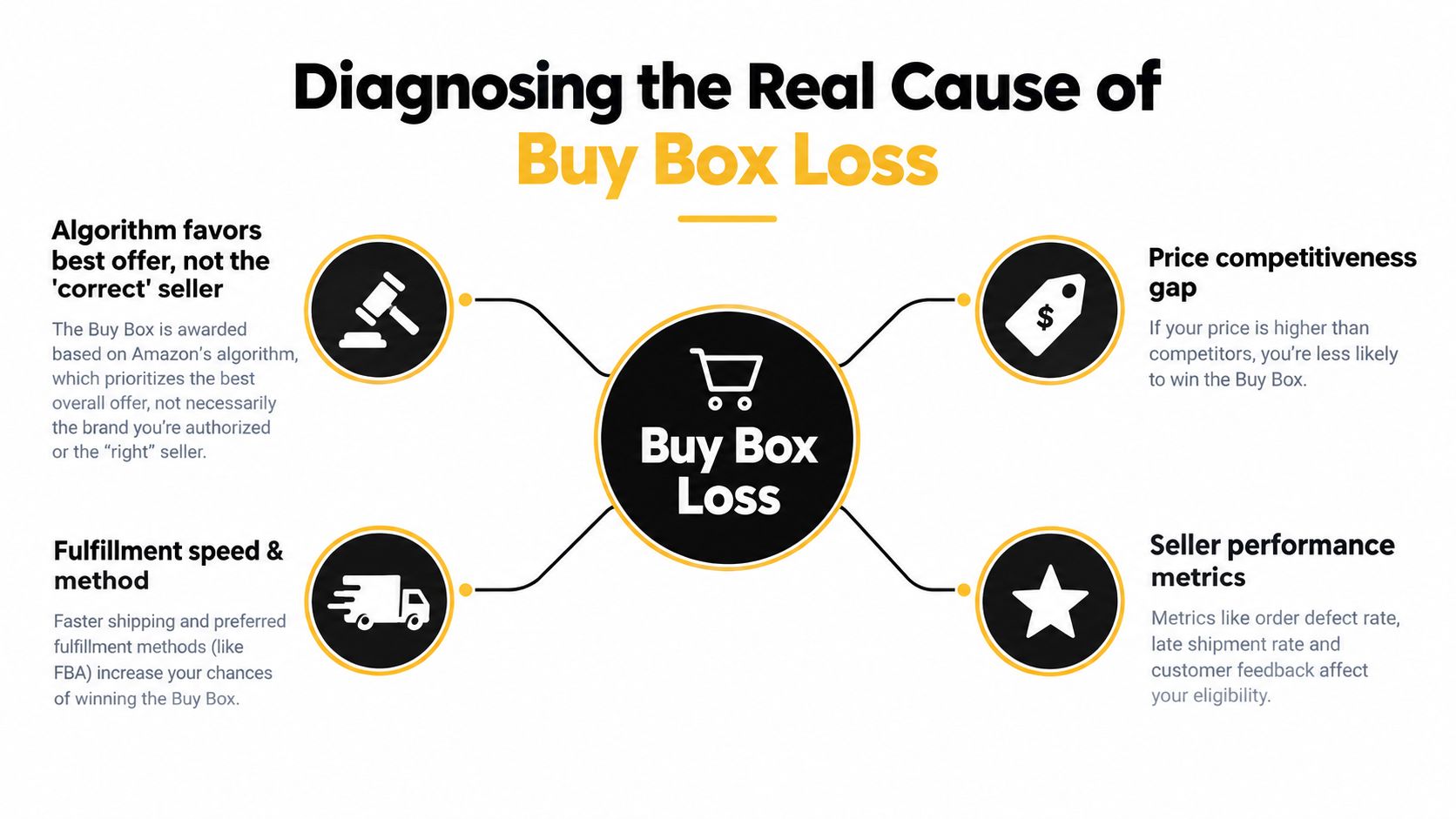
Separate displacement from misconduct
Amazon evaluates total price, shipping speed, product availability, and Order Defect Rate when selecting the Featured Offer. Fulfillment method, delivery promise, inventory position, and customer-service performance also influence the result. For a broader explanation of what the Amazon Buy Box means operationally, review how these offer-level inputs affect the purchasing path.
An authentic reseller can therefore displace your offer without selling counterfeit goods. The seller may have obtained genuine units through a distributor, liquidation channel, retail arbitrage, returned inventory, or leakage from an authorized wholesale network. A lack of your distribution permission alone does not establish an Amazon policy or intellectual-property violation.
Use this decision sequence before opening a complaint:
- Compare the landed offer. Record item price, shipping charge, delivery date, condition, and fulfillment method.
- Check the product match. Confirm the seller is offering the correct ASIN, identifier, variation, and condition.
- Check eligibility. Determine whether your offer is eligible or Amazon has excluded it independently.
- Verify the unit. Conduct a controlled test buy if authenticity, expiry, damage, packaging, or lot identity is uncertain.
- Classify the violation. Decide whether the issue is competitive displacement, channel leakage, counterfeit, trademark misuse, inaccurate content, or pricing-policy abuse.
Practical rule: “Unauthorized” describes a relationship with your channel. It does not, by itself, identify an Amazon policy violation.
Create daily offer snapshots for priority ASINs. Save the seller name, seller ID, offer price, shipping, fulfillment, delivery promise, stock status, Featured Offer percentage, and your own conversion and margin data. A seller's arrival matters, yet the change in business metrics shows whether the offer is merely present or materially affecting performance.
For additional terminology and operating context, consult the Million Dollar Sellers Buy Box guide. Use that context to decide whether the next action should address price and fulfillment eligibility or proceed through brand and policy enforcement. Reporting an unauthorized seller can support a legal or policy case, but it will not repair an offer that Amazon has ranked below a more competitive eligible offer.
Verifying Your Own Offer Eligibility First
Before you challenge another seller, confirm that your own offer can compete. Amazon provides a direct Seller Central check for this, and many brands skip it because they assume ownership of the listing guarantees eligibility.
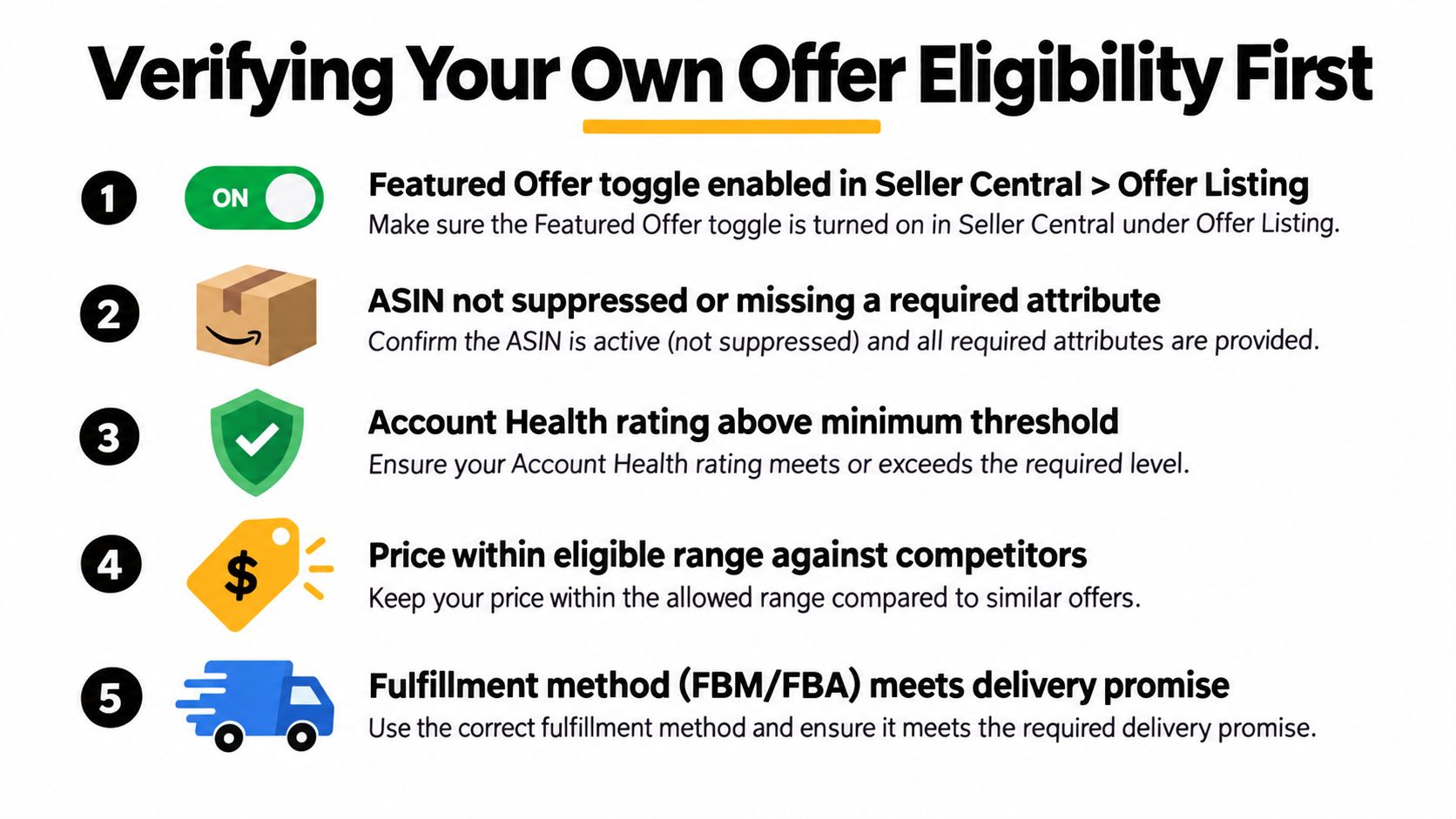
Open Seller Central, go to Manage Inventory, select Preferences, enable the Featured Offer Eligible, formerly Buy Box Eligible, column, and save the setting. Amazon's seller guidance describes this workflow for separating an offer that is ineligible from one that is eligible but has lost the Featured Offer to another merchant. Amazon's Seller Central guidance supports this check.
Audit the account signals that can disqualify you
An eligible status doesn't guarantee the Featured Offer, but an ineligible status changes the diagnosis completely. Review Account Health, inventory availability, listing suppression, fulfillment settings, and customer-service performance before adjusting price.
The commonly used operational thresholds are:
- Order Defect Rate: below 1%.
- Late Shipment Rate: below 4%.
- Pre-Fulfillment Cancellation Rate: below 2.5%.
- Valid Tracking Rate: above 95%.
These thresholds are useful diagnostic benchmarks, not a substitute for the current requirements displayed in your account. A brand with weak tracking, late dispatches, or avoidable cancellations may lose eligibility even when its product and price are competitive. Stronger operators often set tighter internal targets, such as ODR below 0.5% and tracking above 98% to 99%, but those are operating goals rather than Amazon's published minimums.
Check the offer and the economics
Confirm that the ASIN isn't suppressed, missing a required attribute, out of stock, or attached to the wrong condition. Check whether your delivery promise is credible for the marketplace and whether your fulfillment settings create a disadvantage against an FBA offer.
Then calculate the margin impact before changing price. Amazon fees, storage, inbound freight, returns, advertising, and fulfillment costs can make a seemingly small price reduction unprofitable. Online Brand Growth's Amazon profit calculator can help structure that calculation, while its FBA storage fee calculator can isolate storage costs that may be influencing your minimum viable price.
Don't file a Brand Registry report while your own offer is independently ineligible. Removing a reseller won't restore the Featured Offer if Amazon still excludes your offer because of account health, stock, fulfillment, or listing conditions. Fix the internal constraint first, then measure whether the competitive offer remains the reason for displacement.
Executing Immediate Pricing and Inventory Fixes
Once your offer is eligible, treat the detail page as a live commercial contest. Compare the unauthorized seller's offer with yours before changing anything. Record landed price, fulfillment method, delivery promise, inventory status, available seller-performance indicators, and Featured Offer share. Amazon's Featured Offer selection considers total price, shipping speed, availability, and order performance, so a seller report alone may not restore your position.
Choose the right commercial lever
If the reseller is cheaper but slower, test whether a controlled landed-price adjustment recovers the position. If prices are close and the other offer has FBA or a materially faster promise, matching price may not help. Your fulfillment configuration could be the key disadvantage. The guide to winning the Amazon Buy Box provides further context on the commercial factors affecting selection.
FBA may improve delivery and service inputs, but its fees can make an ASIN unprofitable. Model contribution margin before changing price. Include product cost, Amazon fees, fulfillment, storage, returns, promotions, and advertising. The Amazon profit calculator helps make the break-even point explicit instead of relying on gross revenue.
Manual price changes suit a single ASIN with a short-lived event and a team member who can review the result. Automated repricing fits catalogs where offers change frequently, provided the rules include a margin floor, inventory limits, and separate treatment for authorized and unauthorized sellers. If one pricing system must update several marketplaces or sales channels, this resource on how to sync prices across channels via API2Cart can help define the integration requirements.
Set a test window before making a permanent price decision. Monitor Featured Offer share, ordered revenue, conversion rate, contribution margin, and inventory velocity during the test. A lower price that restores placement but destroys contribution is not a recovery.
Protect demand while the offer is unstable
Review branded Sponsored Products and Sponsored Brands campaigns when the Featured Offer changes. A click can still support brand demand, but advertising may fund another seller's conversion when that seller receives the purchase. Pause or reduce campaigns where the offer mismatch is wasting spend, while preserving campaigns that protect branded demand or support a profitable authorized offer.
Inventory also affects competitiveness. An offer approaching stockout may lose appeal even at an attractive price. Maintain enough sellable inventory to support the delivery promise, but do not overstock solely to chase a temporary Featured Offer position.
Run the repricing test and enforcement investigation on separate timelines. Set a 72-hour price-test window while the test-buy and evidence file are being assembled, so neither track waits on the other. A successful price test measures commercial recovery. It does not establish that the seller violated a policy or justify removal.
Filing Brand Registry and Policy Violation Cases
An unauthorized seller can hold the Featured Offer while selling genuine inventory. That creates two separate problems: the algorithm evaluates price, delivery, and seller performance, while Amazon enforcement evaluates whether a specific policy or legal right was violated. Reporting the seller rarely fixes the underlying offer eligibility problem unless the evidence supports the allegation.
Start with the exact conduct. Counterfeit goods, trademark misuse, copyrighted-content misuse, materially inaccurate product representation, and marketplace pricing abuse each require different evidence and reporting paths. A genuine reseller is not usually removed just because the brand did not authorize the seller. A MAP breach is generally a commercial matter, not intellectual-property infringement.
Build an evidence file before submitting
Connect the seller, offer, product, and alleged violation in one case file:
- Seller identity: record the storefront name, seller ID, ASIN, offer ID, and offer URL.
- Offer evidence: save screenshots showing price, shipping charge, condition, delivery promise, and Featured Offer position.
- Test-buy evidence: photograph the received product, packaging, labels, inserts, lot numbers, serial numbers, and differences from authorized stock.
- Rights evidence: include trademark registration details, brand ownership information, and the exact branded content or mark being misused.
- Sourcing evidence: preserve invoices, distributor records, lot tracing, and internal inventory records that may identify diversion.
- Allegation clarity: state which right or policy the conduct violates. Do not call a genuine unit counterfeit without physical evidence.
Submit intellectual-property matters through Amazon Brand Registry, choosing the Report Infringement or Report a Violation workflow that matches the evidence. Amazon's 2020 Brand Protection Report shows why structured controls matter: Amazon invested more than $700 million and employed more than 10,000 people to combat fraud and abuse, blocked more than 6 million attempts to create selling accounts, and blocked more than 10 billion suspected bad listings before publication. Amazon's Brand Protection Report provides the source context. These figures demonstrate platform scale, not a guarantee that every unauthorized offer will be removed.
Use the correct remedy
The Amazon's Marketplace Fair Pricing Policy addresses misleading reference prices, excessive shipping fees, prices significantly above recent market rates, and related customer-trust concerns. Amazon may remove the Featured Offer, remove the offer, suspend a shipping option, or suspend or terminate selling privileges in serious or repeated cases. Before reporting, document comparable market prices, the ASIN, seller ID, item price, shipping charge, and the specific conduct.
| Violation Type | Required Evidence | Reporting Tool |
|---|---|---|
| Counterfeit product | Test-buy photographs, packaging or unit discrepancies, lot or serial evidence, and product comparison | Brand Registry Report Infringement or Report a Violation |
| Trademark or branded-content misuse | Trademark details, screenshots, and the exact mark or content being misused | Amazon Brand Registry |
| Misleading price or excessive shipping | ASIN, seller ID, item price, shipping charge, and comparable market pricing | Marketplace Fair Pricing Policy workflow |
| Genuine but unauthorized resale | Distribution records, diversion evidence, contract terms, and seller identity | Commercial channel remedy, seller contact, or legal escalation |
| MAP breach without IP misuse | Documented MAP policy, offer history, and seller or distributor connection | Commercial enforcement, not an unsupported counterfeit claim |
For a clearer comparison, review Agenty's comparison of brand compliance and MAP compliance. Keep the enforcement track separate from the Buy Box track. A supported case may receive a response quickly, yet brands should plan for follow-up, clarification, possible appeal, and seller reappearance. Amazon may address a proven violation without restoring your Featured Offer if your price, delivery, inventory, or seller metrics remain less competitive.
Avoid unsupported counterfeit allegations. An inaccurate report can create risk for the brand and weaken future enforcement credibility. The Amazon Brand Abuse Takedown guide offers a practical way to organize these workflows. Report the conduct you can prove, not merely the commercial relationship you want Amazon to enforce.
Building Long-Term Channel Protection and Monitoring
Recovering the Featured Offer doesn't close the source of the problem. If genuine inventory continues leaking through distributors, liquidation, retail arbitrage, returns, or other channels, the same seller or a new seller can reappear after every tactical removal.
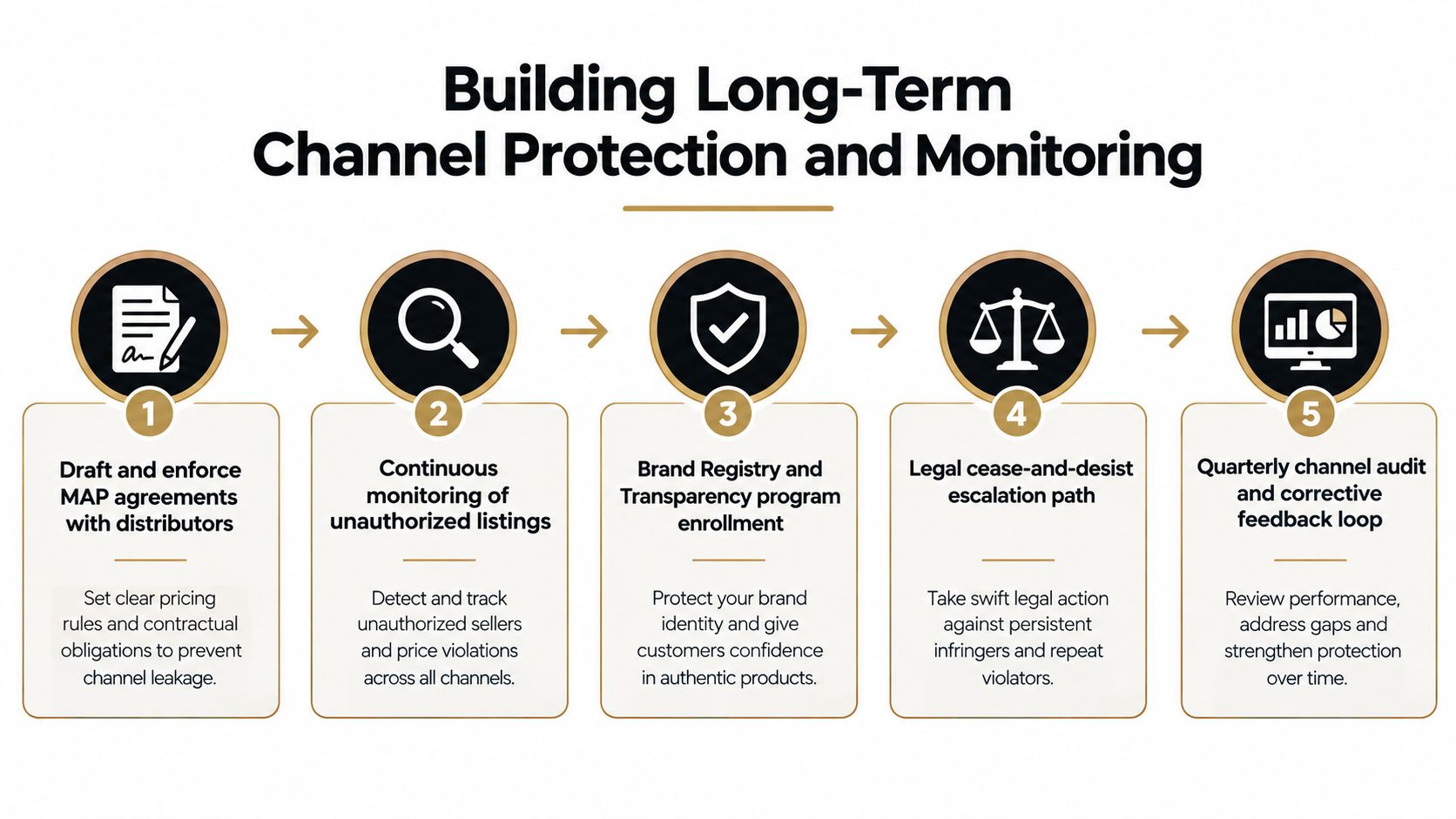
The durable solution combines visibility, traceability, contracts, and escalation. Amazon Brand Registry protects intellectual property and branded content. Amazon Transparency and product serialization can help establish unit authenticity. Neither program replaces distributor controls or automatically enforces a MAP policy.
Close the supply and evidence gaps
Authorized distributor agreements should define where products may be sold, whether marketplace resale is permitted, how inventory can be transferred, and what records the distributor must retain. Add lot-level or serial-level traceability where the product economics justify the operational work. Warranty eligibility can also require proof of purchase through an authorized channel, provided the policy is lawful and communicated clearly.
A MAP policy can establish commercial expectations, but Amazon doesn't enforce every MAP breach. The policy becomes more useful when the brand can identify the seller's supply path and apply documented consequences to an authorized partner. Without that connection, a low offer from a genuine arbitrage seller may remain a commercial problem rather than an Amazon IP case.
Monitoring should produce an action-ready record, not just an alert. Track new sellers, offer ownership, price, fulfillment, delivery promise, content changes, and repeated seller behavior across priority ASINs. Assign responsibility for reviewing alerts, buying samples, opening cases, contacting distributors, and escalating matters to counsel.
Operational insight: The fastest enforcement team isn't the one that sends the most complaints. It's the one that can prove what happened, identify the correct remedy, and prevent the same inventory from leaking again.
Amazon's 2020 Brand Protection Report noted that Brand Registry had grown to more than 700,000 active brands, while proactive controls and structured enforcement remained important because Amazon cannot be expected to identify every problematic offer automatically. Enrollment gives brands reporting access, but the brand still needs clean rights data, product evidence, and a defined response process.
The escalation path may include a seller notice, distributor investigation, cease-and-desist correspondence, test buys, Brand Registry reporting, and legal review. Online Brand Growth's 360 Brand Protection program is one option for brands that need unauthorized seller monitoring, removal workflows, and MAP enforcement handled alongside Amazon operations. It should complement, not replace, supply-chain accountability.
Use this video as an additional visual reference for structuring a channel-protection process:
Securing Your Revenue and Next Steps
The recovery sequence is disciplined:
- Capture the facts. Save the seller, offer, price, shipping, fulfillment, delivery, stock, and Featured Offer data.
- Verify your eligibility. Use the Featured Offer Eligible column and audit account health, inventory, listing status, and fulfillment.
- Model the economics. Calculate the lowest profitable landed price before repricing.
- Stabilize the offer. Improve price, fulfillment, delivery, and inventory where the data identifies a competitive gap.
- Classify the seller. Determine whether the goods are genuine, counterfeit, diverted, damaged, expired, or inaccurately represented.
- Submit matched evidence. Use Brand Registry for IP or content violations and the Fair Pricing Policy path for qualifying pricing conduct.
- Fix the channel. Trace inventory, enforce distributor terms, use serialization where appropriate, and monitor the ASIN continuously.
Measure the recovery using regained Featured Offer share, conversion rate, contribution margin, ad-attributed sales, and seller recurrence. Seller removal alone isn't enough. Amazon may rotate among eligible offers, so your offer must remain competitive after the problematic seller disappears.
The biggest mistake is treating every Buy Box loss as a takedown opportunity. If your price is high, your delivery promise is weak, your inventory is unavailable, or your account performance is poor, an enforcement case won't repair the underlying offer. The second mistake is the opposite, cutting price below contribution-margin break-even while ignoring a genuine counterfeit or diversion problem.
Bring in specialized support when your team can't maintain daily offer monitoring, preserve test-buy evidence, investigate distributor leakage, manage Brand Registry cases, and protect margin at the same time. A structured program is especially useful when multiple ASINs, marketplaces, distributors, or recurring sellers turn isolated incidents into an operating burden.
Book a free strategy call at /#book-call to review your offer eligibility, seller evidence, channel controls, and recovery economics.
Online Brand Growth helps brands monitor unauthorized sellers, manage Amazon Brand Registry enforcement, protect MAP, and restore profitable Featured Offer performance. Visit Online Brand Growth to discuss a practical defense plan for the ASINs and distribution gaps creating the problem.