
Only 13% of products retained a static Buy Box price throughout a six-week observation period in an ACM Web Science study of Amazon Marketplace. For a brand owner, that reframes the pricing problem: leaving your offer unchanged doesn't mean your competitive position stays unchanged. But reacting to every move isn't the answer either. Your repricer needs to protect contribution per order, not buy visibility at any cost.
What Dynamic Pricing Means on Amazon
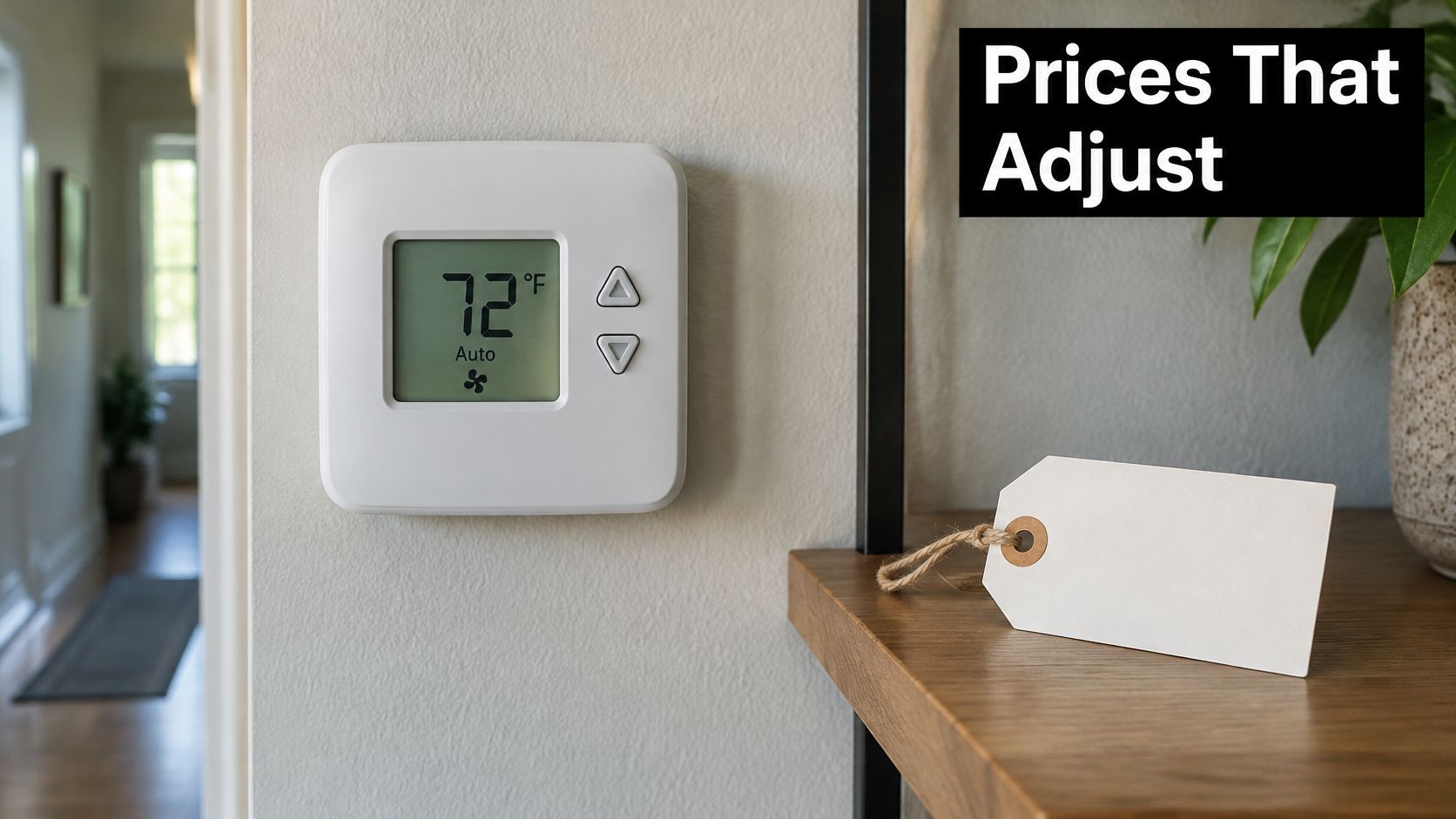
A dynamic price works like a thermostat: you choose the boundaries, and the system adjusts the setting when conditions change. A static price is closer to a tag someone replaces during a quarterly review. On Amazon, competitor offers, inventory availability, demand and the Featured Offer can change while that tag stays untouched.
The scale matters: a 2020 peer-reviewed study on dynamic pricing and inventory management describes approximately 2.5 million Amazon price changes per day, an average listed-product price change every 10 minutes, and a frequency roughly 50 times higher than Walmart and Best Buy; it also recounts the 2011 science-textbook anomaly in which competing algorithms pushed a listing from approximately $100 to nearly $24 million before correction.
The thermostat comparison captures the useful part of automation, provided someone sets sensible limits.
Your offer price isn't the listing's only price
Dynamic pricing on Amazon means setting and resetting an offer price through rules or algorithms. The brand can operate those rules, a third-party repricer can execute them, or Amazon can adjust its own retail offer.
Say your brand sells an FBA offer alongside independent resellers. A reseller lowers its price, your rule responds, and another seller matches. The shopper sees the featured price change even though you haven't changed your product, packaging or wholesale cost.
That distinction matters internally. A manufacturer may own the brand and product content without controlling every offer attached to the ASIN.
Practical rule: Automate the response only after you've decided which competitor signals deserve a response.
Automation needs an economic objective
The textbook incident wasn't a normal consumer transaction. It illustrates what happens when systems treat another algorithm's output as a reliable instruction without checking whether the result makes commercial sense.
For an established brand, the useful objective isn't constant movement. It's maintaining a profitable offer while conditions change.
Start with a catalog task: list the SKUs where a competitor could change price within the hour. Mark which already run on a rule, which depend on manual edits, and who owns the decision when automation reaches its boundary.
The Factors That Trigger Amazon Price Changes
Price-change triggers and the response that protects margin
| Trigger | What It Changes | Response That Protects Margin |
|---|---|---|
| Competitor lowers Buy Box price | Buy Box share | Match only down to your calculated floor |
| Amazon's own offer appears on the listing | Featured Offer eligibility | Compare landed margin before any move |
| Inventory falls below restock cover | Stockout risk and rank | Hold or raise price, pause repricing if needed |
| Unauthorized reseller undercuts | Buy Box and MAP compliance | Route enforceable violations through Brand Registry, don't automatically match |
| FBA versus FBM fulfillment change | Landed price and Buy Box eligibility | Set separate prices per fulfillment method |
| Sales velocity slows | Unit demand | Test a small reduction inside a controlled band |
| Event or coupon promotion | Discount depth and margin | Use a pre-approved promotional floor |
A trigger is a signal, not an instruction to cut. The same competitor reduction can justify matching on a well-stocked SKU and holding on another awaiting replenishment.
In the Amazon Marketplace study published by the researchers, approximately 40% of price changes occurred within one minute of the preceding change. That historical finding supports event-level monitoring, not a requirement to copy every event.
Separate competition from operational problems
When a competitor lowers the Buy Box price, check whether it's a comparable offer before responding. If Amazon's own offer appears, assess the margin available at the competitive landed price rather than assuming you must win immediately.
Inventory changes the objective. When available stock won't cover the replenishment window, accelerating sales can create a more expensive problem than temporarily losing orders.
An unauthorized reseller requires a different workflow. Document the seller and offer, identify any actionable intellectual-property or policy violation, and route enforcement accordingly. Brand Registry isn't a general mechanism for enforcing MAP or removing every unauthorized seller.
Check fulfillment and demand before cutting
FBA and FBM offers can carry different shipping charges, delivery promises and operating costs. Don't copy the same item price across both without recalculating the resulting economics.
The Buy Box, now called the Featured Offer, isn't awarded on price alone. Fulfillment, seller performance and landed price also matter, which is why winning the Amazon Buy Box requires more than undercutting.
Slower sales call for diagnosis before discounting. Check availability, traffic and conversion, then test price if the offer itself appears to be the constraint.
For Prime Day or coupon activity, approve the combined discount exposure before competitive rules run. Name the trigger first, choose the response second. Never reprice first and diagnose later.
Calculating a Profitable Price Floor
Passing Amazon's minimum-price validation doesn't prove an offer makes money. A technical acceptance check isn't a substitute for a SKU-level profit calculation.
Your floor needs to cover product cost, landed fulfillment, selling fees, advertising, returns, storage and inventory carrying cost, plus the contribution you intend to retain. Start with your actual settlement and finance records, not a competitor's price.
Cost layers that make up the price floor
| Cost Layer | Where to Find It | What to Watch For |
|---|---|---|
| Referral fee | Amazon fee schedule for your category | Apply the correct category rate, minimum and fee basis |
| FBA fulfillment fee | Amazon fee guide for the current year | Set by size and weight tier, so re-check whenever the tier changes |
| Advertising cost per unit | Campaign reporting | Total ad spend divided by units sold, not ACoS |
| Returns allowance | Business Reports, reconciled with Payments and returns reports | Refund and unrecovered return cost per unit |
| Storage fees | Inventory and fee reports | Monthly storage and aged inventory charges |
| Inventory carrying cost | Your finance team | Capital tied up in stock while it sits in Amazon warehouses |
Build the floor from costs, not a desired discount
For a hypothetical $30 item with a 15% referral fee, the referral fee alone would be $4.50. That's arithmetic for an illustrative scenario, not a category benchmark, and it leaves fulfillment, advertising and returns unpaid.
Where the referral fee is a simple percentage and the other allowances are fixed per unit, use:
Price floor = (non-percentage unit costs + required contribution dollars) ÷ (1 - referral fee rate)
Adjust the model when minimum fees, percentage-based advertising assumptions or other price-dependent charges apply. The point is to solve for the selling price, not add a referral percentage to cost and assume the result protects margin.
Use our free FBA storage fee calculator to model the inventory-cost layer. Reconcile the assumptions with actual charges before approving the floor.
Keep advertising inside the calculation
A low ACoS can coexist with weak contribution after fulfillment and returns. Our PPC bids are managed ASIN by ASIN against contribution margin targets rather than ACoS figures, so pricing and advertising decisions use the same economic objective.
Use a consistent contribution margin calculation across finance and channel reporting. If reconciling settlements, fees and inventory costs is the bottleneck, HireAccountants' Hire Bookkeepers resource can help you identify bookkeeping support for that underlying work.
A floor built from incomplete costs is still an incomplete floor, even when the repricer follows it perfectly.
Calculate the floor for your top ten SKUs by revenue first. Enable repricing only after someone has checked the cost inputs and approved the retained contribution.
How to Set Up Automate Pricing in Seller Central
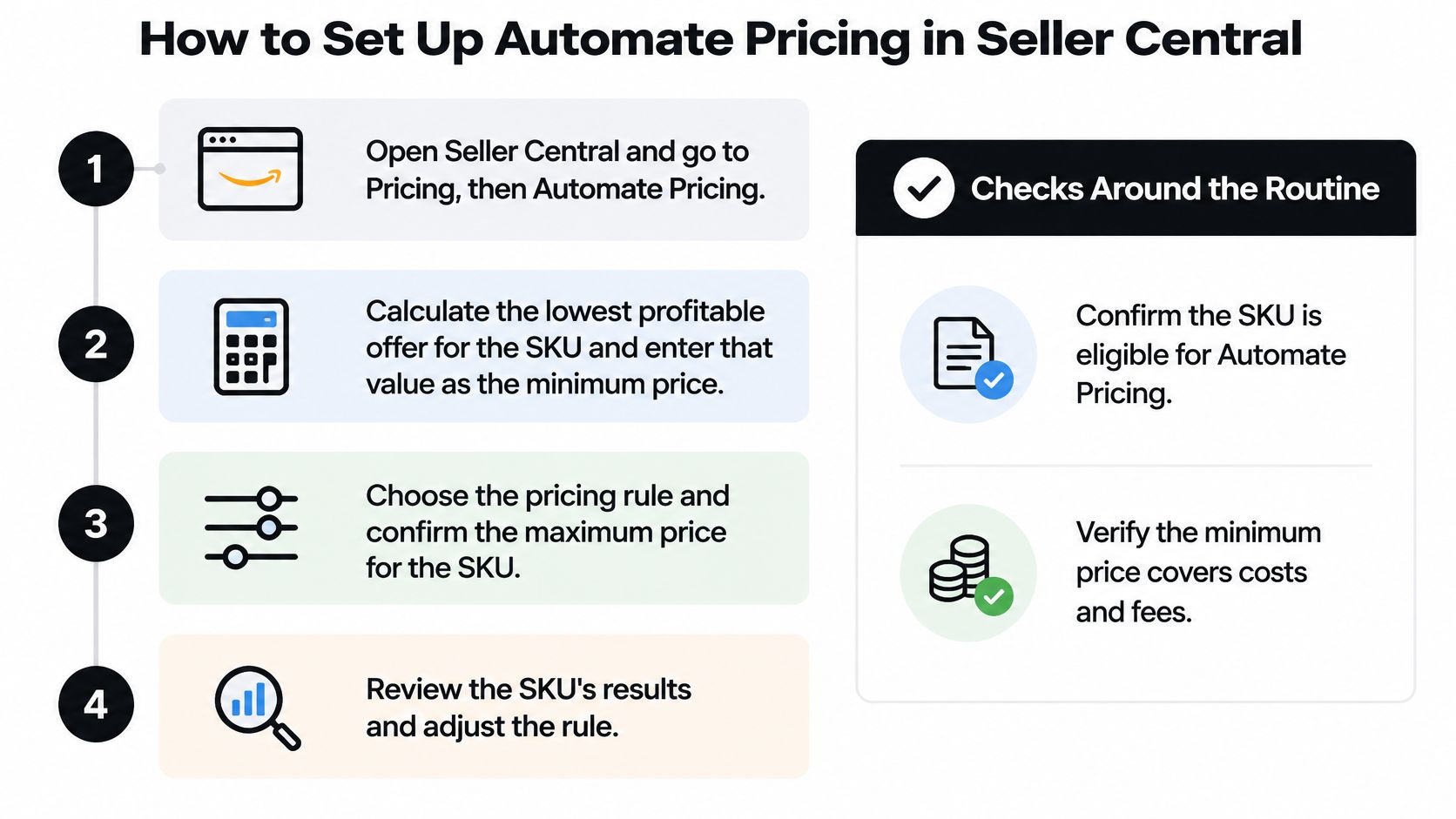
Use Amazon's Automate Pricing guidance for the native workflow: create a rule, assign applicable SKUs, enter minimum prices and optionally set maximum prices. The tool can respond to pricing events involving the Featured Offer and external competitive prices.
Keep the setup sequence visible while you work.
Configure the rule deliberately
Open Seller Central, then Pricing, then Automate Pricing. Confirm the SKU is eligible and you're working in the intended marketplace.
Calculate and enter the lowest profitable offer. Use our free Amazon profit calculator to model referral fees, fulfillment costs, advertising and retained margin before entering the minimum.
Create a clearly named pricing rule. Include its purpose in the name, such as defending a mature FBA offer, so another operator can recognize its intent.
Select the applicable SKUs. Check the ASIN, variation and fulfillment method rather than assigning an entire product family without inspection.
Set an optional maximum price. Under Amazon's minimum and maximum price validation, the maximum must be below six times the ASIN's recent sales price or $200, whichever is higher, while the minimum must exceed the category's minimum referral fee, commonly about $0.50 to $1.00.
Choose the competitive response. Confirm what reference offer the rule follows and whether its behavior matches the SKU's purpose.
Review the resulting prices before leaving the rule live. Check contribution, the customer-facing offer and any shipping charge, not just whether Seller Central accepted the settings.
Check bulk assignments after processing
For larger catalogs, Amazon's Automate Pricing file instructions require the exact rule name, SKU, minimum price, applicable country and currency, and a START action; a maximum price can also be supplied. Match the template's field names, including minimum-seller-allowed-price and the relevant rule-action field.
After processing, spot-check accepted assignments against the source worksheet. Confirm that currency, decimal placement and variation mapping haven't turned a valid upload into an incorrect pricing rule.
Keep a dated copy of the approved inputs. That gives your team a reliable rollback reference if the first live results don't match the intended behavior.
For a visual walkthrough alongside the Seller Central checks:
Where Repricing Protects Profit and Where It Erodes It
Winning more Buy Box share isn't proof that repricing increased profit. Judge each move by contribution per order, then check whether the resulting order volume improves total contribution.
The Amazon algorithmic-pricing economics summary reports a median absolute price movement of $0.02 and 78% of changes moving downward, while also discussing how simple pricing algorithms can produce coordinated high prices through tacit collusion. Neither repeated undercutting nor following rivals upward is a substitute for independent commercial judgment.
Repricing responses by scenario
| Scenario | Repricing Response | Margin Check |
|---|---|---|
| Strong reviews with low competition | Hold price and avoid undercutting | Contribution per order stays above the floor |
| Competitor undercutting with healthy margin | Match down only to the calculated floor | Margin per order after fees and ads |
| Stock under two weeks of cover, as an illustrative warning condition | Hold or raise price, pause repricing if needed | Stockout risk weighed against lost units |
| Unauthorized seller undercutting | Don't automatically match, pursue actionable enforcement | Buy Box share and MAP compliance |
| Small cross-channel price gap | Align with the DTC channel policy before rules run | Channel conflict avoided |
Distinguish recovery from discounting
A competitive adjustment can recover lost visibility when the SKU has stock, comparable fulfillment and enough contribution to support the move. That doesn't mean every recovered order is worth acquiring.
Say a lower offer wins more orders but leaves less contribution after advertising and returns. Keep it only if the overall contribution result justifies that trade-off. Conversely, a differentiated product may support holding price even when a cheaper offer exists.
Buy Box share is a diagnostic measure. It isn't the profit objective.
Don't let channel policy become an afterthought
We can price a brand's products higher on Amazon than on its DTC channel and limit one-time sales and promotions to fit the overarching brand strategy. That capability still requires an explicit channel policy and review of Amazon's pricing requirements, not a blanket instruction to maintain a premium.
For a broader controls perspective, Faberwork LLC's discussion of profitability gains from smart controls offers a useful parallel: define the objective and operating boundaries before relying on automated adjustments. It isn't evidence of an Amazon-specific performance lift.
Keep the exception report focused on decisions: which rule changed the price, what happened to contribution per order, and whether the additional volume justified the concession. A report showing only revenue and Buy Box percentage can't answer those questions.
Guardrails and a Go or No-Go Check Before Repricing
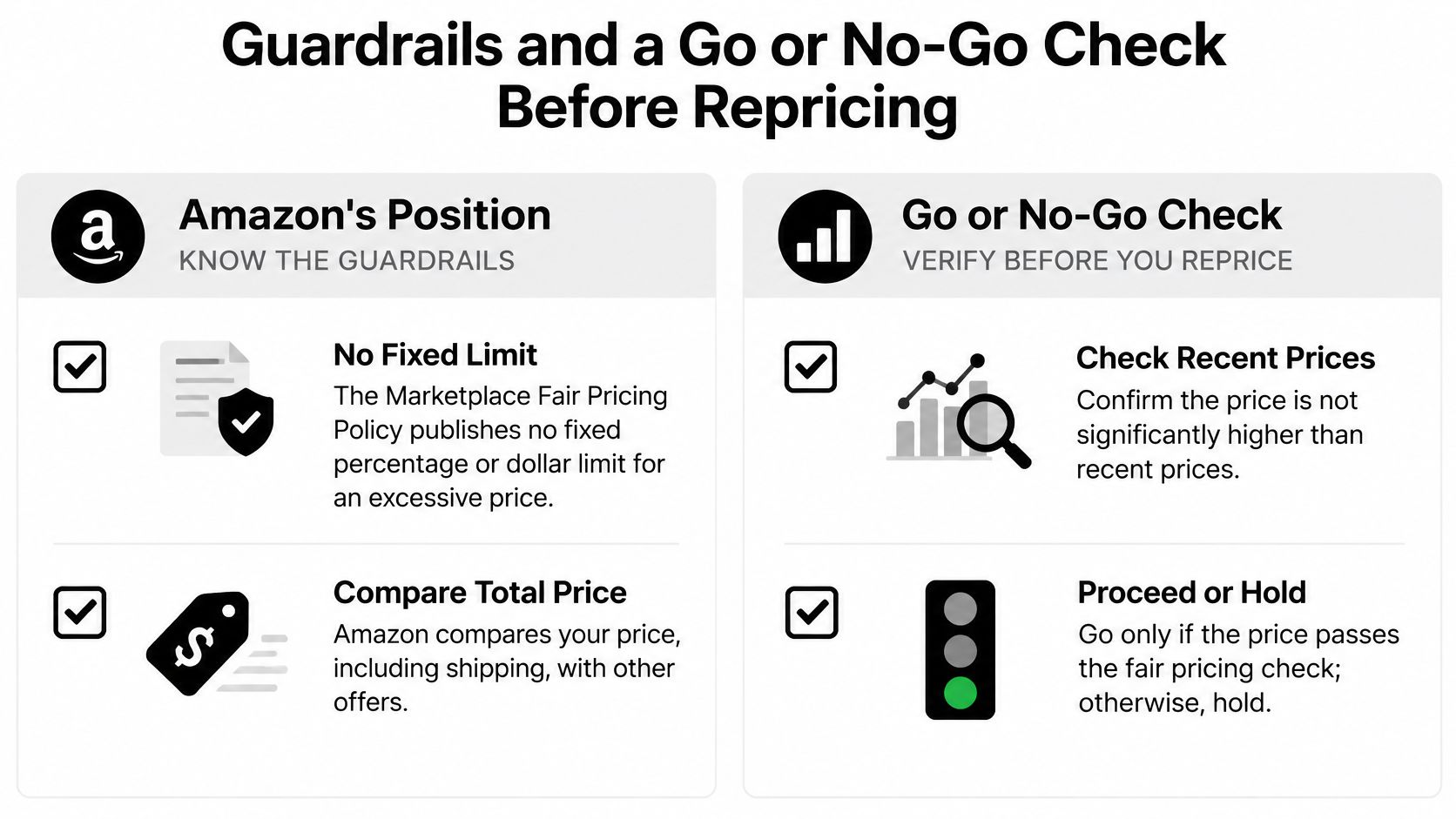
Amazon doesn't publish a universal percentage or dollar threshold for excessive pricing in its Marketplace Fair Pricing Policy, which considers shipping and other available prices, prohibits examples such as misleading reference prices, significantly inflated recent-price comparisons, higher per-unit multipack pricing and excessive shipping, and allows Featured Offer removal, offer removal, or suspension or termination of selling privileges in serious or repeated cases.
A technically valid maximum isn't permission to charge that price. Review the customer-facing total against recent offers and comparable off-Amazon prices before approving a ceiling.
Use this checklist as the operating control, running on every repricing cycle rather than only at launch.
Set limits that someone owns
- Contribution floor. Assign a named owner to approve cost inputs and update them when product, fulfillment or advertising economics change. A stored minimum needs a review trigger, not just an approval date. When a referral fee or fulfillment fee shifts, the floor moves with it, and an outdated floor means the rule can win orders at a loss before anyone notices.
- Maximum change frequency. Where your tool supports it, control how quickly the rule can react again. Otherwise, use monitoring and pause procedures rather than assuming the native tool offers every desired control.
- Controlled price steps. Bound individual changes and cumulative downward movement where supported. Five small reductions over a week are one commercial decision wearing a disguise, so review them as a single sequence.
- Stockout response. Define the inventory condition that changes the objective from selling faster to preserving availability. Use the replenishment date and available stock, not an arbitrary catalog-wide threshold, because a SKU with six weeks of cover and one with six days should never share the same reaction.
- Promotion separation. Specify which rule applies during coupons and events, who approves it, and how normal pricing resumes afterward. The failure mode here is a repricer treating its own discounted event price as the new reference point.
- Anomalous-offer exclusion. Avoid reacting blindly to implausible prices, mismatched pack sizes or offers that aren't meaningfully comparable.
Record what your selected tool can enforce. If stockout logic or competitor exclusions require manual intervention, name the person responsible and define the alert that prompts action.
A spreadsheet policy is not an automated safeguard. The distinction matters when the operator who normally watches the account is unavailable.
Test the best-selling pack size first
Online Brand Growth runs controlled price tests on the best-selling pack size, using the Buy Box as the guardrail. That means testing inside an approved band and monitoring visibility while evaluating the economic result, rather than letting the algorithm discover your boundaries by breaking them.
Before starting, record the current offer, contribution per order, Buy Box share, unit sales, advertising exposure and stock position. Keep the product content and promotional conditions stable enough that you can interpret the price test. A listing image change in week two of a four-week test contaminates everything you measured.
Compare the results against the baseline, but don't treat a simple before-and-after comparison as perfect proof. Competitor stock, demand and advertising conditions can change during the test.
Our free sales rank checker can help you inspect rank alongside sales and contribution. Rank is supporting context, not a replacement for profit measurement.
Route reseller problems to enforcement
Online Brand Growth handles enforcement against unauthorized resellers to protect MAP and the Buy Box. Route those issues into an evidence-based enforcement process rather than allowing a repricer to mirror every suspected violator.
Use minimum advertised price monitoring to identify offers requiring review. Preserve seller identity, offer details and the relevant policy or rights issue before taking action.
Keep the routes distinct. MAP enforcement operates through the brand's applicable commercial arrangements, while Brand Registry reports need an eligible intellectual-property or policy basis. Matching a violator's price with your rule just pays for the privilege of legitimizing their offer.
Hold condition: If the only way to regain the Featured Offer is to violate your approved economics or channel commitments, leave the SKU on manual review.
Schedule an exception report with actions
Build the weekly report around exceptions, not a catalog dump. Include the price before and after each flagged change, the triggering rule, contribution per order, Buy Box share and any stock or promotion condition.
Each exception needs an outcome: retain the rule, revise the boundary, investigate the offer or pause automation. Without an owner and disposition, the report only documents losses after they've happened. A rule flagged three weeks running with no revision is a signal your process, not your pricing, has failed.
Reconfirm the profit-calculator assumptions and storage-cost inputs whenever fees or stock conditions change. Preserve the approved version so finance and the Amazon operator aren't working from different numbers, because a repricer executing faithfully against a stale floor is still losing money on schedule.
Make the release decision SKU by SKU
- Full cost approved. The floor includes landed product cost and the relevant operating allowances.
- Ceiling checked. The maximum passes Amazon's validation and a separate fair-pricing review.
- Pack pricing checked. The multipack doesn't cost more per unit than the comparable single item.
- Exception logic assigned. Stockout, promotion and reseller responses exist, whether automated or manually owned.
- Monitoring scheduled. The weekly exception report has a recipient, an owner and a pause procedure.
Any SKU that fails stays on manual pricing. Releasing the compliant portion of the catalog beats forcing every product into the same rule, because repricing is a margin decision and margins differ by ASIN.
We typically work with brands spending at least a few thousand dollars per month on Amazon ads, where pricing and advertising need a shared contribution target. Both our fractional operator model and the Stoic Brands model begin with a complimentary Amazon audit, so the operating approach starts with the channel's actual economics rather than assumptions.
Online Brand Growth helps brands connect pricing rules, advertising and inventory to contribution profit. Book a free strategy call to review your SKU floors and repricing guardrails before enabling automation.