
The most popular advice on Amazon brand protection is to compare providers by how many takedown notices they file. That's the wrong scorecard. Amazon already blocks many suspected infringing listings, so the useful service is the one that identifies what kind of problem you have, builds the right evidence file, and shows whether Buy Box share and contribution margin recovered.
Amazon's Trustworthy Shopping Experience Report says Amazon identified, seized, and disposed of more than 15 million counterfeit products worldwide in 2025 (Amazon's 2025 report). A high notice count can mean your catalog is noisy, not that a provider is effective. The right model depends on whether you're dealing with fakes, altered content, unauthorized authentic sellers, or diverted inventory.
Best Amazon Brand Protection Services by Situation
| Situation | Model that fits | Why it wins | Where it fails |
|---|---|---|---|
| Rare complaints, small catalog | Brand Registry, Report a Violation, Project Zero | No extra vendor if a person checks offers daily | Misses repeat sellers and margin impact |
| Counterfeit units in FBA or retail | Transparency plus Brand Registry | Unit codes are checked before listing, sale, or shipment | Doesn't police MAP or authorized distribution |
| MAP breaks and unauthorized authentic offers | Managed monitoring with test buys | Offer-level order IDs and repeat-seller tracking | Weak without a letter of authorization or MAP policy |
| Image, title, or bullet hijacks | In-house rights owner in Brand Registry | Fast ASIN reports with before-and-after proof | Fails when nobody watches the detail page |
| Diverted goods across Amazon and retail | Distribution audit plus counsel | Traces supply, not just the live offer | Software notices alone don't stop the source |
Takedown volume is a weak buying signal. Measure whether the service identifies the right violation, supports the report with usable evidence, and improves the commercial result.
For a small catalog with occasional complaints, start with Brand Registry and Report a Violation. Project Zero may also fit if Amazon qualifies your brand and someone on your team can check offers every day. Paying an outside provider to file a few straightforward reports may add cost without adding control.
If counterfeit risk involves physical units, pair Brand Registry with Transparency. A listing removal addresses an offer or content problem; it doesn't authenticate a unit already in FBA. If the recurring issue is MAP breaks or unauthorized sellers offering authentic products, use a managed operator that can test-buy, retain order IDs, and track sellers who return under a different storefront name.
A detail-page hijack often suits an in-house rights owner who can spot a change and file quickly. Diverted inventory requires a different investigation: a distribution audit can trace where stock entered the channel, while counsel can assess the appropriate response. Another generic notice won't repair a leak in your supply chain.
Protecting a brand also means protecting the assets used to identify it. For a useful look at an often-overlooked part of that work, see this guide to protecting brand identity through font licensing.
Choose the row that matches this week's actual problem. The rest of the operating plan should follow that choice, not a provider's feature list.
Amazon Tools Inside a Real Protection Stack
Brand Registry is the foundation, not the whole protection program. Amazon launched it as a free service for brand owners, including owners who don't sell directly in Amazon's store. The program had more than 500,000 enrolled brands by 2020. In 2021, participation exceeded 700,000 active brands, up 40% in one year, while the average number of valid infringement notices submitted per enrolled brand declined 25% (the U.S. Trade Representative submission). Centralized brand information can reduce repeated work, but it doesn't replace someone checking offers and pages.
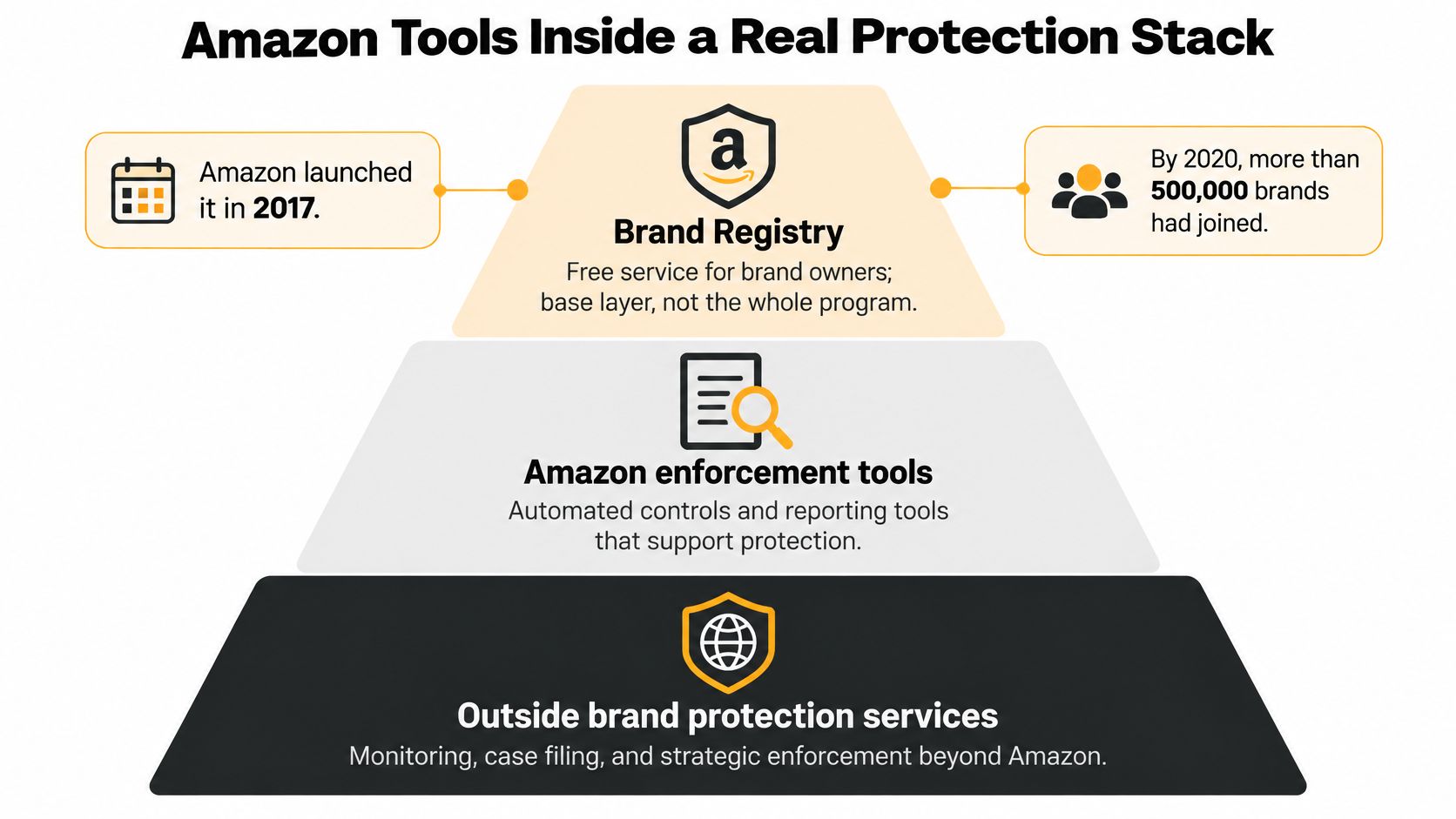
The stack has distinct jobs:
- Brand Registry connects your brand rights to Amazon's reporting workflow. It gives rights owners a structured way to manage brand information and report issues. The relevant portal path is Protect, then Report a violation.
- Project Zero adds self-service counterfeit removal for brands Amazon qualifies. It's useful when your team can reliably distinguish a genuine infringement from a false positive. It isn't a MAP-enforcement tool.
- Transparency addresses product units. It assigns unique codes that Amazon can use to authenticate units before listing, sale, or shipment.
Amazon says its proactive controls blocked more than 99% of suspected infringing listings before brands needed to report them, while valid infringement notices from brands declined by about 35% as product selection expanded. Amazon also reports that Transparency has verified more than 2.5 billion units as genuine and covers 88,000 brands worldwide. Those are Amazon-reported figures, not an independent benchmark; check results against your own catalog (Amazon's Brand Registry and protection tools).
The distinction matters operationally: listing tools remove bad offers and bad content; Transparency helps keep bad units out of fulfillment. Neither tool creates your authorized reseller list or enforces your MAP policy. If your team sells apparel with original artwork, you can also review this resource for trademark checks for Amazon shirt designs. For a fuller overview of enrollment and setup, see Amazon Brand Registry benefits.
Match the Case to the Right Enforcement Path
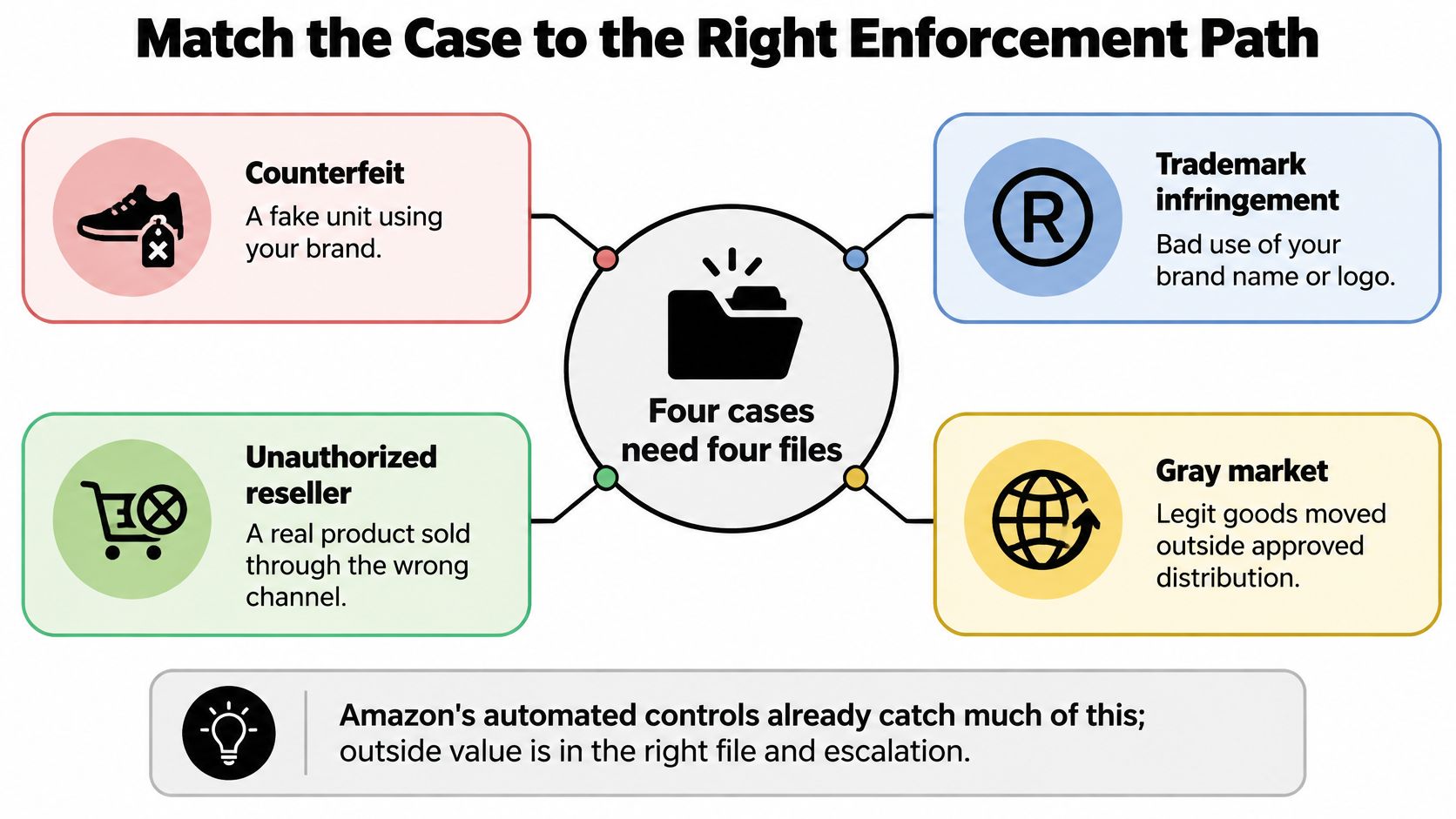
The useful protection service does more than flag suspicious offers. It distinguishes counterfeit goods, gray-market inventory, listing hijacks, and MAP violations, then tracks whether enforcement improves Buy Box share and contribution margin.
| Case | What you're seeing | Primary path | Evidence that matters |
|---|---|---|---|
| Counterfeit offer | Fake unit, packaging, or branding | Report a Violation, counterfeit type, plus test buy | Registered trademark and order ID |
| Content or image hijack | Your ASIN changed without your edit | ASIN-level Report a Violation | Before-and-after screenshots, brand assets, ASIN URL |
| Unauthorized authentic seller | Genuine product, seller not on your list, MAP broken | Reseller monitoring, test buy, MAP file | Authorization list, MAP policy, order ID, invoices |
| Gray market or diversion | Genuine product from an unwanted channel | Distribution audit, sometimes Transparency | Invoice chain back to your customer, unit codes if enrolled |
Amazon's proactive controls blocked more than 99% of suspected infringing listings before brands needed to report them, according to Amazon's customer-trust and safety report. For brands, the remaining work is to classify the case correctly, preserve evidence, and assess the effect on Buy Box share and contribution margin.
A counterfeit allegation concerns the product and the applicable intellectual property right. An unauthorized seller may have genuine goods, so the relevant evidence is the authorization list, MAP policy, and offer details. Unauthorized status alone does not make genuine goods counterfeit.
For a content hijack, save the detail page before and after the change. For suspected diversion, trace invoices toward the customer or distributor that supplied the inventory. Transparency can help authenticate units, but valid codes do not establish that a seller is authorized.
Brand Registry & Enforcement includes Brand Registry setup, reseller monitoring, and an enforcement process to remove violators. The service is most useful when the case is classified before a report is filed. For separate online reputation issues, this guide on how to suppress false claims in search discusses documenting and addressing inaccurate claims.
Filing gate: If you can't name the right, the ASIN, and the evidence type, you aren't ready to submit the report.
Amazon's guidance on responding to a suspected trademark or counterfeit issue shows why brands should retain invoices, authorization letters, order IDs, and screenshots. Sellers may use documents such as invoices or authorization records in an appeal.
File Reports Amazon Can Actually Act On
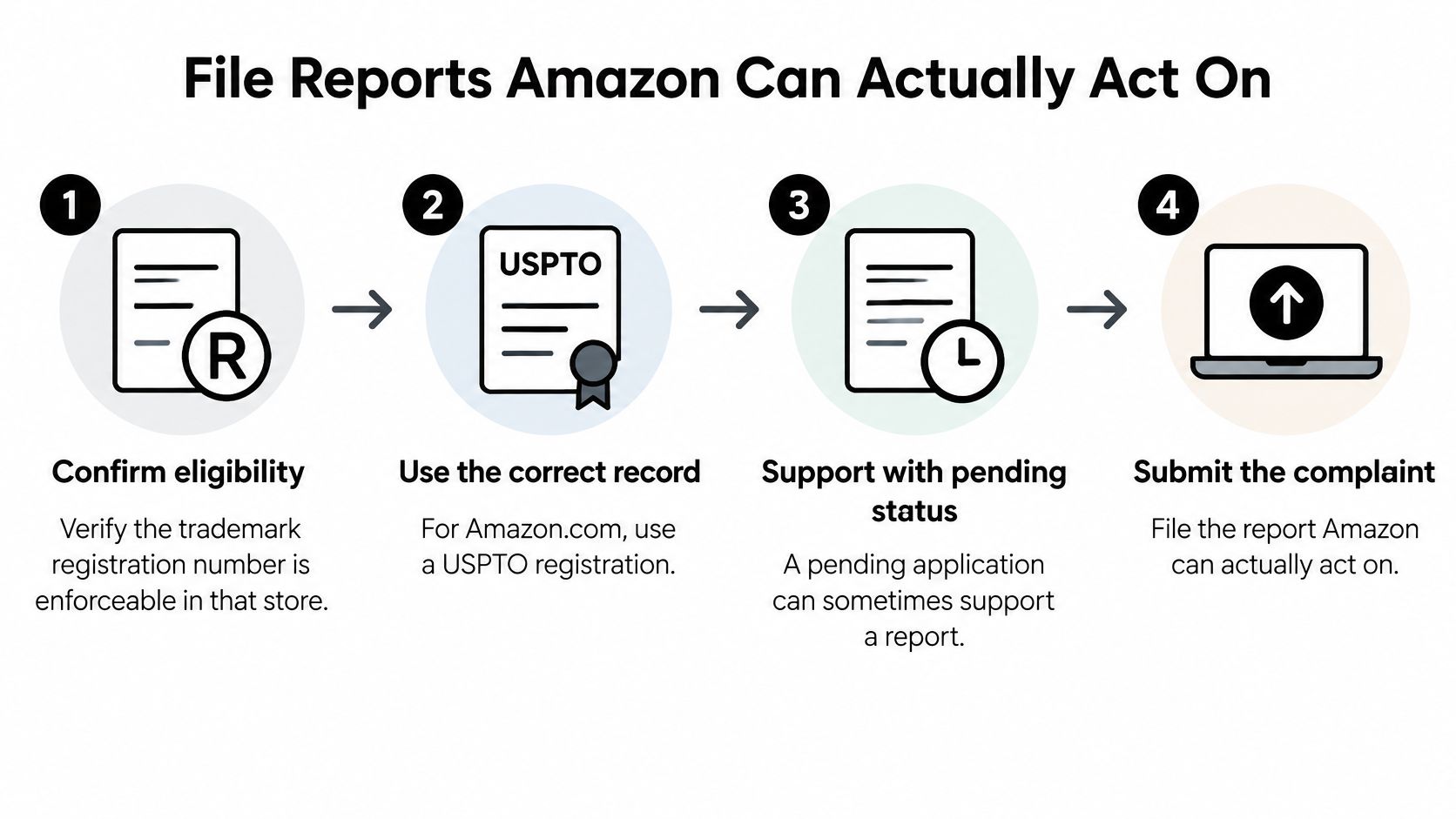
Treat each report as a case file, not a message to seller support. Amazon's workflow lets a rights owner or registered agent find a listing by ASIN, product link, or uploaded image, select an ASIN or seller offer, choose an infringement type, and submit the report. The offer-level versus ASIN-level choice determines what evidence you need (Amazon's Report a Violation guidance).
- Confirm the right is usable in the store. Check the trademark registration number and jurisdiction before you file. For Amazon.com, use a trademark registration enforceable in the United States.
- Open the right workflow. In Brand Registry, go to Protect, then Report a violation.
- Find the product or offer. Search by ASIN, product link, or uploaded image. Check that the selected record matches the suspected violation.
- Select the right target. Choose the ASIN when the violation is on the detail page. Select the seller offer when the allegation concerns that specific offer. Don't substitute one case type for the other.
- Build the appropriate evidence file. For an offer-level report involving suspected counterfeit goods or trademark use on the product or packaging, make a test buy and retain its order ID. A complete ASIN complaint does not require a test buy under Amazon's cited guidance.
- Choose one infringement type and submit. Group products only when the infringement type and specific issue are the same. Separate trademark, copyright, patent, and counterfeit allegations.
A pending trademark application may help with Brand Registry enrollment in some circumstances, but it cannot support a counterfeit report. Common-law rights can't support that report either. Amazon's guidance says a counterfeit report requires a federally registered trademark; its reporting form permits up to 50 products in one report only when they share the same infringement type and specific issue (Amazon's infringement-report requirements).
After submission, save the report ID and monitor status in the portal's submission history. If a seller appeals, brands should be ready to distinguish a product or packaging allegation from a detail-page trademark complaint. A seller may support product authenticity with an invoice or order ID; a disputed detail-page issue may require page corrections or supporting authorization documents through Account Health.
Keep one folder per ASIN containing the trademark details, screenshots, test-buy order ID, invoices, and authorization letters. That gives the person handling an appeal the evidence needed to continue the case rather than reconstruct it. For additional context on handling Amazon brand-abuse takedowns, keep the core rule in view: submit the report that matches the actual record and evidence.
Score Services on Outcomes Not Notice Volume
A provider's spreadsheet of filed URLs isn't a performance report. Amazon expects an infringement submission to identify the right, explain where the violation appears, and include the affected ASINs and detail-page URLs. Its guided workflow and submission history give brands a basis for checking report quality and outcome, rather than counting notices in isolation (Amazon's Brand Registry enforcement guidance).
| KPI | Strong | Weak | Where to read it |
|---|---|---|---|
| Report acceptance | Most first submissions accepted | Repeated rejections for missing rights or URLs | Brand Registry submission history |
| Time to removal | Clear IP cases close in days | Cases sit open for weeks | Report status in Protect |
| Repeat infringer rate | Same sellers stop returning | New store names, same product photos | Offer monitoring log |
| Reinstatement rate | Few appeals overturn a correct report | Content or offers return without a fix | Account Health appeals you can document |
| Buy Box after enforcement | Hero ASIN Buy Box back with the brand or authorized seller | Shared or lost to the violator | Detail page and Business Reports |
| Margin, rank, complaints | Contribution margin up, rank stable, authenticity complaints down | Takedowns up, profit and Voice of the Customer flat | Profit calculator, sales rank checker, Voice of the Customer |
Track these results by ASIN, not just across the account. A removal that doesn't return the Buy Box on a hero product may have little commercial value; a recovered Buy Box is more meaningful if contribution margin also improves after advertising, fulfillment, and selling costs.
Use the Amazon profit calculator to compare contribution margin on the affected ASINs, not just ad-attributed sales. Check rank movement with the sales rank checker, then compare customer feedback in Voice of the Customer for authenticity complaints. If the Buy Box loss left FBA units aging, estimate the storage exposure with the FBA storage fee calculator.
Ask for a monthly ASIN-level report with the six scorecard measures, evidence completeness, and a note on what changed after enforcement. The internal pass line should be practical: repeat sellers are falling, the Buy Box on important ASINs is stable or recovered, and contribution margin on the enforced catalog is improving within 30 to 60 days. A service that reports takedowns without those outcomes is measuring its activity, not your business result.
Choose Between In-House, Agency and Managed Platform
Compare operating models by cost per resolved case, not by monthly fee alone. In-house can be economical when the rights file is already organized and someone checks offers daily. If that person also handles every report, appeal, and reinstatement, the work can pile up when several cases arrive together.
| Model | Control | Typical cost driver | Best fit | Watch for |
|---|---|---|---|---|
| In-house team | Full control of files and appeals | Salaried time plus tools; price depends on staffing and software | Trademark data and daily offer checks already in place | Reinstatement backlog when one person owns everything |
| Agency filing service | Filings done for you, brand keeps the rights | Retainer or per case; compare quotes on the same case set | Backlog of thin reports to clear | Filings without ASIN audit trail or test-buy discipline |
| Managed protection platform | Monitoring, test buys and repeat-seller tracking | Per ASIN or per monitored offer; compare inclusions | Unauthorized seller and MAP leak | Weak without letter of authorization and MAP policy |
Before you agree to a service, put four terms in writing:
- Price per resolved case: Separate filed cases from cases that reach an agreed outcome.
- Test-buy responsibility: Identify who places the order and who retains the order ID and receipt.
- Audit trail: Require the ASIN-level record before work starts, including evidence, report status, and seller reappearance.
- Exit terms: Set an exit review against your agreed outcome measures, including the effect on the Buy Box and contribution margin.
For an agency filing service, establish whether appeals and reinstatement work are included or billed separately. For a managed platform, find out whether the scope covers seller tracking and evidence collection as well as alerts. Record any unanswered pricing fields in your baseline so quotes can be compared against the same ASINs and the same commercial target.
Build the RFP and the Evidence File
Give a prospective provider a usable evidence file, not a shared login and a hope. The RFP should make clear what rights, seller records, and internal approvals the brand already has, and how each report will be supported.
- Marketplace-specific trademark records. List the registration number, serial number, class, and owner name for each relevant marketplace. The owner information should match Brand Registry. Amazon requires an enforceable registration in the store's jurisdiction, and a pending application or common-law right can't serve as the basis for a counterfeit report (Amazon's report requirements).
- Authorized reseller and distributor list. Include the current MAP policy and name the person who can approve an exception. The operator needs this record to distinguish an authorized seller's pricing breach from an unknown seller or a distributor leak.
- Test-buy rules. Set a budget, assign who places the order, and specify how the order ID and purchase records will be stored. That evidence matters for the offer-level cases that require a test buy.
- Account access and ownership. Define access for the rights owner or registered agent. Don't make case ownership depend on a shared login with unclear responsibility.
- Separate case categories. Keep trademark, copyright, patent, counterfeit, and parallel-import matters in distinct buckets. Amazon allows products to be grouped only when they share the same infringement type and specific issue.
- A weekly violator export. Include active sellers, ASIN, offer price versus MAP, report ID, report status, any reinstatement, and whether the seller returned.
- An appeal folder template. Include an invoice, authorization letter, screenshots, and order ID where applicable, so the brand can respond with a complete record.
- A scheduled outcome readout. Require acceptance, removal timing, repeat sellers, Buy Box status, and contribution margin in the reporting cadence.
Add an edge case to the RFP: parallel import needs the right named, and genuine products leaking from a distributor won't become counterfeit just because the seller is unwanted. Ask who performs the account work and whether any filing is outsourced. Stop the process if the bidder can't show a redacted ASIN audit trail with evidence and status fields.
Start With a 30 Day Protection Baseline
Before signing a provider, build a baseline packet from your own account. Export the last 30 days of Account Health information, collect Voice of the Customer complaints mentioning authenticity or “used sold as new,” and record the offers on your top 20 ASINs. For each offer, note who holds the Buy Box and the price difference from your MAP policy.
Run those ASINs through the Amazon profit calculator and sales rank checker. If a lost Buy Box leaves FBA units aging, estimate the storage cost with the FBA storage fee calculator. This packet shows whether your immediate gap is counterfeit units, unauthorized authentic offers, content changes, or missing evidence.
Match the response to the leak. Keep enforcement in-house if the rights file and daily offer check already exist. Consider Transparency when counterfeit units are the physical-product concern. For unauthorized sellers and MAP issues, Online Brand Growth offers a 360 Brand Protection program for unauthorized seller removal and MAP enforcement. Its Amazon reseller monitoring guide explains the monitoring context, and the free Unauthorized Seller Playbook covers moves used to identify, document, and remove unauthorized resellers and MAP violators.
Leave the baseline with three decisions: which violation types you'll file, what evidence you still lack, and what Buy Box and contribution-margin result you want to see at your next review. After an intro call, Online Brand Growth provides a complimentary brand audit and strategic roadmap with account-specific recommendations.
Bring your baseline packet to a free strategy call with Online Brand Growth. We offer 360 Brand Protection for unauthorized seller removal and MAP enforcement, and can review the evidence gaps and Amazon outcomes you need to measure.