
Moving budget to whichever ad format has the higher ROAS sounds disciplined. It isn't, unless you know whether those sales would have happened anyway. In the Amazon Sponsored Brands vs Sponsored Products decision, the useful question is what profitable demand would disappear if you stopped funding each format, not which campaign dashboard looks cleaner.
Why the Sponsored Brands vs Sponsored Products Question Is Framed Wrong
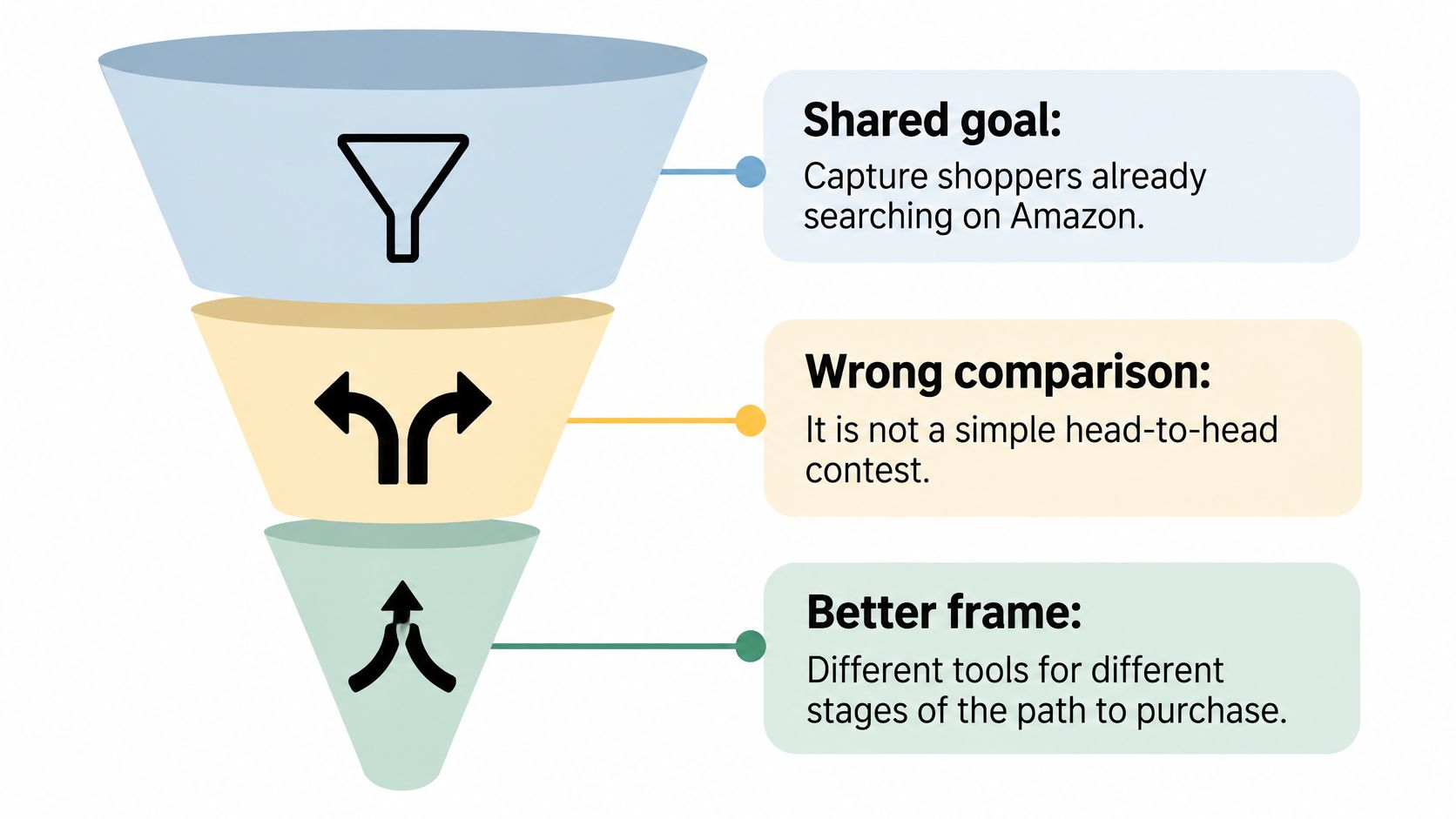
Sponsored Products and Sponsored Brands aren't interchangeable ways to buy the same outcome. Sponsored Products concentrate spend on an individual product detail page, while Sponsored Brands give advertisers more control over how shoppers encounter a brand and its assortment.
The distinction matters before you compare bids or approve creative. An ad that helps someone choose a specific ASIN has a different job from an ad that introduces a product family.
What shoppers actually see
| Decision point | Sponsored Products | Sponsored Brands |
|---|---|---|
| Advertising unit | Individual product | Brand-led creative and selected products |
| Destination | Advertised product detail page | Brand Store or selected product pages |
| Creative control | Primarily listing-led execution | Logo, custom headline, video or lifestyle creative, depending on format |
| Core role | Capture product-level purchase intent | Support discovery and portfolio consideration |
| Eligibility | Professional sellers and vendors | Generally Brand Registry-enrolled professional sellers or vendors |
These format, destination and eligibility distinctions follow Amazon's advertising overview, which also reports average increases of 50% in weekly units ordered and 30% in glance views within a year of Sponsored Products launch. Those are Amazon-reported averages, not a causal forecast for your next campaign.
A mature brand should treat the formats as complementary tools with separate investment cases. That doesn't mean both deserve funding automatically. It means neither should be eliminated because the other captures more immediately attributable revenue.
Confirm eligibility and placement before planning spend
Start by checking your selling account and brand enrollment, then inspect which campaign options your advertising console exposes. Don't brief a Store-led campaign before confirming that the brand, destination and eligible products are available.
Sponsored Products can appear in shopping results, product detail pages and checkout pages, with selected external placements depending on marketplace and settings. Sponsored Brands occupy placements at the top of, alongside or within shopping results. Availability isn't a promise that your campaign will receive every placement.
The brand-level controls have a history. Trade histories commonly place Amazon Marketing Services around 2012; Amazon consolidated its advertising businesses under Amazon Advertising in September 2018, renaming Headline Search Ads as Sponsored Brands, as outlined in the Sponsored Brands background and documentation. The current offering supports three formats, product collection, Store Spotlight and video, across desktop and mobile shopping results.
That evolution explains why treating Sponsored Brands as a larger product ad misses its purpose. You can control the message, assortment and destination rather than choosing which listing receives a click.
Operating principle: Assign an outcome to the campaign before assigning a budget. A format isn't a strategy.
Before launch, write down the buying decision you want to influence. Is the shopper choosing a specific item, comparing your range, or discovering why your brand belongs in the consideration set?
Then check whether the destination helps that decision. Sending a category-level shopper to an unrelated Store homepage wastes the creative opportunity. Sending a ready-to-buy shopper through unnecessary navigation can be equally unhelpful.
The practical comparison isn't awareness versus sales. It's which shopping task each campaign helps complete, and whether completing that task adds profitable business.
Targeting, Bidding and Budget Mechanics
Build account structure around intent and destination, not just ad format. Otherwise, branded demand, category discovery and competitor targeting end up competing for the same budget without a clear owner.
In Seller Central, start with Advertising > Campaign Manager > Create campaign, then inspect the available Sponsored Products and Sponsored Brands options. Interface labels can vary, so confirm the setup controls in your account before building bulk changes.
Separate the spending jobs
- Product-level capture: Use Sponsored Products keyword targeting for known purchase intent and automatic targeting for discovery. Keep discovery spending distinguishable from proven demand.
- Brand defense: Isolate your own brand queries so their efficiency doesn't conceal weak non-branded acquisition.
- Portfolio discovery: Give Sponsored Brands a destination curated around the query, rather than routing every campaign to the same Store page.
- Competitive testing: Separate competitor-oriented activity so you can cap its exposure and evaluate it without contaminating core performance.
Sponsored Products use CPC and send traffic to the advertised detail page; Sponsored Brands support broad, phrase and exact keyword matching, with CPC and, in certain implementations, viewable CPM or fixed/upfront structures, according to Amazon's sponsored advertising FAQ.
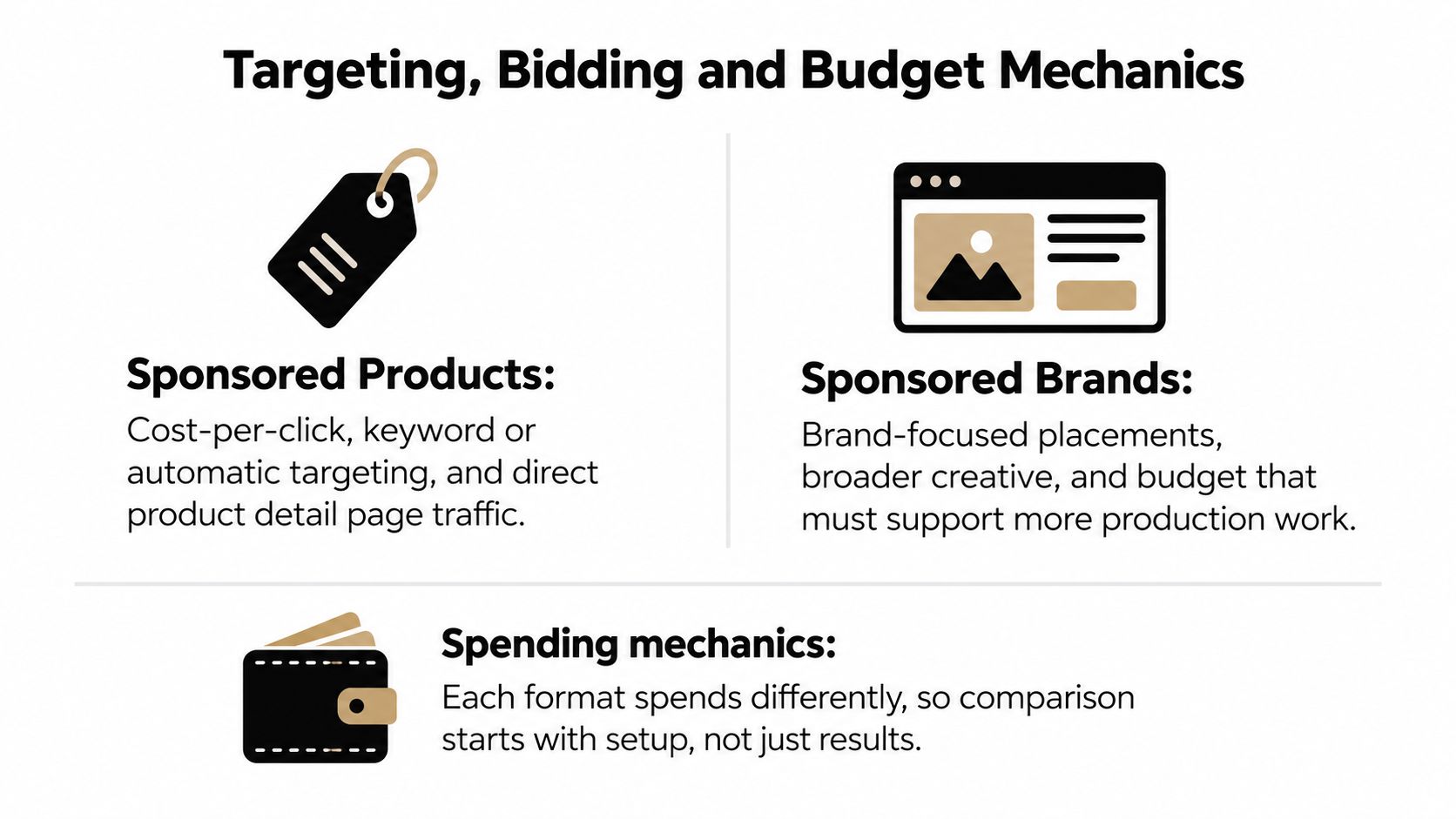
Budget separation won't eliminate cannibalization. It makes overlapping investment visible enough to test.
Keep a discovery allowance distinct from the spend needed to maintain profitable, established campaigns. Don't fund experimental reach by starving a hero SKU's productive queries.
For bid changes, use a documented Amazon PPC bid strategy rather than reacting to yesterday's ROAS. Record the reason for each material adjustment, including whether you're testing price sensitivity, placement value or query quality.
Creative and Copy Requirements for Each Format
Sponsored Products generally involve less separate creative production because execution draws on the product listing. Sponsored Brands require you to make decisions about the message, visual assets and shopping destination.
That additional work is justified only when the creative helps shoppers understand something the listing alone doesn't communicate well.

Brief the buying question, not just the asset
For listing-led execution, examine whether the product image and title make the item immediately understandable. Treat listing changes carefully, because you're changing the retail experience as well as the advertising input.
For Sponsored Brands, give the production team a specific task. Demonstrate the product in use, explain a meaningful difference between models, or show how complementary products fit together. A logo animation without a buying argument isn't much of a test.
Amazon accepts Sponsored Brands video in MP4 or MOV, lasting 6 to 45 seconds, with 20 seconds or less highly recommended; files must be 500 MB or smaller, use 16:9, and meet supported dimensions including 1280 by 720, 1920 by 1080 or 3840 by 2160 pixels, according to the Sponsored Brands video specifications.
- Test the message: Change the customer benefit or demonstration, while keeping targeting and destination stable.
- Check the destination: Make the ad's promise visible on the landing page. This Amazon Storefront guide is useful when planning that experience.
- Include production economics: Count editing, revisions and asset maintenance when deciding whether video is worth funding.
Don't impose a creative calendar that your traffic can't support. Keep an asset live long enough to evaluate useful behavior, then replace it for a documented reason rather than because the team has grown tired of seeing it.
KPIs and Measurement for Each Format
A blended ROAS report can hide both weak acquisition and excessive spending on shoppers who already know you. Build separate scorecards, then reconcile them against channel profitability.
| Scorecard | Primary questions |
|---|---|
| Sponsored Products | Which ASINs, queries and placements produce profitable purchases? |
| Sponsored Brands awareness | Are impressions generating qualified engagement? |
| Sponsored Brands acquisition | Are we reaching new-to-brand customers at acceptable economics? |
| Portfolio performance | Does traffic produce valuable sales beyond the entry product? |
For Sponsored Products, prioritize advertised-ASIN sales, conversion rate, CPC, ACOS/ROAS and search-term efficiency. Use the ACOS definition and calculation consistently, but don't mistake attributed efficiency for incremental profit.
Read the reports at their actual scope
The Sponsored Brands Search term report includes customer searches that generated at least one click, while the Targeting report covers targets in Sponsored Products and Sponsored Brands receiving at least one impression; keyword targeting identifies the targeted keyword, and Product Attribute Targeting identifies the targeted category, according to Amazon's Search term report documentation.
That distinction changes your diagnosis. A missing query in the Search term report doesn't prove the campaign received no impressions for it.
- Query review: Identify relevant searches with purchases or strong engagement, then inspect whether the landing experience matches intent.
- Target review: Investigate targets receiving exposure without useful clicks.
- Placement review: Separate a productive target from an unproductive placement before cutting the target altogether.
For Sponsored Brands, use impressions and CTR for awareness objectives, then add new-to-brand orders, sales, purchase rate and cost per new-to-brand purchase. Amazon's category benchmark report compares impressions, CTR and ROAS against the median, bottom 25% and top 25% of relevant peers; Amazon also reports an average 9% CTR uplift for Sponsored Products campaigns using video versus those without it, on its Sponsored Brands measurement page.
Neither comparison supplies a universal profitability threshold. Your margins still determine what you can afford.
Performance Benchmarks and the Incrementality Gap
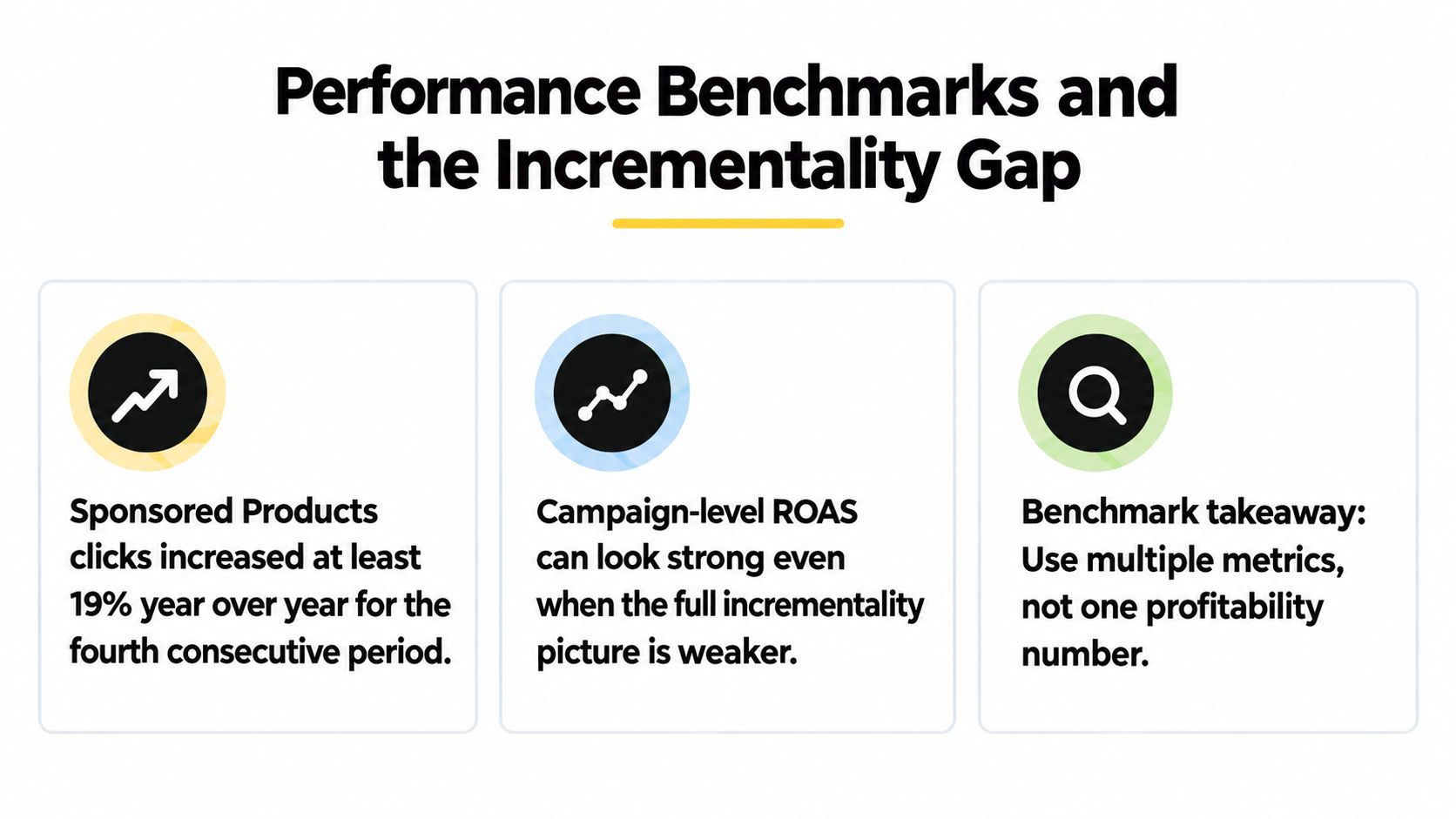
The headline benchmark favors Sponsored Products, but it doesn't settle the budget decision.
In Q1 2026, Sponsored Products clicks increased at least 19% year over year for the fourth consecutive quarter, spend rose 21%, and average CPC increased 2%; Sponsored Brands spend grew 3%, clicks fell 10%, and CPC increased 14%, according to Tinuiti's Digital Ads Benchmark Report.
Those figures describe the benchmark population, not what your account should achieve. They also don't establish whether either format generated sales that wouldn't otherwise have happened.
Test what disappears
Choose a clearly defined campaign group and document its expected contribution before reducing spend. Keep pricing, promotions, inventory availability and other major campaign changes as stable as practical.
Track total category sales, contribution margin, branded-search activity, new-to-brand customers and Store engagement. Include assisted-conversion evidence where available, but don't assume every account exposes a complete customer journey.
A fall in attributed sales isn't sufficient evidence of lost business. Check whether total sales and contribution fall with it.
Use a comparable untreated product group or period where feasible. If demand shifts materially, or a promotion overlaps the test, record that limitation instead of claiming a clean causal result.
Promotional analysis involves a similar baseline problem. ELECTE's resource on how to measure sales lift from promotions offers relevant context for distinguishing observed sales from additional sales.
Keep branded and non-branded results separate throughout the test. Otherwise, efficient demand capture can conceal ineffective discovery, or weak direct attribution can conceal a useful portfolio effect.
Higher reach costs aren't a reason to protect Sponsored Brands unconditionally. They're a reason to demand a sharper hypothesis and better evidence.
Portfolio Economics and When Sponsored Brands Deserve Funding
A Sponsored Brands campaign can deserve funding despite weaker direct ROAS. The condition is that you can demonstrate valuable catalog behavior, not merely point to attractive creative or rising impressions.
Amazon research summarized in this Amazon advertising guide reports that brands adding Sponsored Brands video to 12 static Sponsored Products ads achieved 25% higher CTR and 10% higher year-over-year sales growth than the comparison group. That evidence concerns a particular video combination, not every Sponsored Brands campaign, and it doesn't guarantee incremental profit.
Evaluate the assortment, not only the entry ASIN
Consider a manufacturer with entry-level, premium and complementary products. A Store destination may help a shopper select the appropriate model or add a compatible item, but that remains a hypothesis until purchase behavior supports it.
Build a portfolio scorecard around:
- Revenue per branded visitor: Does the destination attract valuable shopping activity rather than cheap clicks?
- Cross-ASIN orders: Are shoppers purchasing beyond the product that first attracted attention?
- Product mix: Does the campaign shift demand toward healthier-margin products?
- Customer quality: Track new-to-brand acquisition and repeat purchase where your reporting supports them.
- Contribution after advertising: Deduct product, fulfillment, selling and advertising costs using a consistent accounting basis.
Avoid double-counting revenue across campaign reports. Reconcile attributed results to actual channel sales before making the investment case.
The strongest case for a multi-product destination is a coherent assortment that helps shoppers decide. An unrelated collection of inventory isn't a portfolio strategy.
Funding test: Accept weaker direct efficiency only when the additional catalog value is visible enough to justify it.
If the supposed cross-selling benefit never appears in the available evidence, stop using it to excuse poor performance. Narrow the assortment, change the destination or move the budget.
Implementation Checklist and Budget Allocation by Funnel Stage
A defensible budget split comes from campaign jobs, product economics and testing capacity. It doesn't come from a standard percentage assigned to every established brand.
Configure the account before expanding spend
- Confirm access: Check Amazon Brand Registry enrollment and whether the intended brand and products appear in Campaign Manager.
- Name campaign roles: Distinguish branded defense, non-branded capture, discovery and competitive activity.
- Separate targeting: Keep automatic discovery, proven keywords and product-targeting tests identifiable. Review the available targeting controls for each selected format.
- Maintain exclusions: Review negative keyword and negative product-targeting options where available, removing irrelevant traffic without blocking valuable discovery indiscriminately.
- Schedule weekly reporting: Pull Search term and Targeting reports, review campaign and placement performance, and retain Store and new-to-brand results where available.
- Log changes: Record budget, bid, creative and destination adjustments so the next review has context.
Pressure-test the retail economics before increasing bids. Use the free Amazon profit calculator to examine product profitability and the FBA storage fee calculator to account for inventory carrying exposure.
The sales rank checker can provide additional product context, but don't treat rank as a substitute for sales or margin measurement.
Allocate by the next commercial constraint
| Product situation | Initial funding priority | Reason to change direction |
|---|---|---|
| New ASIN needing purchase validation | Focused product-level demand capture | Relevant traffic doesn't convert, requiring retail corrections |
| Established hero SKU | Protect economically productive demand | Additional spend produces little additional contribution |
| Coherent product family | Test curated portfolio traffic | Cross-ASIN value and customer quality support expansion |
| Weak-margin or inventory-constrained item | Restrict expansion | Economics or availability improve |
Give each test enough budget to answer its question without compromising productive campaigns. Shift money when the evidence supports a better marginal return, not because one format's average ROAS exceeds another's.
Strategic Recommendations and Your Next Step
Keep Sponsored Products accountable for the product-level opportunity and Sponsored Brands accountable for the customer or assortment opportunity. Don't let either team claim success while total channel contribution deteriorates.
The immediate management task is to identify your largest untested assumption. It might be that branded advertising is fully incremental, that Store traffic creates cross-selling, or that every productive hero SKU deserves more budget.
Decide who owns the complete result
An in-house team can manage this work when someone owns campaign operations, retail readiness and financial reconciliation. That owner needs authority to change a landing page, challenge a margin assumption and stop an unsuccessful test.
Outsourced support becomes more useful when those responsibilities sit with disconnected teams or when execution capacity prevents testing. The selection criterion should be operational coverage and clear accountability, not the size of a reporting deck.
Evaluate the operating model against concrete responsibilities:
- Advertising and retail readiness: Coordinate PPC with listing improvements, A+ content and Brand Store or Storefront work.
- Financial decisions: Reconcile campaign reporting with contribution margin rather than rewarding spend growth.
- Channel protection: Address unauthorized seller removal and MAP enforcement through a defined process, such as the 360 Brand Protection program, without treating enforcement as a guaranteed outcome.
- Decision ownership: Assign responsibility for test design, implementation and the decision to continue or stop.
Before commissioning more assets or approving another budget increase, ask for a campaign-role map, a product-level margin view and a documented incrementality test. Those deliverables make the discussion specific enough to act on.
The objective isn't to prove that a preferred format works. It's to discover which investments add profitable demand, which merely collect attribution, and which need a different destination or offer before they deserve more money.
Online Brand Growth offers integrated PPC, listing, Storefront and channel-protection support aligned to channel contribution margin. To evaluate your Sponsored Products and Sponsored Brands allocation against incremental profit, book a free strategy call.