
The common advice says summer meltable issues are just a fulfillment problem. That's too shallow. If you switch heat-sensitive ASINs to FBM without tightening packaging, carrier choice, and complaint monitoring, you've moved the risk from Amazon's warehouse into your own account health, and Amazon still owns the enforcement action when customers report melted product.
Amazon requires sellers to ensure meltable products reach customers in satisfactory condition and warns that repeated complaints about melted products can lead to termination of the corresponding offers. For an operator, that means summer FBM is not a neutral workaround, it's a different operating model with a very real downside if your team treats it like a temporary label swap. A useful framing piece on the physical side of fulfillment is Peak Transport on fulfillment operations, because the storage and handoff mechanics matter more than most brands admit.
The Hidden Risks of Summer Fulfillment Workarounds
Seller-fulfilled meltables are often pitched as the easy escape hatch when FBA closes the door for summer. In practice, that move transfers the hardest parts of the problem, temperature exposure, packaging validation, and complaint liability, to your own team. Amazon doesn't take over those risks just because you're no longer inbounding to FBA.
FBM shifts responsibility, it doesn't remove it
Under seller fulfillment, you own the condition of the product when it reaches the customer. That sounds obvious until your customer service team starts dealing with melted chocolate, warped gummies, or soft bars that technically shipped on time but arrived in poor condition. Amazon's policy language is blunt about the consequence, repeated complaints can end the offer.
Practical rule: If you can't prove the lane works in hot weather, don't assume FBM is safer than holding inventory out of FBA.
The hidden mistake is assuming the channel change solves the temperature problem. It doesn't. It changes who absorbs the failure, your warehouse, your carrier, and your support team instead of Amazon's fulfillment network. That's why many brands see summer FBM as an account-health decision first and a logistics decision second.
What most teams under-plan
A real meltable FBM lane needs more than a mailer and a faster ship method. It needs validated insulated packaging, realistic geographic restrictions, and a returns policy that accepts that melt damage may come back as a customer complaint rather than a reimbursable loss. If your operation can't absorb that, the margin on summer sales can disappear quickly.
The operational trade-off is simple. FBA gives you Amazon's fulfillment machinery outside the restricted window. FBM gives you control, but also full liability for condition, delivery experience, and complaint volume. For brands moving seasonal confectionery, that's not a tactical tweak, it's a different risk profile.
Defining the Meltable Classification and Thresholds
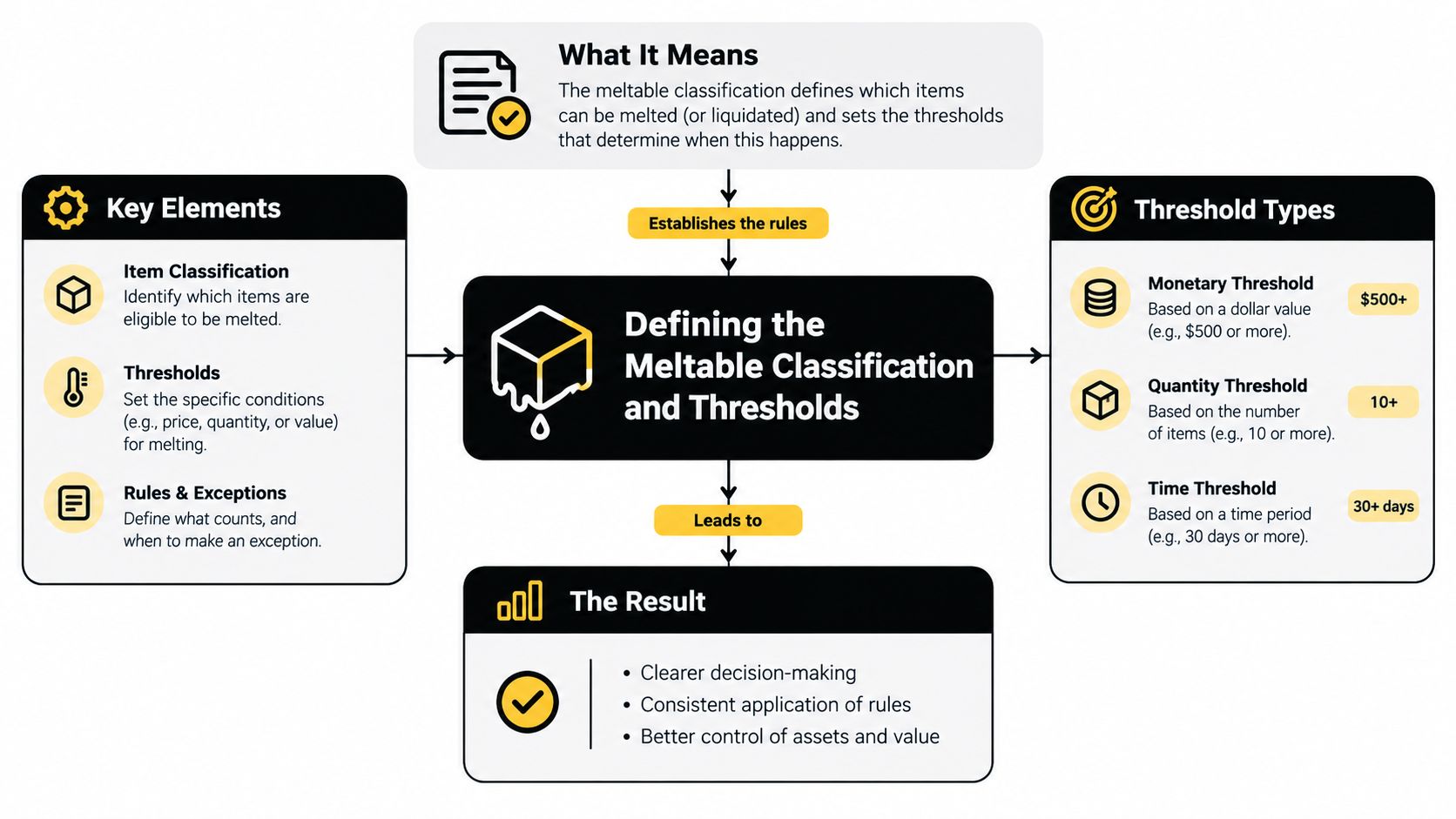
Amazon classifies meltable inventory as heat-sensitive consumables that face a high risk of melting during exposure to temperatures at or above 155°F (68°C), including chocolate, gummies, and certain jelly- and wax-based products. That definition matters because it isn't just about product category, it's about how the product behaves under heat exposure in storage and transit. Amazon's meltable inventory help page is the starting point for any catalog audit.
The 155°F threshold is not the whole story
The 155°F line is the classification trigger for meltable FBA treatment. It's the point Amazon uses to decide whether a product belongs in the seasonal lane, not a promise that anything below it is safe. That's why a product can still be technically deliverable while losing shape, texture, or consumer appeal well before it reaches that threshold.
The practical distinction is between product survival and product quality. A snack bar may survive a hot truck without fully liquefying, but still arrive deformed enough to trigger complaints and returns. Amazon's operational logic is built around that quality risk, not just whether the item remains physically intact.
What belongs in the audit
Brands should review every ASIN with heat-sensitive ingredients, coatings, fillings, wax components, or jelly-based construction. Chocolate, gummies, protein bars, cookies, and coated candy all deserve separate handling logic, because a broad “food” label is too crude for Amazon's seasonal classification rules. A wax-based product may behave very differently from a bar with a chocolate shell, even if both show up in the same portfolio.
If your product gets soft in a delivery van, it doesn't matter that it never fully melted in the warehouse.
I'd treat the catalog review as an ASIN-level exercise, not a brand-level one. That's the only way to catch mixed assortments, seasonal pack sizes, and edge-case SKUs that behave differently under heat. It also keeps you from sending a product down the wrong fulfillment path just because it sits next to a non-meltable item in the same line.
Navigating the 2026 Seasonal Acceptance Calendar
Amazon's meltable policy is seasonal, not a permanent ban, but the reopening is staggered by product type. Under the current policy, gummies, protein bars, cookies, and coated candy ASINs may be inbounded to FBA beginning August 31, 2026, with Amazon fulfillment beginning September 14, 2026. Milk and dark chocolate, coated chocolate nuts, chocolate fruit, caramel, and gelatin gummies may be inbounded beginning September 21, 2026, with fulfillment beginning October 5, 2026. The Amazon help page for the current policy shows why the intake date and ship date are not the same milestone.
A quick way to think about it is simple. Amazon can accept a box before it will ship from that box. That creates a 14-day gap for each product group, and if your replenishment plan ignores that gap, you can end up with inventory stranded in a facility before it's eligible to move.
| Product Category | Inbound Eligibility | Fulfillment Start |
|---|---|---|
| Gummies, protein bars, cookies, coated candy | August 31, 2026 | September 14, 2026 |
| Milk and dark chocolate, coated chocolate nuts, chocolate fruit, caramel, gelatin gummies | September 21, 2026 | October 5, 2026 |
Mapping those dates into replenishment
Start with your sell-through forecast, then work backward from the fulfillment start, not the inbound date. If a PO is likely to land early, hold it back or split it so it doesn't cross the line before Amazon will ship it. That matters most for seasonal confectionery because demand windows are narrow and the wrong arrival date can turn a normal restock into an unfulfillable shipment.
The cleanest planning workflow is to separate ASIN groups by acceptance window, then line up purchase orders, receiving appointments, and transit timing around the later date. That keeps you from assuming “accepted by Amazon” and “available for sale” mean the same thing, because they don't.
Forecasting with sell-through, not optimism
Use your own sales rhythm, not a generic replenishment rule. If a meltable SKU sells heavily in late summer, the order timing needs to be more conservative than a winter SKU with slower velocity. The Amazon sales rank checker is useful here as a directional input, because it helps you sanity-check velocity before you commit inventory to a window that might close on you.
Evaluating FBM as a Summer Fulfillment Strategy
FBM is workable for meltables only if your operation can control the lane end to end. That means insulated packaging, carrier selection, geography filters, and customer-service rules for melted arrivals. The moment you rely on standard packaging and hope for the best, you're running a complaint-generation program, not a fulfillment strategy.
The trade-off between control and risk
FBA removes a lot of operational friction outside the seasonal restriction window. FBM gives you control, but you also inherit the weather problem, the carrier problem, and the replacement problem. That's especially visible on returns, because Amazon's Japan guidance shows an important principle, meltable returns can move under standard, non-temperature-controlled conditions, and melted products in return transit are not eligible for reimbursement.
That's the part many teams miss. The risk doesn't end when the customer clicks buy. It follows the box through outbound transit, doorstep dwell, and return transit, which is why your support policies need to match your shipping lane rather than your catalog margin sheet.
Build the lane by destination, not by SKU alone
A single FBM rule usually isn't enough. You need a lane-by-lane decision framework that asks where the order is going, how long it will take, what packaging it needs, and whether the product still arrives in sellable condition after any delay. Shipping a chocolate item to a hot region in July is not the same problem as sending the same item into a cooler market with a one-day carrier path.
If your team wants a broader comparison of fulfillment models, the internal guide on Amazon FBA vs FBM is a useful companion, but the operative point here is narrower. For meltables, the channel decision should be driven by product stability and complaint tolerance, not by convenience.
Useful filter: If the product can't tolerate standard parcel transit plus a delivery delay, the lane isn't ready for summer FBM.
Executing Pre-Cutoff Removal and Disposal Workflows
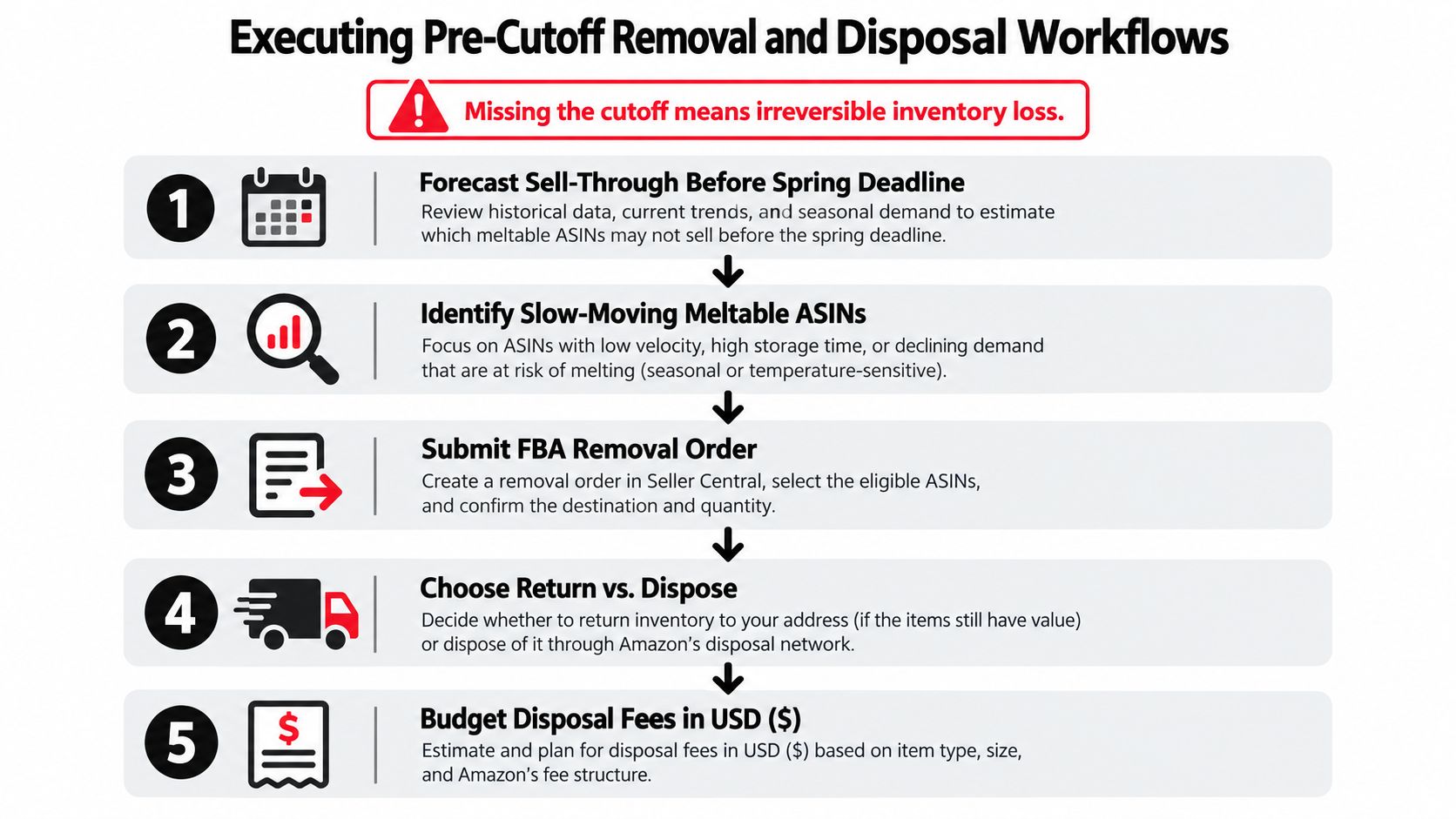
The seasonal window for meltable FBA inventory runs October 16 through April 14. Miss that cutoff, and inventory that arrives or stays in the restricted period can be marked unfulfillable and disposed of for a fee. Amazon's seasonal forum guidance makes the operational reality plain, late action can turn into permanent inventory loss.
Remove early, not at the deadline
Start with sell-through forecasting, then work backward from the cutoff. Review meltable ASINs before the season turns, isolate slow movers, and create removal orders in Seller Central before the calendar starts working against you. Waiting for the final week creates processing delays, transit lag, and stranded inventory that quietly eats margin.
Amazon's removal settings matter just as much. Unfulfillable inventory can be returned, liquidated, or disposed of through configured removal preferences, and if no automated setting is in place, disposal can become the default. Make sure disposal isn't the default outcome unless you intend that outcome.
Use configured settings and cost logic
The right workflow combines policy with cost control. If a SKU is close to the seasonal cutoff, compare removal cost, liquidation value, and the chance of recovery through a return. The FBA storage fee calculator helps pressure-test that decision before aging inventory sits in FCs and becomes hard to recover.
A practical SOP looks like this:
- Forecast sell-through early: Start with your slowest meltable ASINs and identify what will not clear before the restricted period.
- Submit removal orders in Seller Central: Do not wait for warehouse congestion to decide for you.
- Set removal preferences: Make sure disposal isn't the default outcome unless you intend that outcome.
- Track inbound timing: A box that arrives too late can be treated as unfulfillable even if the PO looked clean on paper.
- Check storage economics: Compare removal, liquidation, and storage exposure before you leave product sitting in place.
Modern 3PLs are starting to automate exactly this kind of disposition logic, see how AY Automate applies AI to logistics workflows. For teams managing more than meltables, Amazon stranded inventory and its failure modes is a useful parallel, because the same delay patterns show up across other dead-stock scenarios.
Securing Exemptions Through Seller Support
Some products hold up to heat better than Amazon's default meltable bucket suggests. In those cases, the right move is not to argue from instinct, it's to build an evidence package and ask for reclassification through Seller Support. Amazon requires a manufacturer letter confirming that the product can be stored at temperatures up to 155 degrees Fahrenheit for extended periods, and Seller Support verifies that information. SPS Commerce's summary of the process captures the key requirement.
What the evidence needs to do
The manufacturer letter should be tied to the exact product or ASIN, not just a brand family. That matters because Amazon is looking for product-specific proof, not a general claim that “our line runs hot tolerant.” If you're asking for an exemption, the documentation has to make the case that the product can survive the seasonal environment Amazon is worried about.
A strong packet usually includes a formal statement on manufacturer letterhead, the product identifier, and a clear temperature claim that matches the ASIN under review. Submit it through Seller Support before the seasonal deadline so there's time for verification and follow-up if Amazon asks for clarification.
Why proactive submission wins
Waiting until the season flips is the wrong play. Once inventory is already boxed into the wrong classification, you're buying time with storage, removals, and possible sales interruption. That's especially painful for higher-margin heat-stable items, because an exemption can preserve year-round FBA access if the documentation is solid.
A reclassification request is a documentation exercise, not a debate.
The best operators use this path selectively. If the product really is stable, the exemption process can protect the margin. If it's a borderline item that only looks safe in ideal conditions, the better move is often to keep it in the meltable lane and plan around the season instead of forcing a weak exemption.
Integrating Compliance into Brand Protection and Profitability
Meltable control is a margin decision tied to compliance. If your removal settings are sloppy, your FBM lane is fragile, or your exemption files are incomplete, the cost shows up in stranded inventory, support cases, and Buy Box instability. Amazon's inventory-removal guidance says unfulfillable inventory can be returned, liquidated, or disposed of, and if no automated setting is enabled, disposal can become the default outcome. Amazon's removal guidance makes that risk plain.
Model the full cost before you choose the lane
Build the economics around the full summer outcome, not just shelf margin. Include shipping premiums, removal fees, disposal loss, and the operational time needed to keep FBM orders within spec. The Amazon profit calculator helps pressure-test each meltable ASIN before you decide whether to route it through FBM, hold it out of FBA, or pull it from sale.
The same discipline applies to catalog protection. Seasonal movement can leave room for unauthorized sellers to exploit stale or poorly stored inventory against your offer. Our guide to brand protection on Amazon covers enforcement and MAP control in detail, which matters more when product condition varies by season.
Build the operating rule once, then reuse it
Brands that handle this well do not improvise every spring. They set a calendar, define the ASIN-level meltable list, choose a removal setting, document exemption candidates, and decide which lanes justify FBM effort. That gives operations, finance, and customer service a shared rule set, and it keeps the summer ban from becoming a yearly fire drill.
The hidden risk is treating FBM as a clean workaround. If temperature control is weak, late arrivals, soft packaging, or carrier delays can create account health issues that cost more than the inventory you saved. I use a lane-by-lane review: heat-stable products with tight packing and predictable transit can justify FBM, borderline items should stay in the meltable lane, and anything with weak compliance or reseller exposure needs tighter controls before it moves.
If you want to pressure-test your meltable catalog, model the economics, and tighten your seasonal playbook, book a free strategy call with Online Brand Growth and put your summer FBA plan on firmer footing.