
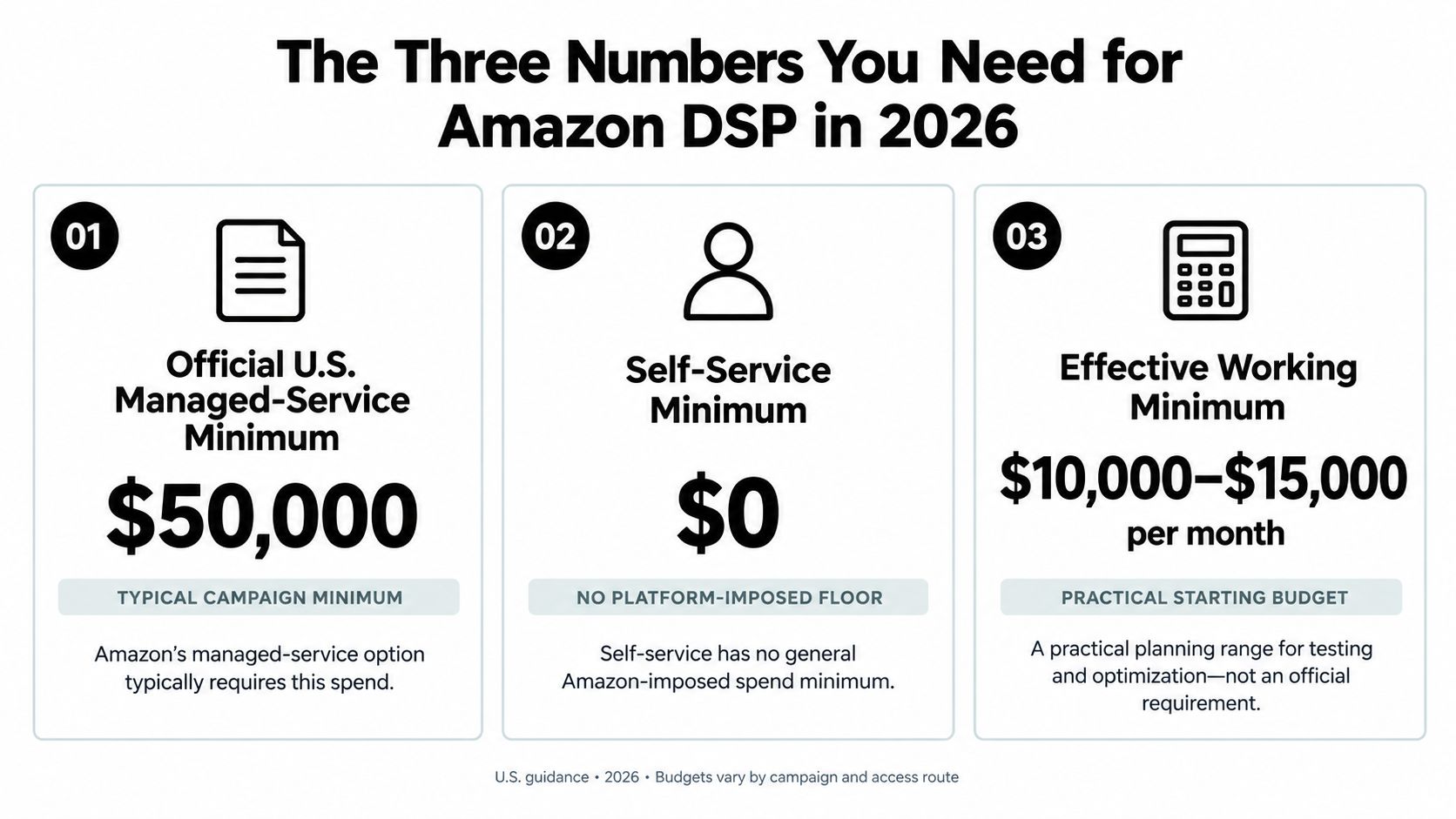
Amazon's official managed-service DSP threshold in the U.S. is typically $50,000 in 2026, while self-service DSP no longer has an Amazon-imposed floor after the November 2025 change. A practical self-service starting budget is still around $10,000 to $15,000 per month to generate usable optimization signal.
You're probably comparing a DSP proposal with the Sponsored Products budget you already manage. Finance wants a commitment period, your team wants incremental customers, and the proposal says “minimum spend” without explaining whether that means media, service fees, or a contractual obligation. Resolve that ambiguity before you approve the purchase order.
The 2026 Answer and Why One Number Is Not Enough
A DSP proposal lands with one figure labeled “minimum spend.” Before approving it, identify which route that figure applies to. Amazon's access threshold, a provider's commercial terms, and the budget needed to learn from campaign delivery are separate numbers, and each affects the decision differently.
Amazon's official advertising FAQ lists $50,000 as the typical U.S. managed-service requirement, with variation by market. Self-service access is a different route. Removal of its floor after November 2025 unBoxed changes the access question, but it does not pay for campaign execution or ensure the budget will produce useful results.
Separate permission from viability
Check three items in the proposal:
- Amazon access threshold: The commercial commitment tied to the route Amazon offers your business.
- Partner minimum: Any media requirement, seat charge, or management commitment in the provider's agreement.
- Operating budget: The media investment needed to answer a defined business question without spreading delivery too thin.
These figures serve different purposes. A low entry requirement may make access possible, while the provider's terms and the campaign's learning needs determine whether the test is workable.
A small allocation can become too thin if it must cover prospecting, remarketing, display, streaming TV, several markets, and multiple product families. Delivery gets divided across too many variables, making it harder to identify which audience or tactic drove the result.
Practical rule: Concentrate spend enough to learn; avoid adding complexity just to make the plan look impressive.
For broader channel budgeting, Adwave's resource helps you compare digital and social ad pricing. Use it to compare buying models, not to assume equivalent purchase intent or profitability.
Choose the available route, clarify every commercial obligation, and forecast delivery around a focused test. Then assess whether the expected economics support your contribution-margin target.
Managed-Service vs Self-Service Access in 2026
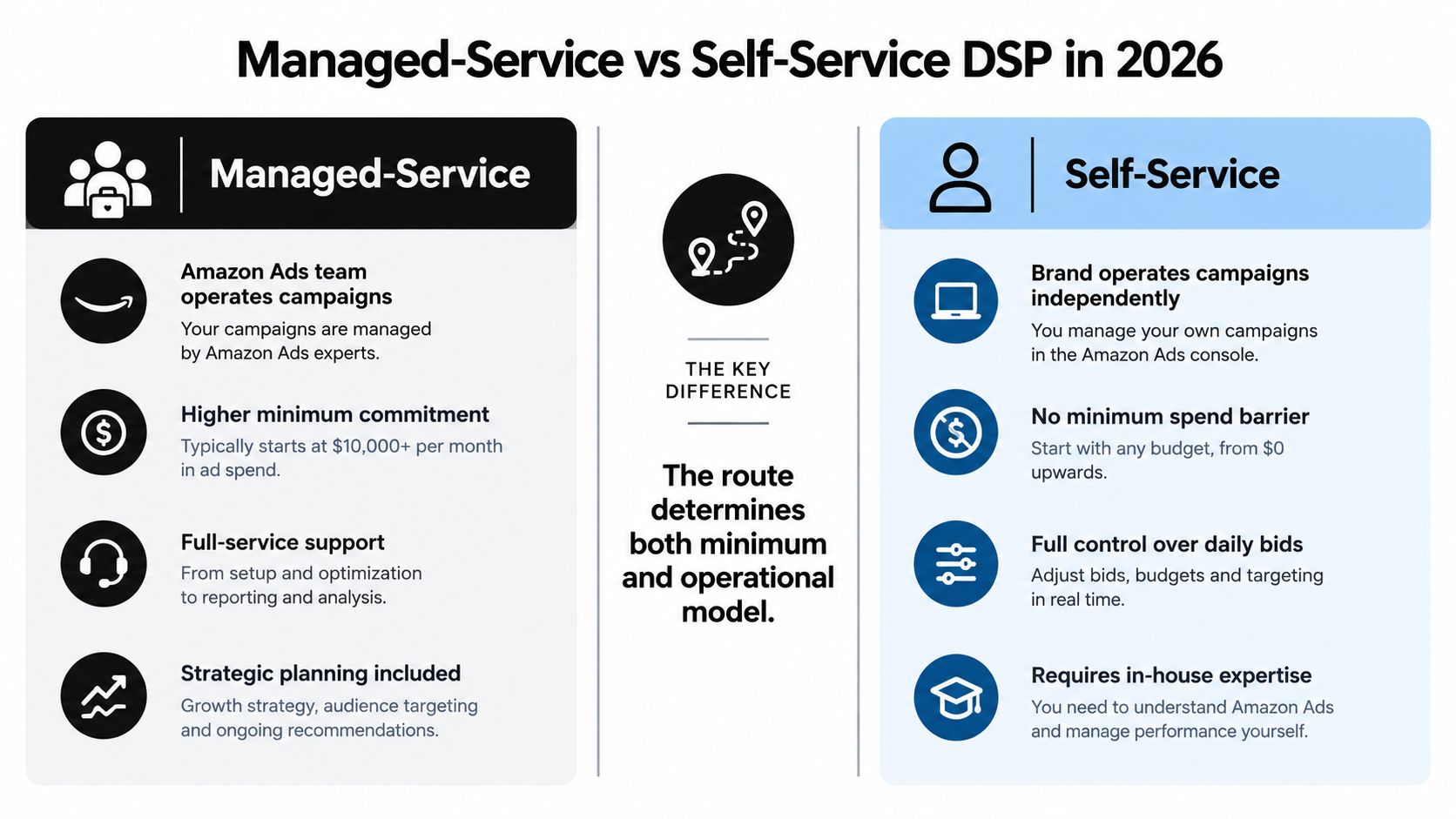
Managed-service DSP delegates execution to an Amazon Ads account team. Self-service DSP leaves execution with the advertiser or the operator using its seat. That difference affects who builds audiences, approves creative, adjusts bids, and explains performance when delivery misses the plan.
Amazon's documentation on advertising pricing distinguishes Sponsored Products, Sponsored Brands, and Sponsored Display as CPC advertising with advertiser-controlled budgets and no minimum spend, while identifying DSP as programmatic buying with a typical $50,000 U.S. managed-service requirement. Don't transfer the sponsored-ad budgeting model into a DSP proposal.
Decide who owns the daily decisions
For managed service, ask the Amazon Ads account executive to define the execution scope. Campaign operation, creative support, strategic recommendations, and reporting should be written deliverables, not assumptions attached to the words “managed service.”
For self-service, assign an accountable operator before requesting access. Someone needs to monitor pacing, evaluate audience overlap, manage creative approvals, and distinguish weak conversion performance from limited delivery.
The operating responsibilities differ even when the advertiser's business objective is identical.
Compare the inventory plan, not just the service label
DSP supports programmatic buying across websites, apps, and streaming services, as described in Amazon's pricing documentation. For either route, request an inventory and targeting map that specifies the Amazon-owned placements, third-party supply, streaming inventory, shopping audiences, and remarketing options available to your account.
Don't assume every placement, audience, or premium deal is available because the proposal says Amazon DSP. Confirm market eligibility and any additional restrictions.
For platform-level context, AdManage.ai reviews top ad platforms. That's a useful comparison resource when evaluating operational requirements beyond your existing sponsored-ad workflow.
The margin implication is simple: paying for impressions isn't the same as paying for a shopper's click. Evaluate a DSP plan through expected exposure, response, attributed purchases, and acquisition economics. A familiar Sponsored Products ROAS target doesn't automatically make sense for a prospecting campaign with a different attribution window and customer objective.
Three Numbers That Get Confused as One
A proposal can satisfy the access requirement and still fail your financial review. Conversely, a modest-looking service quote can require more media than your team initially expected.
Three Separate Numbers Behind “Amazon DSP Minimum Spend”
| Layer | What it actually is | Typical 2026 figure |
|---|---|---|
| Amazon access threshold | A route-specific commercial access requirement | Managed-service baseline established above; confirm local terms |
| Partner commercial minimum | A contractual media minimum, service fee, seat charge, or combination | Agreement-specific, not a universal Amazon figure |
| Effective operating budget | A planning recommendation for generating useful campaign data | $10,000 to $15,000 per month, according to self-service operating guidance |
That operating guidance connects the recommended budget with the need for impressions, clicks, product-detail visits, and attributed purchases. Treat the range as a starting hypothesis, not a performance guarantee or an Amazon-mandated floor.
Read each line item separately
The access threshold belongs in the contract review. The management charge belongs in the expense forecast. Media belongs in the delivery model.
A partner's minimum might refer to billable media, total invoiced expenditure, or a service retainer. Those aren't interchangeable. Ask for a sample invoice showing where media, management, technology, creative, and any data charges appear.
Then check whether a required media commitment counts toward the quoted total or sits alongside it. You shouldn't have to infer that from a sales presentation.
- For finance: Record committed cash separately from discretionary campaign spending.
- For the operator: Record net deployable media after any deductions.
- For the ecommerce director: Record the business outcome the available media can realistically test.
Our Amazon DSP advertising guide provides additional campaign context for connecting that financial structure to an advertising plan.
Avoid the false economy of a tiny test
A budget isn't usable just because it can launch. If each audience receives sparse delivery, changing bids or replacing creative may reflect noise rather than a repeatable pattern.
Narrow the question instead of adding budget indiscriminately. Test a priority market and product set, then choose prospecting or remarketing as the primary objective. Expand only after the initial setup produces interpretable evidence.
Confusing these layers creates predictable mistakes: overcommitting to services, underfunding media, or calculating ROAS against an expense total that excludes material charges.
How to Actually Get a DSP Seat
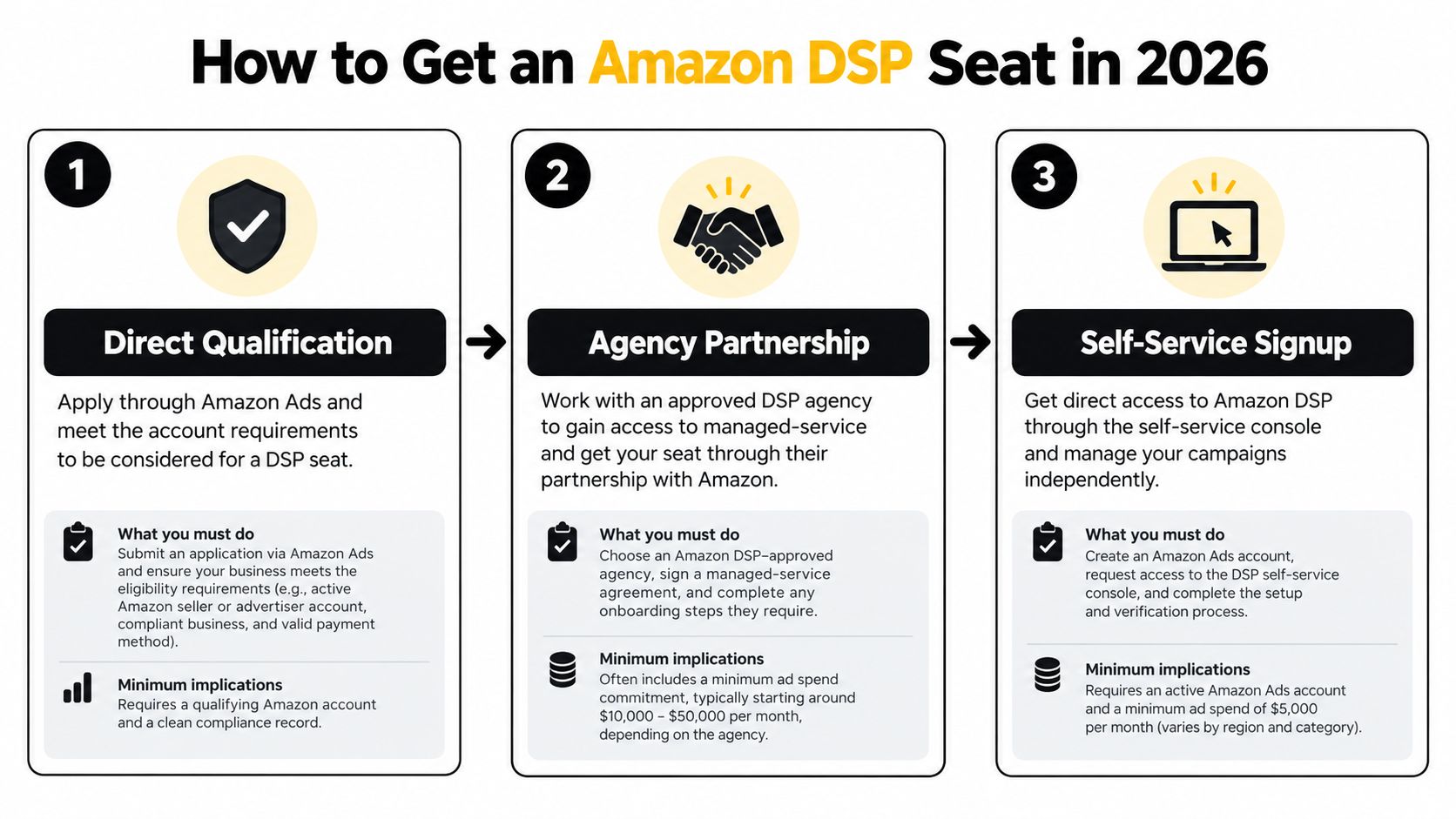
Start with qualification, not campaign setup. Ask Amazon which access routes are available to your legal entity and market, then establish who will own the account, operate campaigns, and retain reporting access.
The reported removal of the self-service floor at November 2025 unBoxed means access needn't depend on an Amazon-imposed media minimum, but eligibility and commercial arrangements still require confirmation through the Amazon DSP product and access information.
Establish the route and ownership
- Direct Amazon qualification: Contact an Amazon Ads account executive with your market, proposed commitment, product scope, and campaign objective. Request the applicable managed-service terms and onboarding requirements.
- Direct self-service access: Confirm current eligibility with Amazon before promising an internal launch date. Designate the operator and determine advertiser permissions, billing ownership, and reporting access.
- Partner seat: Establish whether the partner operates campaigns for you or provides an arrangement under which your team operates them. An agency-operated self-service seat isn't the same thing as Amazon-managed service.
Treat these as alternative routes, not mandatory sequential steps.
Keep onboarding distinct from advanced capabilities
Don't assume opening Seller Central's Advertising area or the Amazon Ads console establishes a DSP seat. Ask the account team for the specific invitation, account provisioning, billing, and user-permission steps that apply to your route.
Use your current Sponsored Products and Sponsored Brands reporting to prepare a product-level baseline. Check Seller Central Business Reports, particularly Detail Page Sales and Traffic by Child Item, as part of the launch-readiness review. These are preparation tasks, not substitutes for DSP qualification.
Amazon Marketing Cloud collaborations and private marketplace deals belong in a separate capabilities discussion. Ask whether your arrangement supports the AMC audience work you need and the publisher deals you intend to buy. Neither should be presented as a shortcut around account access requirements.
There's no defensible universal annual advertising budget that guarantees qualification. Compare your available commitment, internal expertise, and reporting requirements against the actual terms offered.
The Amazon DSP agency access guide is useful for evaluating seat ownership and responsibilities. The lowest entry requirement isn't necessarily the lowest total cost once you include operator time, fees, creative work, and measurement.
Modeling a $50,000 Managed-Service Commitment
Amazon's published managed-service wording describes a typical $50,000 U.S. minimum, with country-specific variation, rather than establishing a universal monthly fee. If your agreement makes that a monthly commitment, the annualized amount is $600,000; if it covers a campaign flight, your cash schedule depends on that flight's terms.
Build the media plan only after the commitment period is documented.
Model delivery before allocating formats
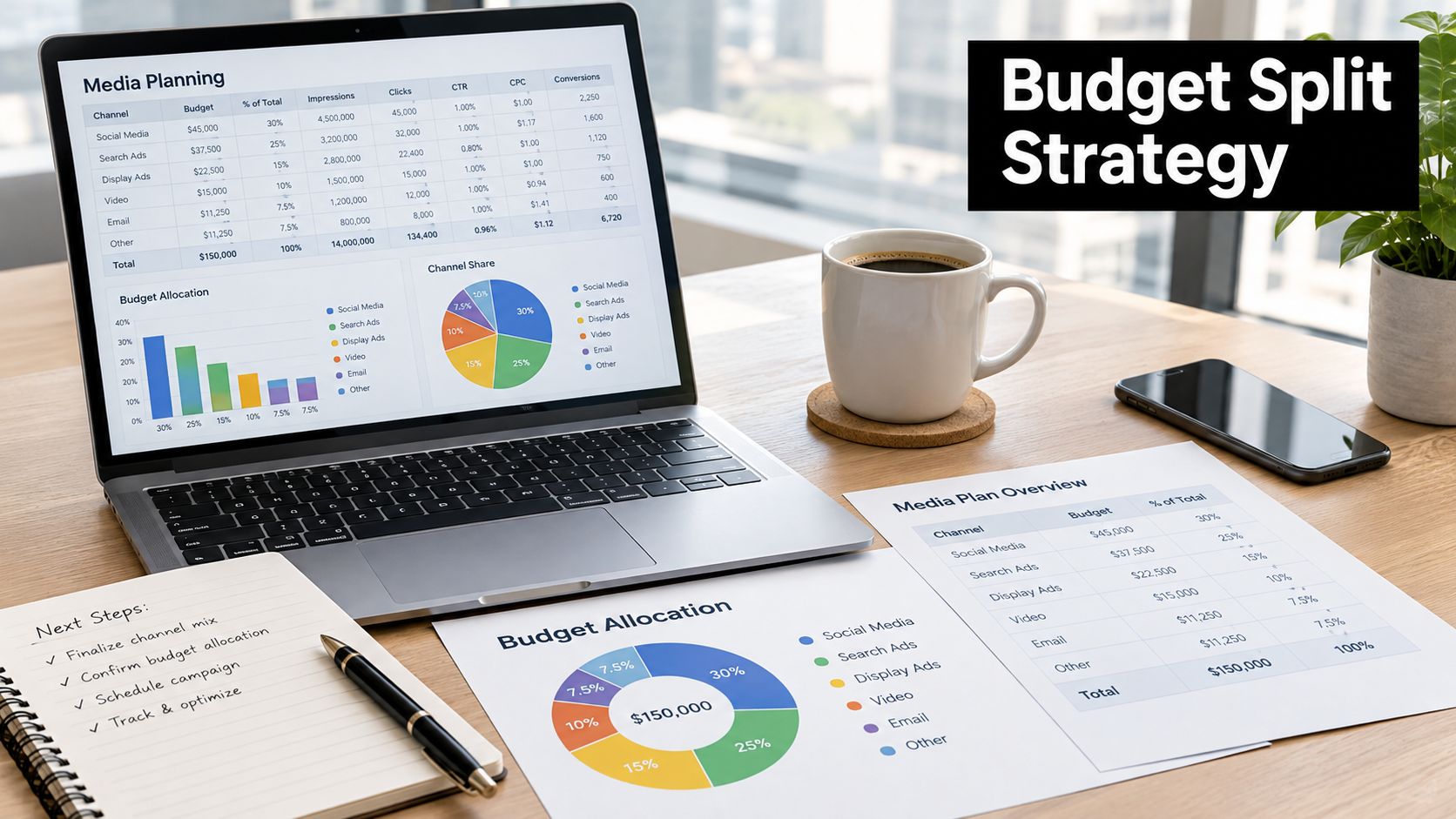
Create separate planning rows for prospecting display, streaming TV, and remarketing. Use current inventory estimates from the account team rather than generic CPM benchmarks.
| Planning input | What to establish |
|---|---|
| Net media | Budget available for delivery after applicable charges |
| Effective CPM | Expected inventory cost, with the included charges identified |
| Audience capacity | Addressable audience and expected delivery constraints |
| Reach and frequency | Whether spend expands exposure or repeatedly reaches the same people |
| Flight length | Time available for delivery, conversion lag, and evaluation |
Use the Amazon Ads campaign manager to review the campaign structure with your operator. Request audience-size and delivery estimates from Audience Builder or the audience-planning workflow available in your DSP account. Treat estimates as planning inputs, not promised outcomes.
Allocate remarketing against available audience capacity, not an arbitrary budget share. If the audience is narrow, increasing its allocation may primarily increase repeat exposure.
Protect the test from fragmentation
Streaming-TV and display plans shouldn't receive identical outcome expectations. Model their inventory costs and measurement roles separately, then decide what evidence would justify each allocation.
This video can accompany the planning review without replacing the written forecast.
Keep launch variables constrained. Adding audiences, devices, markets, and creative versions simultaneously makes diagnosis harder when the campaign underperforms.
A useful media plan tells you what you'll stop doing if the evidence is weak, not just where you intend to spend.
For finance teams familiar with other marketing services, Social Cloud's resource helps compare influencer agency fee models. Apply the same accounting discipline here: separate delivery expenditure from service expenditure before comparing proposals.
Negotiation Questions That Change the Real Cost
Ask for a marked-up commercial schedule, not reassurance that the arrangement is flexible. Your forecast should survive a campaign pause, a delayed creative approval, or an inventory problem without revealing an unexpected obligation.
Put the commitments in writing
- What period does the commitment cover? Specify whether it applies monthly, quarterly, to the entire flight, or per insertion order. Ask when payment becomes due and whether delivery must occur within the same period.
- What counts toward the minimum? Identify whether the quoted amount is media only or includes management, technology, data, and creative charges.
- What happens to undelivered media? Document cancellation rights, rollover treatment, refunds where applicable, and any requirement to extend the flight.
- Who controls the account and reporting? Establish user access, export rights, advertiser ownership, and what remains accessible after the relationship ends.
An agreement that permits pausing delivery but not pausing the financial obligation requires a different cash reserve from an arrangement billed against actual delivered media. Don't treat the two as equivalent tests.
Contract check: If an important answer exists only in a call recording or sales email, move it into the agreement.
Require reporting that supports a decision
Specify the reporting cadence and the exact deliverables. Ask for campaign and line-item performance, audience and creative breakdowns, inventory visibility where available, attribution settings, and a reconciliation between invoiced costs and reported media.
A partner dashboard can be useful, but screenshots alone aren't enough. You need exportable information that finance and your internal team can reconcile.
The Amazon PPC agency pricing guide provides context for separating media and management costs. Don't assume the fee mechanics of an existing PPC agreement automatically carry into DSP.
Use the free Amazon profit calculator to establish the product economics before adding DSP acquisition costs. Include landed product cost, Amazon fees, fulfillment expenses, promotions, and expected returns in the underlying margin model.
Reject arrangements that won't identify the commitment period, disclose charges, or provide usable reporting. Commercial flexibility is valuable only when the contract defines it clearly enough for your team to act.
Two Realistic 2026 DSP Scenarios for Mid-to-Large Brands
These are illustrative planning scenarios, not client results or performance benchmarks. They show how different routes require different continuation decisions.
A consumer-brand launch with a managed-service flight
Consider a mid-sized consumer brand planning a $50,000 managed-service commitment, using Amazon's published access baseline. For this example, the negotiated flight runs over a quarter rather than renewing monthly, with streaming TV supporting discovery and audience remarketing supporting product consideration.
The operator shouldn't choose the allocation before checking creative readiness, inventory availability, and remarketing audience capacity. Reserve room to adjust delivery instead of promising each format a fixed allocation regardless of what happens.
Track effective CPM, reach, frequency, detail-page-view rate, new-to-brand rate, attributed sales, and contribution margin. Review attribution windows alongside those results so finance understands what the dashboard counts as an attributed purchase.
| Decision | Evidence to review |
|---|---|
| Continue the flight | Delivery matches the plan and customer-acquisition economics remain credible |
| Change the allocation | A format delivers exposure but insufficient qualified product interest |
| Pause expansion | Product availability, conversion readiness, or margin assumptions no longer support spending |
Streaming exposure followed by attributed purchases isn't, on its own, proof that every purchase was incremental. Check the broader sales baseline and document concurrent promotions or Sponsored Products changes before claiming lift.
A larger brand with a controlled self-service test
For a contrasting hypothetical, a larger brand allocates roughly $12,000 per month to self-service DSP alongside Sponsored Products. That's an illustrative budget choice within the operating range established earlier, not a new platform requirement.
Keep the test to a priority market, a narrow product set, and a defined prospecting or remarketing objective. Maintain a record of changes to Sponsored Products so the team doesn't mistakenly attribute every movement in total sales to DSP.
Review the same measurement set, but interpret it against the chosen objective. A remarketing campaign shouldn't continue merely because its attributed ROAS looks strong if it mostly reaches shoppers who were already likely to buy.
Use the free FBA storage fee calculator to stress-test inventory carrying costs against the sales plan. Use the Amazon sales rank checker to monitor rank movement alongside sales and availability, not as proof of DSP incrementality.
Continue when the campaign produces interpretable evidence and acceptable acquisition economics after fees. Pause when inventory, margin, or measurement weaknesses prevent a defensible decision.
The Decision Rule and What to Do Next
Choose the route that supports a measurable business objective at an affordable total commitment. Qualification alone isn't a reason to launch.
Before approving spend, require a documented access route, a defined commitment period, a concentrated media plan, and a forecast showing positive contribution margin after DSP-related costs. Also establish the evidence that would justify continuing, adjusting, or stopping the campaign.
Don't fund additional demand while ignoring unauthorized sellers, unstable offer ownership, or pricing problems. Advertising can increase product interest without ensuring that your business captures the intended margin.
Keep product economics, inventory carrying costs, and sales-rank observations in the review alongside campaign reporting. The decision belongs at the channel-profit level, not inside an isolated advertising dashboard.
Online Brand Growth connects DSP planning with Amazon advertising, operations, and contribution-margin management, with its 360 Brand Protection program supporting unauthorized seller removal and MAP enforcement. Book a free strategy call to assess your access route, full commitment, and whether a focused DSP test makes financial sense.