
Coupons appeared on just 9.1% of products on Amazon U.S. between June 2 and June 16, 2024, down from 13.6% during the same period in 2023, according to Adverio. A coupon attached to a credible reference price can stand out, but visibility isn't the same as profit.
For an established brand, the useful Amazon Coupons vs Lightning Deals comparison is incremental contribution after fees and displaced full-price sales. A promotion can generate positive contribution on every order and still leave you worse off than selling fewer units without it.
Coupons and Lightning Deals Side by Side
Coupons and Lightning Deals are different tools with different risks. Choose based on how demand arrives, not which discount looks bigger.
Amazon Coupons vs Lightning Deals on core criteria
| Criterion | Amazon Coupons | Lightning Deals |
|---|---|---|
| Where shoppers see it | Clippable on product detail pages, search results, the Deals page and cart-related placements | Featured on Today's Deals in Amazon's deal merchandising |
| Duration | Runs until the seller ends it, its scheduled end or the budget-triggered shutdown | Generally up to 12 hours, or until inventory sells out |
| Account and listing rules | Professional account, new condition, discount at least 5% below the reference price | Professional account, new condition, FBA or seller-fulfilled free shipping |
| How Amazon charges | Charges tied to redeemed coupon sales, plus the coupon discount you fund; confirm the applicable participation and variable fees | Per submitted deal that runs, with the fee shown at scheduling |
| Stacking | Combines with other active incentives | Combines with coupons, promotions, sale price, Business Price and giveaways |
| Inventory exposure | Usually more gradual, on units shoppers claim and buy | Concentrated, needs stock in place before the window opens |
| Best role | Always-on conversion incentive and hero SKU testing | Short, high-velocity bursts for aged stock or planned events |
Amazon's seller promotions guide describes coupon discovery across shopping surfaces and Lightning Deals as limited-quantity offers generally lasting 4 to 12 hours. The account-specific requirements and fees still need checking in Seller Central before submission.
Match the offer to the shopper
A coupon primarily changes the decision for someone evaluating your product. It can help when shoppers understand the product but hesitate at the price. It won't repair weak imagery, missing dimensions, an unclear variation structure or poor delivery availability.
A Lightning Deal adds urgency and deal merchandising. That makes it useful when the listing already converts and the operational problem is moving available inventory quickly. It doesn't guarantee genuinely new customers or sales that wouldn't otherwise have happened.
Practical rule: Treat a coupon as a conversion test and a Lightning Deal as a demand-concentration event. Neither deserves credit for orders you would have earned anyway.
The market context doesn't justify blanket coupon deployment. Give each offer a job: improve qualified conversion, test price sensitivity, clear excess inventory or support a planned event. Without that job, a coupon becomes a permanent subsidy and a Lightning Deal becomes an expensive sales screenshot.
Eligibility Rules and Setup Steps for Each Format
Check coupon eligibility before building the campaign calendar. A valid ASIN isn't automatically a promotion-ready ASIN.
Under Amazon's coupon eligibility guidance, sellers need a Professional selling account, at least a 3.5 Seller Feedback Rating, and a product offered in new condition. Products with no reviews can qualify; products with 1 to 4 reviews need at least a 2.5-star average, while products with 5 or more reviews need at least a 3-star average.
The same guidance requires a discount at least 5% below the applicable Was Price or List Price and permits both FBA and seller-fulfilled offers. Used, collectible and renewed products are excluded, alongside restricted product types.
Clear the coupon gate first
Check the reference price, review band and product condition before choosing the discount. Seller Feedback Rating is an account measure, not the product's star rating, so don't substitute one for the other.
The basic coupon setup sequence starts with these account and listing checks.
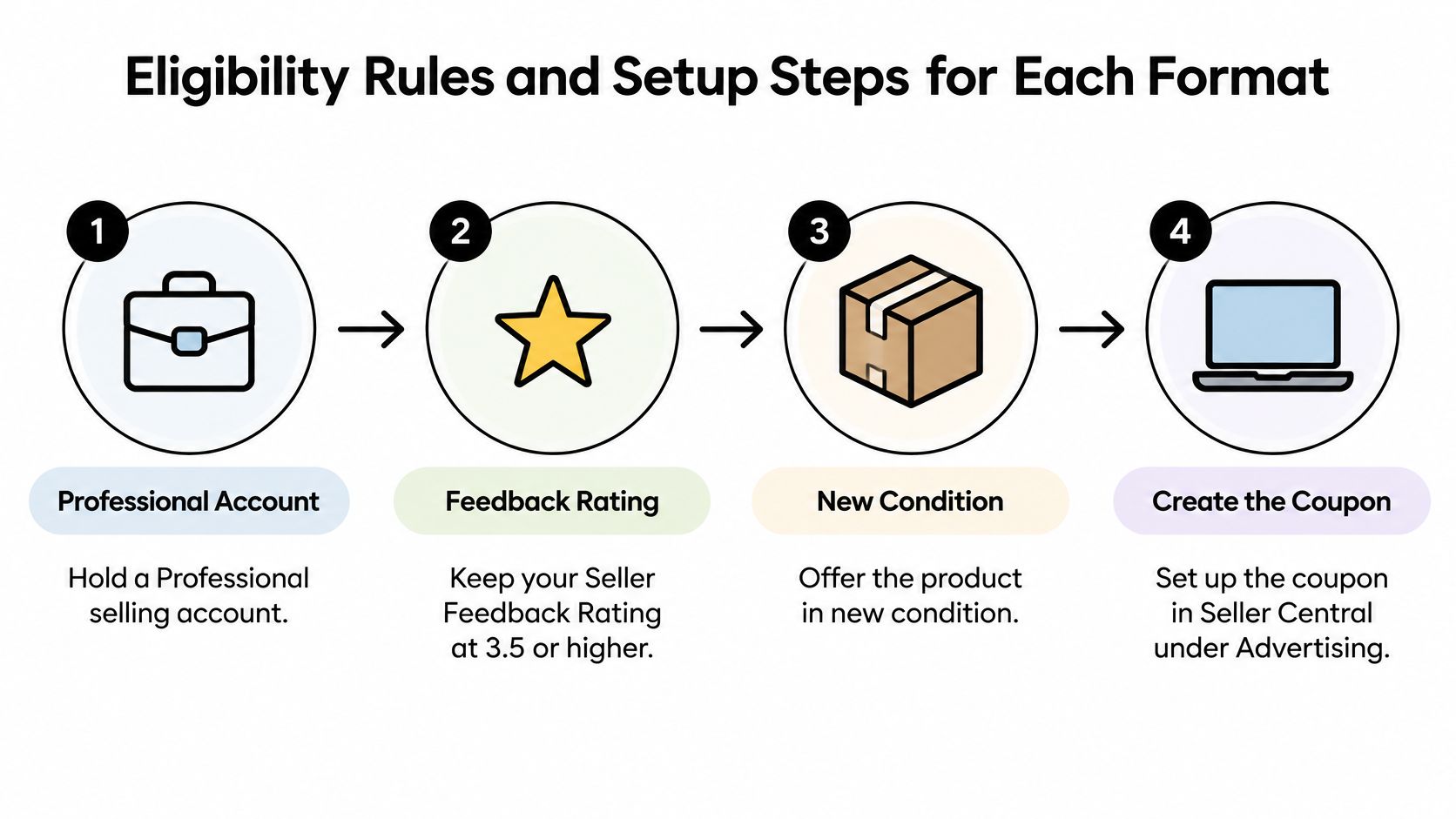
In Seller Central, open Advertising > Coupons, select the eligible product, enter the discount and configure the dates and budget. Review the fee calculation and final customer offer before submitting. Don't assume an entered List Price establishes an accepted reference price.
Build the Lightning Deal around confirmed availability
Lightning Deal access is stricter. Amazon considers product rating and review volume, while category, variation, condition and fulfillment restrictions can exclude an otherwise healthy listing.
Amazon's Lightning Deal guidance generally requires new products with FBA or seller-fulfilled free shipping and says final scheduling is normally communicated within two weeks of the proposed deal week. Listed exclusions include e-cigarettes, alcohol, adult products, medical devices and medicines, and baby formula.
Use this submission sequence:
- Open Deals in Seller Central.
- Select an eligible ASIN.
- Choose the store and proposed week.
- Configure the discount and committed quantity.
- Review the displayed fee and submit.
Plan replenishment before submitting, not after receiving the final slot. An inbound shipment isn't the same as sellable inventory, and a carrier delivery confirmation doesn't establish that units are available for customer orders.
Fee Structures and Break-Even Math for 2026
Build the fee model from the applicable marketplace notice and the amount displayed in your account. Don't carry historical flat fees into a current forecast.
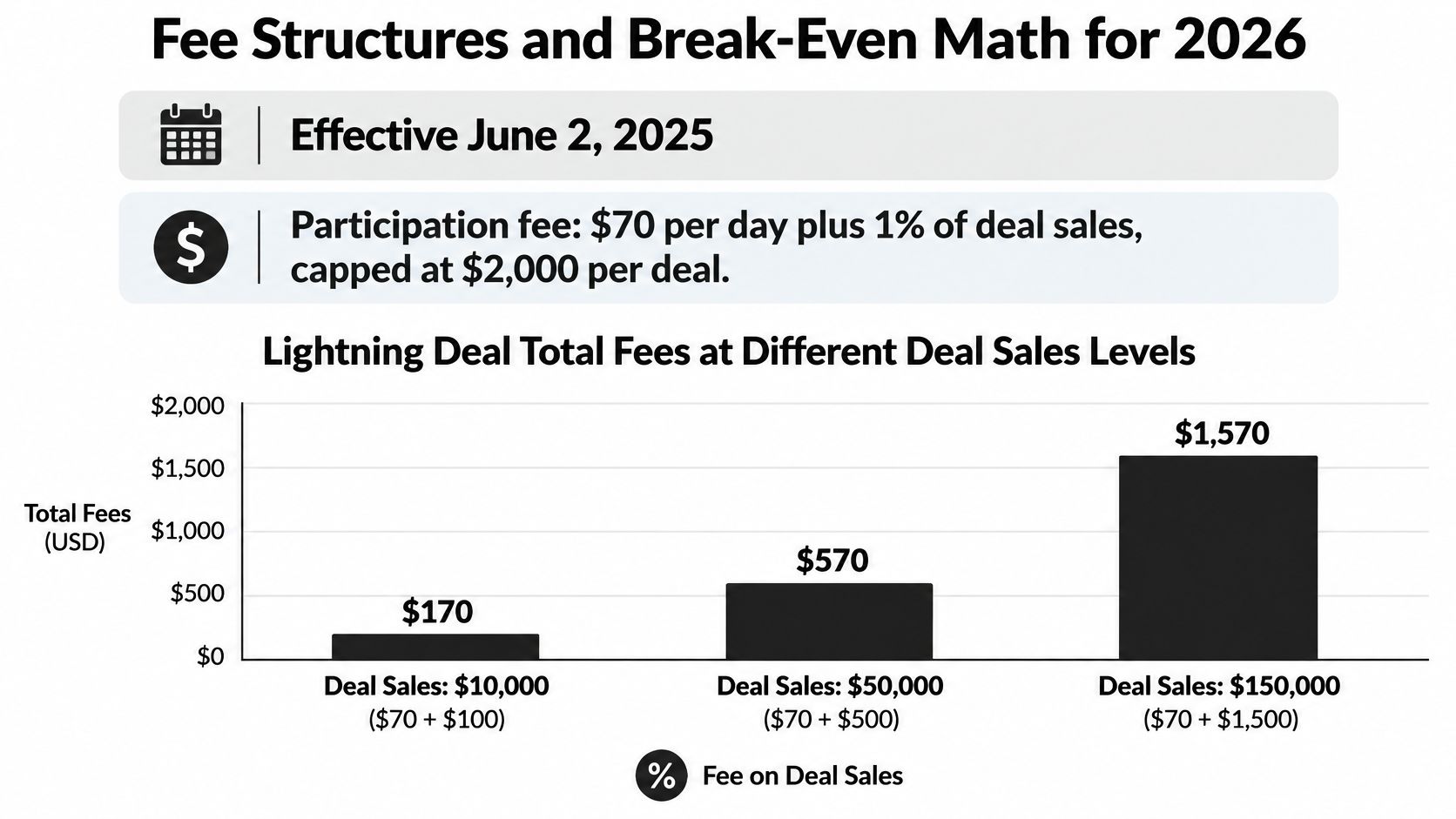
The Amazon U.S. fee update effective June 2, 2025 lists Lightning Deals at $70 per day plus 1% of deal sales, with the variable charge capped at $2,000 per promotion, and coupons at $5 plus 2.5% of coupon sales. The notice also lists a $500 participation fee for Prime-exclusive Lightning Deals.
This visual shows how the standard Lightning Deal charge increases with sales.
Find the fee crossover
For a hypothetical standard event charged for a single day, with equal promotional revenue and no event surcharge:
5 + 0.025R = 70 + 0.01R
The computed crossover is approximately $4,333 in promotional sales. Below that revenue, the coupon has lower listed fees; above it, the Lightning Deal has lower listed fees, before considering different discount depths.
Listed fees by deal revenue, US, from June 2, 2025
| Deal sales | Coupon fees (5 + 2.5%) | Lightning Deal fees (70 + 1%) | Lower fee |
|---|---|---|---|
| $1,000 | $30 | $80 | Coupon |
| $10,000 | $255 | $170 | Lightning Deal |
| $50,000 | $1,255 | $570 | Lightning Deal |
| $150,000 | $3,755 | $1,570 | Lightning Deal |
These are calculated examples using the listed formulas. The Lightning Deal variable charge reaches its cap at $200,000 in sales; the participation charge remains additional.
Historical comparisons need careful labeling. PPC Land reports that before June 1, 2025, U.S. Lightning Deals cost $150 on ordinary days and $500 during peak events. Older coupon guidance also uses a per-redemption model, so confirm the model shown in the coupon budget area rather than blending incompatible schedules.
Lower fees don't establish higher profit
The crossover excludes the discount, COGS, referral fees, fulfillment, storage and advertising. It also assumes equal revenue, which isn't how competing promotion plans necessarily perform.
Online Brand Growth's free Amazon profit calculator models the full P&L using Amazon's 2026 fee structure, including referral, FBA fulfillment, storage, inbound placement, ads and COGS. Use the confirmed account fees as inputs and calculate each format separately.
For additional promotion context, watch the walkthrough below.
Worked ROI Examples and the Lift You Need to Break Even
Use a hypothetical SKU priced at $40, with $12 COGS, a 15% referral fee, and $6 FBA fulfillment. Full-price contribution is therefore $16 per unit, before advertising and other costs.
These are scenario assumptions, not category benchmarks. Substitute your actual referral category, fulfillment fee and landed cost, using a consistent contribution margin calculation.
Lightning Deal with positive unit margin but uncertain incrementality
Assume a 20% discount to $32, selling 500 units in a 6-hour window. Revenue is $16,000, and the standard fee formula produces $230 in fees.
Contribution per unit is:
$32 - $4.80 referral fee - $6 fulfillment - $12 COGS = $9.20
That produces $4,600 before promotion fees and $4,370 after fees. But each unit that would have sold at full price loses $6.80 against the baseline.
The incremental outcome is:
Promotional contribution after fees - contribution from displaced full-price units
At 100% incrementality, the gain is $4,370. At 50%, subtract the baseline contribution from 250 displaced units, leaving $370. At 30%, subtract the baseline contribution from 350 displaced units, producing a $1,230 loss.
Break-even requires approximately 45.4% of units to be incremental. Extra advertising raises that requirement.
Coupon with a shallower discount
Now assume 15% off to $34, with 400 redemptions over 30 days. Revenue is $13,600, and the participation-plus-percentage model produces $345 in fees.
Each unit contributes $10.90 after referral, fulfillment and COGS. Total contribution is $4,360 before coupon fees and $4,015 after fees.
At 40% incrementality, the gain is $175. At 30%, the result is a $465 loss. The computed break-even incremental share is approximately 37.3%.
Worked contribution outcomes by incremental share
| Scenario | Units sold | Incremental share | Incremental contribution after fees |
|---|---|---|---|
| Lightning Deal, 20% off to $32, 6 hours | 500 | 100% | +$4,370 |
| Lightning Deal, same deal | 500 | 50% | +$370 |
| Lightning Deal, same deal | 500 | 30% | -$1,230 |
| Coupon, 15% off to $34 | 400 | 40% | +$175 |
| Coupon, same coupon | 400 | 30% | -$465 |
The fee conflict matters. AMZ Tool Hub's July 2025 playbook cites $0.60 per coupon redemption and a general $150 Lightning Deal fee, which conflicts with the updated schedule. If your account uses the per-redemption coupon model, this hypothetical coupon costs $240, improving each coupon outcome by $105.
A profitable promotional order isn't proof of a profitable promotion. Subtract what those customers would have contributed without the discount.
Measure demand rather than attributed revenue
Amazon's coupon budget guidance says coupons go offline when redemption value reaches 80% of the entered budget, reserving the remaining 20% for already-clipped offers, while sellers remain responsible for obligations exceeding the budget.
Track units, sessions and Unit Session Percentage in Business Reports > Detail Page Sales and Traffic by Child Item. Use the sales rank checker alongside those reports before, during and, as a practical measurement window, for 14 days after the hypothetical promotion. A post-event drop in organic units can reveal purchases pulled forward from later periods.
If PPC supports the offer, Rapid Ads' ROAS break even formula and examples helps translate contribution into an advertising threshold. Calculate that threshold from discounted economics, not full-price margin.
Which Format Fits Each Product Lifecycle Stage
Choose the starting format from the SKU's lifecycle, then reject it if the economics don't work. The same promotion can be sensible for excess seasonal inventory and wasteful for a supply-constrained bestseller.
Recommended format by product lifecycle stage
| Lifecycle stage | Better format | Why | Watch for |
|---|---|---|---|
| Launch, fewer than 5 reviews | Coupon | No minimum review-count gate and broad discovery | Discount must sit at least 5% below the reference price |
| Growth, rising rank | Coupon at two tested discount depths | Measures price response without committing stock to a deal window | Redemption costs grow with sales |
| Mature hero SKU | Coupon as the base incentive, Lightning Deal on planned event days | Supports ongoing conversion with selective bursts | Stacking with the deal discount |
| Aged or excess FBA stock | Lightning Deal | Concentrated velocity can clear units quickly | Storage cost while waiting for the window |
| Prime-exclusive or peak event | Lightning Deal, only if margin passes | Concentrates exposure during the event | $500 participation fee on Prime-exclusive deals |
| Competitor conquest or brand-search defense | Coupon | Remains discoverable across shopping surfaces during the campaign | Budget overrun remains the seller's responsibility |
The review counts, discount threshold and participation fee in this decision table are eligibility and fee inputs, not performance benchmarks.
Launch and growth need controlled learning
A new listing usually needs sustained qualified traffic and a clear price test, not a large inventory commitment. A coupon can help distinguish price resistance from weak listing communication, provided you don't change imagery, bids and the discount simultaneously.
For a growing listing, test a shallower coupon against a deeper coupon in comparable periods. Read contribution alongside conversion and rank, not conversion alone. Our product launch strategies connect those tests to listing readiness and traffic planning.
Mature and excess-stock SKUs need different objectives
A mature hero SKU can support a continuing coupon only while it earns incremental contribution. Don't call it a base incentive if the actual effect is discounting loyal branded-search customers who already intended to buy.
Aged FBA stock deserves a different comparison: promotional recovery versus continued storage, later markdowns or removal. Use the FBA storage fee calculator to estimate monthly storage by dimensions before deciding whether waiting for a deal slot is economical.
Inventory judgment: Clear stock because the expected recovery beats the alternatives, not because a large unit count looks like successful growth.
Peak-event participation requires credible volume and replenishment, while competitor conquest requires proof that the traffic converts economically. Lifecycle stage narrows the options. Incremental margin decides which option survives.
Coordinating PPC and Inventory Around Each Promotion
Bid changes belong before the deal window, not inside it. For a Lightning Deal, I would start a controlled Sponsored Products bid increase three days before the window opens, provided the discounted unit still earns positive contribution after the added spend. That timing is a planning recommendation rather than an Amazon rule.
Hold Sponsored Brands and branded-term bidding steady where possible, then use Sponsored Display to re-engage eligible audiences once the deal ends. Resist raising every campaign budget while the discount is live. If spend and price move together, the deal's unit total blends incremental buyers with displaced full-price demand, and you lose the ability to judge whether the promotion actually paid for itself.
Separate deal support from catalog defense
Keep ASIN-by-ASIN bid management, keyword harvesting, competitor conquest and defensive campaigns running across the rest of the catalog. A featured promotion concentrates your attention on one SKU at the exact moment competitors notice the shift, and unrelated products should not go unprotected because one ASIN is discounted.
A coupon usually calls for steadier bidding, since the listing incentive is already changing the shopper's economics. Build that distinction into your Amazon advertising strategy instead of treating every discounted ASIN as permission to bid aggressively. For coordination beyond Amazon, AdCrunch's ecommerce paid search strategies for 2026 covers aligning paid-search activity with promotional planning. Judge Amazon promotions on SKU-level incremental contribution, not blended channel ROAS.
Physical availability needs the same attention as campaign settings.

Audit the calendar and reserve organic cover
Amazon's deal-creation guidance prohibits Lightning Deals on the same ASIN within a 7-day period, sets a 21-day restriction for Best Deals, and illustrates a 20% deal stacked with a separate 5% promotion on a $100 ASIN producing a $25 reduction. Check the actual combined customer price rather than assuming incentives replace each other.
While the promotion runs, watch:
- Active incentives: coupons, promotions, sale price, Business Price and giveaways stacking on the same ASIN.
- Sellable stock: available units, reserved units, receiving delays and variation-level allocation.
- Organic cover: expected deal units plus a replenishment buffer on top of the deal quantity.
- Price ownership: Featured Offer readiness, unauthorized sellers and reseller repricing.
As a planning scenario, reserve expected deal units plus 14 days of normal organic demand, then extend that buffer when replenishment runs longer.
Unreceived inbound units are not protection.
Document promotional prices and dates for reseller discussions. Online Brand Growth's brand enforcement services can address unauthorized resellers and MAP concerns, but MAP enforcement should follow the brand's applicable policy and legal framework rather than assume every low resale price can be removed.
Confirm the Format Before You Submit
Run a Lightning Deal only when you can defend the incrementality assumption and cover the inventory exposure. If either depends on optimistic guesses, start with a controlled coupon test or leave the product at full price.
Run the submission check
Confirm eligibility. Check the accepted reference price, review band, Seller Feedback Rating, condition and fulfillment method. Calculate the required discount from the reference price, not by adding a percentage to the offer price.
Model the actual offer. Use the profit calculator with the current marketplace notice and the coupon fee model displayed in Seller Central. Include landed COGS, fulfillment, referral fees, advertising and any overlapping incentives.
Calculate break-even incrementality. Divide promotional contribution after fixed fees and incremental ad spend by full-price contribution per unit to find how many displaced units you can tolerate. Subtract that tolerated share from the total to find the minimum incremental share.
Protect availability. Compare expected promotional units, organic demand and replenishment lead time against sellable inventory. Position stock before the event rather than relying on receiving to finish during it.
Audit the promotion calendar. Check same-ASIN repeat restrictions and every active incentive. Save the customer-facing price, displayed fee and submitted quantity so the forecast can be reconciled afterward.
Make the call. Submit the Lightning Deal only if a conservative demand estimate clears the contribution threshold. Otherwise, test a coupon that passes eligibility and evaluate comparable campaign cycles before increasing exposure.
Reject promotions that can't beat the baseline
A coupon loses money when it mostly subsidizes existing demand. A Lightning Deal loses money when incremental demand can't repay the discount, fees, advertising and contribution displaced from full-price periods.
Neither format is compulsory. If the listing already converts, stock is tight or the full-price baseline is strong, protecting availability and price can be the better decision.
Online Brand Growth connects promotion planning, PPC and FBA operations around channel contribution margin. Book a free strategy call to pressure-test your coupon or Lightning Deal against your SKU's real costs, baseline demand and inventory.