
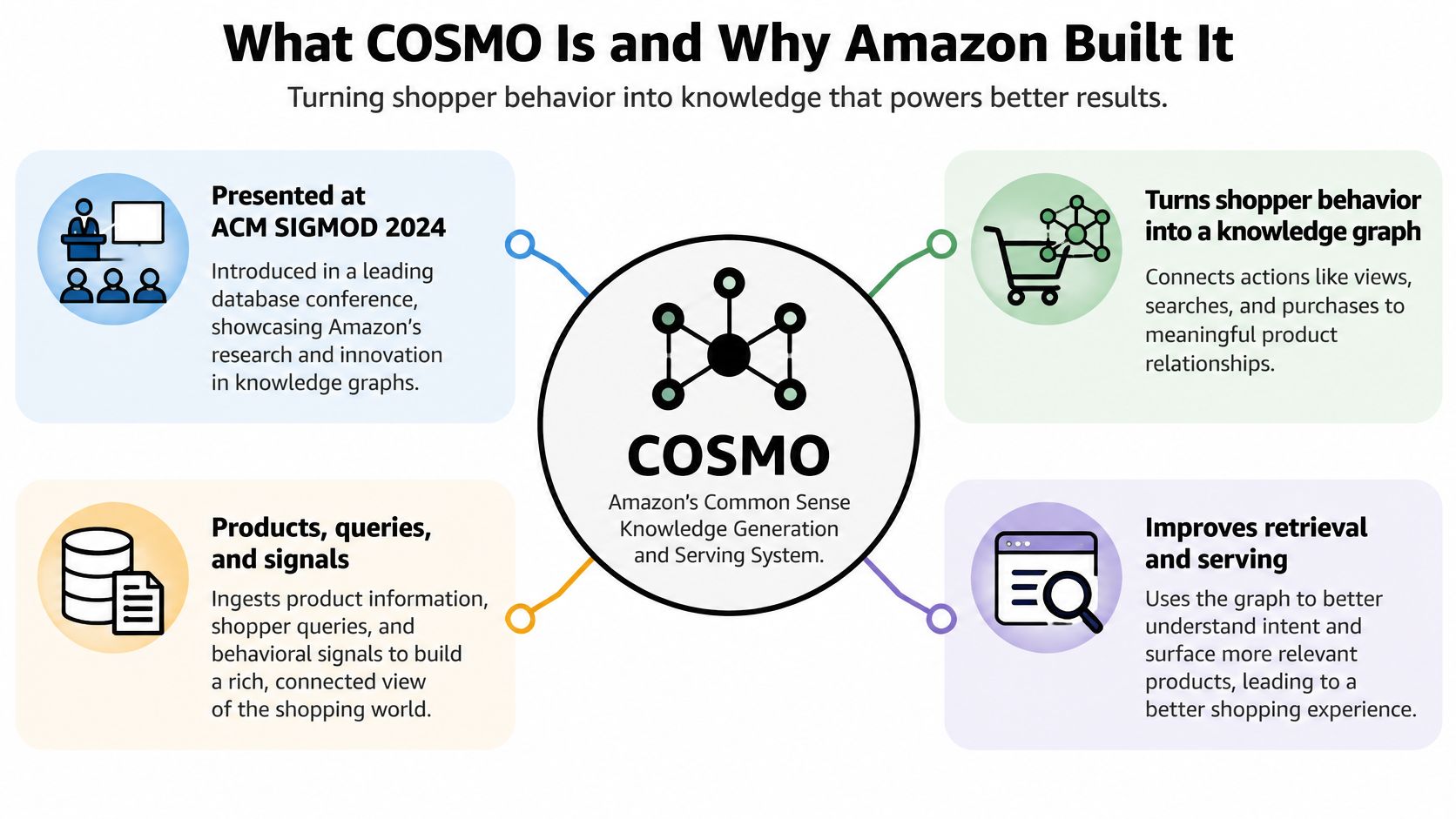
COSMO is Amazon's Common Sense Knowledge Generation and Serving System, presented at ACM SIGMOD 2024, which turns shopper behavior into a knowledge graph of products, intentions and usage contexts, as described in Amazon's COSMO paper. The popular advice to abandon keywords and rewrite everything for the Amazon COSMO algorithm goes further than Amazon's published evidence supports.
What COSMO Is and Why Amazon Built It
Say a shopper searches for a tent. A literal match can find tents, but it doesn't explain the rest of the trip: the shopper may also need a sleeping pad, stove and headlamp. Those products don't share the same product name, but they belong to a related shopping situation.
Think of a library catalog versus a knowledgeable outdoor-store clerk. The catalog matches words on a spine. The clerk asks whether you're camping beside your car or carrying everything up a mountain, then recommends equipment that fits.
That's the useful distinction for a brand owner. Amazon can improve discovery by connecting products to purposes, rather than treating every listing as an isolated collection of words.
From behavior to usable knowledge
The system works through connected layers:
- Behavioral evidence: Search-then-buy and co-buy patterns provide examples of what shoppers purchase after a query and which products they purchase together.
- Knowledge generation: A large language model pipeline converts those patterns into structured assertions about products, intentions and usage contexts.
- Serving: Amazon makes that knowledge available to downstream search and navigation applications.
Amazon reported that COSMO-LM expanded the knowledge graph across 18 major product categories. That describes the scope of the published work, not a seller-facing certification or an optimization score.
The diagram shows how those pieces connect.
What Amazon hasn't published
Amazon hasn't published a COSMO ranking formula, field-by-field weighting or optimization checklist. Calling it an algorithm doesn't make it a replacement for every system that determines discovery and purchase.
Practical takeaway: Explain the product's genuine context. Don't invent audiences, capabilities or compatibility claims to make a listing sound more semantic.
A headlamp listing should explain its intended activities and relevant limitations. Repeating camping throughout the copy doesn't establish whether the product fits a particular trip. Relevance can depend on context, not only on whether the listing repeats a query.
Where COSMO Fits in Search, Navigation and Ads
Amazon systems COSMO touches and what each controls
| System | What It Decides | What You Control | Evidence Level |
|---|---|---|---|
| COSMO knowledge layer | Which products fit a shopping intent or situation | Attribute completeness, use-case copy, complementary context | Published in Amazon research and deployed in search; seller levers are practical inferences |
| Search relevance and ranking | Which listings match a query and in what order | Title, bullets, backend search terms, conversion improvement and customer experience | Amazon documentation; weighting not published |
| Navigation and browse | Which category and product paths shoppers see | Browse node choice, product type, filled attributes | Stated by Amazon as a COSMO application |
| Sponsored Products | Which auctions your ad enters and at what cost | Keywords, targeting, bids in Campaign Manager | Platform controls, documented in Seller Central |
| Buy Box | Which offer is the default purchase option | Price, fulfillment method, stock, seller metrics | Amazon Seller Central help documentation |
Read the COSMO row as a relevance function: which products belong to this shopping situation? Read the Sponsored Products row as an advertising function: which targeting settings and bids determine auction participation and spending?
Those aren't interchangeable. A clearer product page doesn't remove the need for negative targeting, and a higher bid doesn't repair an unsuitable offer.
What the model evaluation proves
In Amazon's fixed-encoder offline evaluation, adding COSMO relationships to a cross-encoder produced a 60% increase in macro F1 over the strongest baseline without those relationships, according to Amazon Science's explanation of commonsense knowledge graphs. Macro F1 gives equal weight to each evaluated class, making it useful for judging classification performance across categories.
That result supports a specific conclusion: structured relationships improved the model's product-matching ability. It isn't a seller revenue benchmark.
Amazon also describes deployment in search-navigation applications. It hasn't publicly established that COSMO directly controls Sponsored Products targeting or supplies Rufus, so don't turn architectural possibilities into confirmed integrations. Our Amazon Rufus optimization guide addresses the customer-facing assistant separately.
What to operationalize
Treat structured attributes and use-case context as useful product information alongside titles and backend search terms, not as proven ranking multipliers.
If catalog scale makes manual review impractical, Sprello's resource can help you find AI tools for catalog operations. Use automation to identify missing fields and draft proposed edits, then have a category specialist verify compatibility, claims and product identity before upload.
The trade-off is straightforward: richer information helps only when it's accurate. Bulk-generated assertions can create catalog errors faster than a team can resolve them.
Signals COSMO Uses to Infer Shopper Intent
Search-then-buy and co-buy are the confirmed behavioral starting points. ZonGuru's third-party summary of the COSMO paper reports samples of approximately 1.87 million search-to-purchase instances and 3.14 million co-purchase instances. Those are research samples, not activity thresholds your ASIN must reach.
Shopper signals, evidence level and your lever
| Signal | What It Tells Amazon | Evidence Level | Your Lever |
|---|---|---|---|
| Search-then-buy pairs | A query led to a purchase | Published Amazon research | Mirror relevant shopper phrasing in bullets and A+ copy |
| Co-buy pairs | Products are bought together | Published Amazon research | Name compatible accessories and bundles in content |
| Click and add-to-cart engagement | Interest before purchase | Inferred, not documented as a COSMO input | Image order, title clarity, price point |
| Conversion rate | Relevance that ends in a sale | Inferred from general ranking practice, not a confirmed separate COSMO input | Listing completeness, pricing, A+ content |
| Attribute completeness | Structured context for the product | Inferred from COSMO's structured design | Fill every relevant backend attribute and use-case field |
| Review content and ratings | Product fit and quality | Inferred as a COSMO input | Earn authentic reviews; use feedback to improve content and fix defects |
Give confirmed behaviors more weight
Search-then-buy pairs connect shopper language to a purchased product. In Seller Central, use Brand Analytics > Search Query Performance to identify the language buyers use, then check whether your copy answers the underlying need.
A query about a travel yoga mat asks a different question from one about cushioning for floor exercises. If your mat is bulky, adding travel language may attract the wrong shopper even when the keyword has demand.
Co-buy pairs suggest complementary needs, but they don't prove technical compatibility. Use Brand Analytics > Market Basket Analysis to identify candidate relationships, then verify dimensions, fittings, materials and intended use before naming an accessory in bullets or A+ modules.
Treat inferred inputs as testable hypotheses
Clicks, cart activity and conversion are useful operating metrics regardless of their precise role inside COSMO. Improve them because they reveal purchase friction, not because someone has established a COSMO engagement score.
Attribute completeness deserves the same distinction. Accurate fields help Amazon describe and organize a product, but Amazon hasn't published a direct completeness-to-ranking equation.
Reviews can expose missing information. If customers repeatedly describe storage problems, explain packed dimensions and show storage clearly. Don't solicit particular wording, incentivize favorable reviews or turn an isolated customer comment into an unsupported product claim.
Build tactics on confirmed behaviors first. Test inferred inputs before using them to justify more spend.
What Changes for Listings, PPC, Buy Box and Brand Registry
Listings and PPC need clearer segmentation
A detail page should make the buying situation legible: who the product suits, what problem it solves, what it works with and what would make it the wrong choice. Keep the primary product identity obvious, then complete relevant fields through Inventory > Manage All Inventory > Edit. Leave irrelevant fields blank; a guessed compatibility value can create returns, complaints and catalog cleanup that cost more than the extra impressions were worth.
For PPC, convert intent analysis into separate targeting decisions. Use Search Query Performance for query opportunities and Market Basket Analysis for complement candidates, then separate intent keywords, complement ASIN targets and conquest targets.
- Intent keywords: Queries that describe a need your product satisfies.
- Complement ASIN targets: Products whose buyers may reasonably need yours.
- Conquest targets: Competing products where your price, capability or presentation advantage is defensible.
Give each group its own bid cap, placement logic and profitability review. Complement clicks can stall because the shopper is still buying the main item; conquest clicks can lose because the rival has stronger reviews or a better offer. The Sponsored Products campaign controls guide covers the bidding structure separately. Amazon has not confirmed a direct COSMO-to-ad-auction relationship, so keep the case for this structure in contribution margin and cleaner targeting.
Offer control and brand control remain separate
COSMO concerns relevance. Featured Offer selection concerns which offer a shopper can buy. If sessions look qualified and orders still leak, check price, fulfillment promise, availability, seller performance and listing eligibility before paying to recover the sale with more traffic.
A listing can win the shopper while another seller wins the transaction. Fix that offer problem first; sending qualified PPC visits into a lost Buy Box taxes margin twice through ad cost and missed contribution.
Brand Registry supports content protection and access to brand tools, yet it does not guarantee exclusive control over every contribution to a detail page. Use Brand Registry > Report a violation when you have valid intellectual-property evidence for a hijacked or infringing page. An unauthorized reseller is not automatically an infringer, and a MAP violation alone is not grounds for an Amazon infringement complaint. Keep trademark evidence, counterfeit evidence and distribution-contract enforcement in separate files.
- Protect catalog identity: Investigate duplicate and hijacked pages that divert shoppers to the wrong product record.
- Document enforcement grounds: Keep trademark records, product evidence and seller correspondence organized before escalating cases.
- Stabilize availability: Resolve suppressions and takedowns before testing content or expanding traffic.
Online Brand Growth built a repeatable system to resolve Amazon listing takedowns and stabilize the catalog. The team handles enforcement against unauthorized resellers to protect MAP and the Buy Box, matching the enforcement route to the underlying issue and reserving infringement complaints for supported cases.
Worked Example of What Amazon's Test Means for Your Account
Amazon reported that a months-long online A/B test covering approximately 10% of U.S. traffic produced a 0.7% relative increase in product sales in 2024, as summarized in AMZBase's COSMO guide.
Use the test as context for evaluating a business case, not as an account forecast.
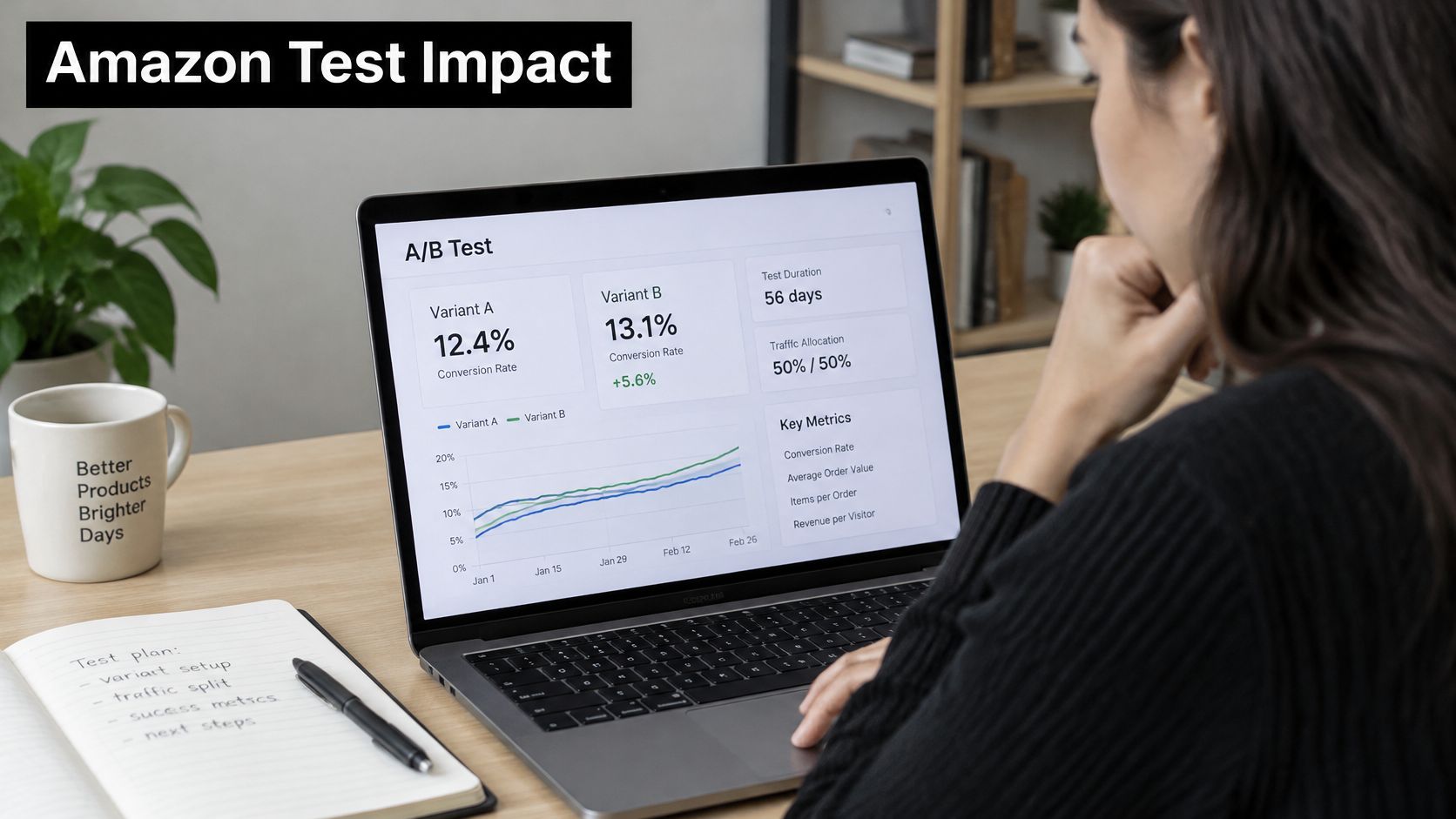
A hypothetical revenue bridge
Assume a brand generates $1,000,000 in annual Amazon sales, exposure is distributed evenly, and the measured relative lift applies only to the exposed slice:
- Exposed sales: $1,000,000 × 10% = $100,000.
- Illustrative incremental revenue: $100,000 × 0.7% = $700 annually.
- Incremental contribution: That revenue still needs deductions for product cost, Amazon fees, returns and any additional advertising.
This is a hypothetical calculation, not a forecast. Sellers can't identify their COSMO-exposed traffic, and Amazon's platform experiment doesn't establish the effect on an individual brand.
The budget implication is more useful than the dollar figure: don't fund a catalog rebuild on the assumption that a model-quality improvement becomes equivalent sales growth. The offline classification result measures a different outcome.
Establish a seller-controlled baseline
Record sessions, Unit Session Percentage, ordered sales, Featured Offer percentage and ad spend for four weeks before your changes. Compare changed ASINs with comparable unchanged ASINs, labeling them as exposed to your intervention, not exposed to COSMO.
Keep promotions, stockouts and price changes in the log. Without those controls, a better result may reflect an offer change rather than better intent coverage.
For additional viewing, keep the distinction between model evaluation and account measurement in mind.
Optimize Listings and Ads for Intent in 90 Days
Start with a week-one audit, not a bulk rewrite. The schedule below is an operating plan, not an Amazon-prescribed learning period or a promise that results will arrive by a deadline.
Use the workflow to sequence diagnosis, content changes and advertising changes.
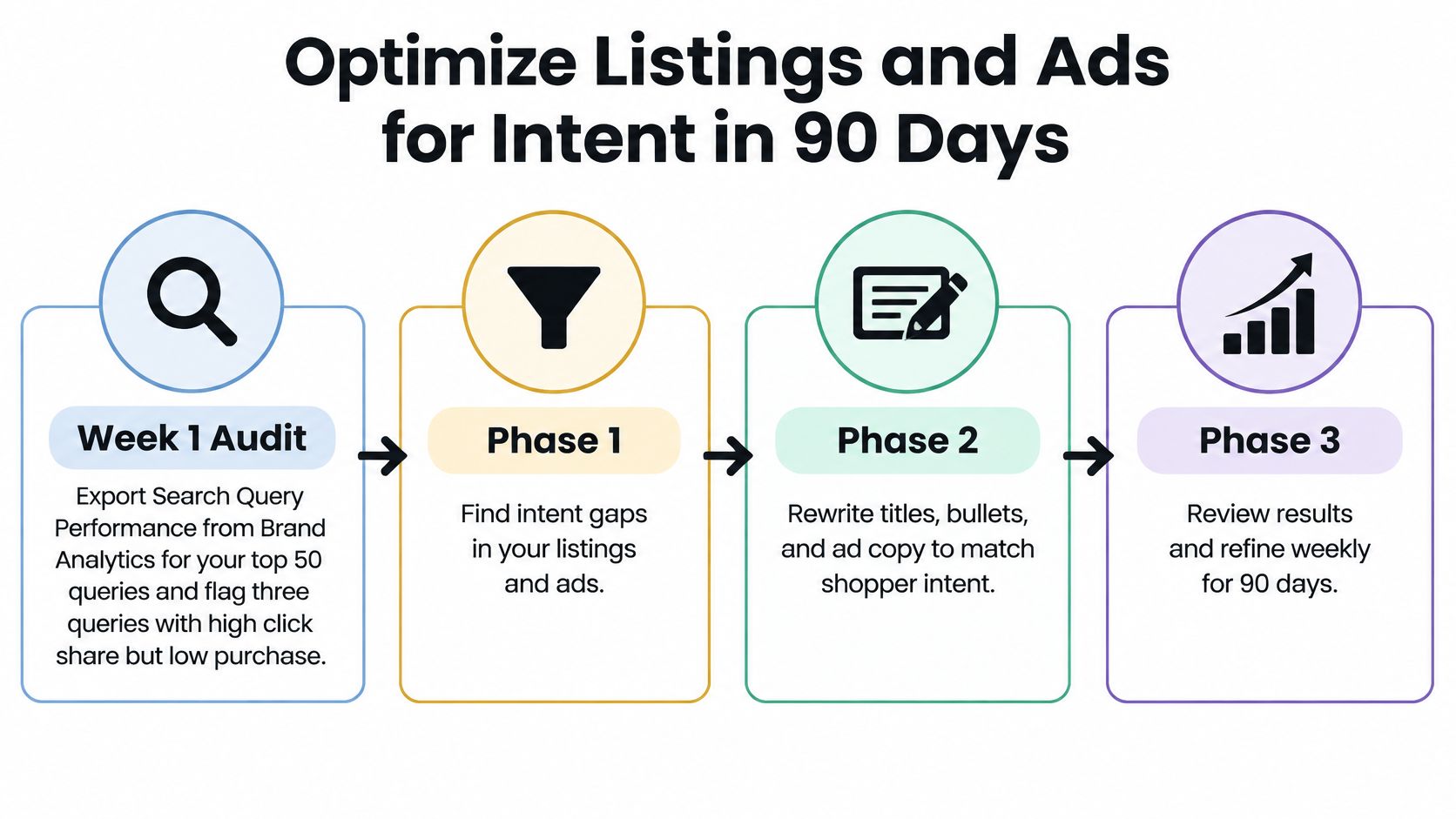
Days 1 to 14 audit the intent gaps
Export your top 50 queries from Brand Analytics > Search Query Performance and flag three with high click share but low purchase share, because those gaps identify traffic you attract without closing proportionately. Compare your brand or ASIN shares within the same query and reporting period. Exclude queries where stockouts or a missing Featured Offer explain the gap.
Open Brand Analytics > Market Basket Analysis for your top five ASINs and flag two co-bought products your listing never names, because they provide concrete complement hypotheses. Confirm that the relationship is useful, not coincidental. If the report isn't available for your account or lacks sufficient activity, don't manufacture a co-purchase story from unrelated browsing suggestions.
Write a use-case line for each shortlisted query and complement, because that forces the team to define the intended shopper before writing copy. Use this working template: for [audience], solves [problem], works with [verified product or setup]. Delete any component you can't substantiate from product specifications, testing or legitimate compatibility documentation.
Save the current page content, attribute export, images and campaign settings before editing. Assign a content owner and an account operator so proposed changes don't become uncontrolled live updates.
Days 15 to 45 rewrite and test
Rewrite the title and first two bullets around the strongest intent gap, then complete relevant backend attributes and compatibility fields, because clarity needs to exist in both visible copy and structured product information. Keep product type and essential selection details easy to scan. Our Amazon listing optimization guide provides a broader page-review framework.
Build A+ Content comparison modules around legitimate selection questions, because buyers need to understand fit and trade-offs before purchasing. Use comparison charts for eligible products in your own catalog, and use image-and-text modules for setup or complementary-use explanations. Online Brand Growth repositioned yoga and fitness products for Amazon purchase intent, structuring page content to answer top buying objections quickly before PPC launch.
Use Brands > Manage Your Experiments for an eligible content test, because a controlled comparison is stronger than a simple before-and-after reading. Test the supported content type rather than assuming every account has a universal Detail Page test. Let it run at least two weeks before an initial review, but don't declare a winner until the experiment has sufficient evidence and has completed its recommended duration.
Keep a dated record of the hypothesis, changed fields and decision rule. An inconclusive result is a reason to collect more evidence or improve the hypothesis, not proof that Amazon ignored the page.
Attribution rule: Don't change the listing and the ads in the same week. Otherwise, you won't know which intervention explains the movement.
Days 46 to 90 scale within contribution limits
- Launch two Sponsored Products campaigns, one for co-purchased ASIN targets and one for intent keywords, because separate budgets make their economics visible. Set a fixed bid cap for each using expected conversion, selling price and target ACoS. Keep conquest activity separate so competitive clicks don't obscure complement performance.
Before raising bids, use the Amazon profit calculator to model whether a hypothetical 10% sales lift would cover the additional ad cost at your target ACoS. Judge incremental contribution, not just attributed revenue.
Check inventory economics too. The FBA storage fee calculator helps assess the cost of carrying the extra stock a scaling plan requires.
If creator traffic is part of the test, schedule it separately from listing and PPC changes. Sup's guide to ecommerce influencer marketing is useful for planning that channel, but creator-driven sales don't prove a COSMO effect.
After the intro call, Online Brand Growth performs a complimentary brand audit and strategic roadmap, including a deep dive into the Amazon account with specific recommendations. The useful output is a prioritized sequence of fixes, not a promise to optimize an unpublished score.
Portfolio Playbook With a Composite Case Study
Consider a hypothetical composite operator with 40 ASINs across three brands. This is an illustrative operating model, not a client result.
The director doesn't need a different COSMO theory for every brand. The team needs consistent product information, controlled changes and accountable owners.
Standardize the work without flattening the categories
Create a category-specific attribute and use-case template. Define required fields, acceptable evidence and approval ownership. Audit completeness monthly in Seller Central, but don't force identical claims across products with different specifications.
Build a category co-purchase map. Use Market Basket Analysis to assign each ASIN its two strongest plausible complements. Verify compatibility before adding the relationship to relevant bullets or A+ content.
Confirm Brand Registry coverage for every brand. Route genuine infringement through Report a violation and persistent unauthorized-seller or MAP issues through the appropriate brand-protection workflow. Keep catalog disputes separate from commercial distribution disputes.
Schedule one eligible detail-page content experiment per quarter per category. Don't run overlapping experiments on the same ASIN. Log the hypothesis, dates, changed content, result and implementation decision.
Hold a monthly intent review. Rank the top 20 queries by the gap between click share and purchase share. Give each actionable gap an owner, deadline and proposed intervention.
Stage the portfolio changes
The composite operator stages implementation in three waves: attributes first, complement mapping next, then ad structure. That sequence lets the director investigate a result without untangling simultaneous changes across the entire catalog.
Each wave uses a four-week pre-change baseline and comparable unchanged products where possible. Report conversion change on intervention-exposed ASINs alongside the comparison group, rather than presenting the blended account total as evidence.
Also report contribution and operational exceptions. A conversion improvement isn't a clean win if the team bought it with expensive discounts, costly traffic or inventory that won't turn.
KPIs to Track and What Good Looks Like
A COSMO-aware scorecard separates what Amazon measured from what sellers infer. Amazon confirmed a navigation-engagement lift in one test surface; ranking, sessions and query-level sales remain proxies you read through contribution, stock and offer health.
KPIs for COSMO-aligned optimization
| KPI | Where to Find It | How to Read It | Check Frequency |
|---|---|---|---|
| Search term impression share | Brand Analytics, Search Query Performance | Rising share on intent queries suggests better visibility; investigate other causes too | Weekly |
| Click-through rate on search results | Brand Analytics, Search Query Performance | Falling trend against the query's baseline points to image, title, price or offer problems | Weekly |
| Conversion rate by query | Campaign Manager, search term report | Clicks without proportional orders suggest an intent or offer mismatch | Weekly |
| Sessions by ASIN | Business Reports, Detail Page Sales and Traffic by ASIN | Use session trends as a loose discovery proxy; navigation engagement is measured inside Amazon | Monthly |
| Sales from co-purchased ASINs | Campaign Manager, targeting report filtered to ASIN targets | Improving attributed orders support the complement hypothesis | Biweekly |
| Buy Box percentage | Business Reports, Featured Offer (Buy Box) Percentage | Below your operating threshold, investigate price, fulfillment, stock and seller metrics | Weekly |
| Sales rank direction per ASIN | Online Brand Growth's free Sales Rank Checker | Watch direction within the same category, not isolated absolute rank | Weekly |
Separate relevance gains from offer losses
Rising impression share on selected intent queries suggests improved visibility. If click-through rate falls at the same time, inspect the main image, title, price and competing offers before adding more keywords.
For paid traffic, calculate query conversion from orders and clicks in the search term report. That's advertising performance; organic query conversion is not exposed in the same report. Treat a Buy Box percentage below your operating threshold as an internal investigation trigger, then check offer competitiveness and availability first. Stronger relevance cannot rescue an offer shoppers cannot reliably buy.
Use platform results as context
The COSMO paper reported an 8% increase in navigation engagement rate among approximately 10% of U.S. traffic exposed to COSMO in 2024, according to Conner Carter's LinkedIn post sharing the COSMO paper. Read it as evidence that intent-aware serving can move engagement, then translate any similar lift into P&L terms: more detail-page views matter when sessions convert, margin holds after fees and ads, and inventory keeps turning.
Review exceptions weekly and portfolio patterns monthly. For complement campaigns, evaluate attributed orders and contribution; an ASIN target report shows attributed sales, while many basket relationships stay invisible. Use Online Brand Growth's free Sales Rank Checker to watch each ASIN's direction within its category. Rank supports the read on discovery; profitable orders decide whether the change worked.
Online Brand Growth connects listing optimization, PPC and catalog operations to account-level profitability, without treating COSMO as a published ranking checklist. Book a free strategy call to identify which intent gaps and operational fixes deserve priority.