
Amazon Brand Registry enrollment costs $0, but a U.S. brand's USPTO base trademark filing fee starts at $350 per international class. The budget question isn't what Amazon charges to enroll, it's what you'll spend to qualify and get the trademark, packaging evidence, and brand details lined up.
You're in Seller Central, you've opened Brand Registry, and you're bracing for another marketplace subscription. There isn't one. The expense sits upstream, in trademark filing and the legal or operational work needed to make your application match what Amazon expects.
What Amazon Brand Registry Actually Costs You
Amazon Brand Registry has no enrollment fee, subscription, or per-product access charge. Amazon describes it as a free service that gives eligible brand owners access to intellectual-property protection, listing-management tools, and brand-building features, whether or not they sell through Amazon's store (Amazon Brand Registry).
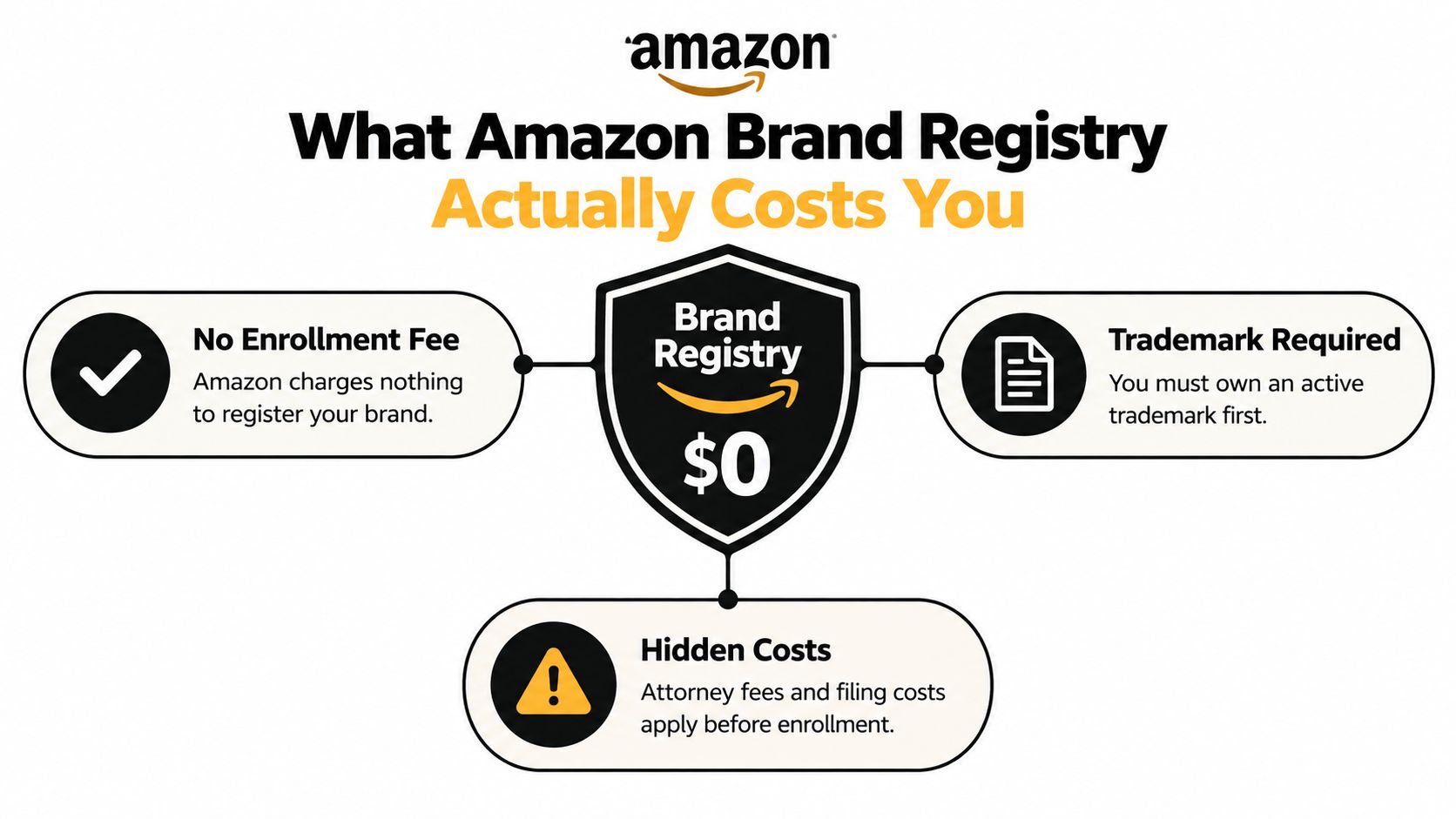
That makes “Amazon Brand Registry cost” a misleading search. The program itself is free. The actual spend is the prerequisite trademark, plus any professional help and preparation needed to secure it and submit a clean application. Amazon requires an eligible active registered trademark or, in supported circumstances, a pending application. The mark generally must be a text-based word mark or an image-based mark containing words, letters, or numbers issued through an approved intellectual-property office.
For a brand that already owns a qualifying trademark, incremental enrollment cost can be zero. For a new brand, budget for filing fees, legal or service fees, and practical work such as preparing matching packaging evidence. Costs also vary by country because trademark offices set their own fees and rules.
Budgeting rule: Separate the free Amazon enrollment from the cost of becoming eligible. Treat downstream advertising and other commercial programs as their own line items, not as Brand Registry fees.
The four cost buckets to plan for are government filing fees, professional services, Amazon IP Accelerator, and post-enrollment Amazon services. The first step is to check whether your existing trademark already covers the brand and product categories you plan to sell.
USPTO Filing Fees and the True Cost of a U.S. Trademark
For U.S. brands, the USPTO filing fee is the clearest starting point. The base electronic application costs $350 per international class. That means $350 for one class and $700 for two, before additional fees or professional services. The USPTO also lists an additional $100 per class for insufficient information and $200 per class when the applicant uses the free-form identification field instead of the Trademark ID Manual (USPTO trademark fees).
The class count matters because the application covers specific goods or services, not every product a company might sell. A consumer brand may need more than one class if its product lines span distinct categories. Don't add classes as a defensive guess. Match the filing to the goods you sell or plan to protect, and use the Trademark ID Manual where it fits.
Map the long-term government fees
The initial application isn't the only government expense. Between the fifth and sixth years, the owner must file a declaration of use. At the ten-year renewal point, the USPTO lists a combined declaration-and-renewal fee of $650 per class. The verified fee information doesn't specify the declaration fee between years five and six, so the table shows that line as not included in the calculable total.
| Filing scenario | Initial filing | Year 5 to 6 declaration | Year 10 combined filing | 10-year total |
|---|---|---|---|---|
| One class | $350 | Required, fee not specified here | $650 | $1,000 plus declaration fee |
| Two classes | $700 | Required, fee not specified here | $1,300 | $2,000 plus declaration fee |
| Three classes | $1,050 | Required, fee not specified here | $1,950 | $3,000 plus declaration fee |
These totals include only the stated initial and year-ten fees, not the year-five-to-six declaration, attorney costs, service-provider fees, or other administrative expenses. For a practical overview of the application process and decisions involved, see this US trademark registration guide from Chern & Co.
Before you file, confirm that your mark, product scope, and Amazon brand identity match. This guide to trademarks for Amazon sellers can help you think through the marketplace-specific side of that preparation. USPTO fees are the government portion only, and a filing that needs correction or legal attention can cost more.
Attorney Fees, Filing Services, and DIY Options Compared
Once you know the government fee, choose who will prepare and manage the application. The trade-off isn't just price. It's how much legal judgment and follow-through you're buying, especially if the USPTO raises an issue.
| Route | What you get | Main trade-off |
|---|---|---|
| Trademark attorney | Search, application strategy, filing, and potentially office action responses | Higher professional fees, with legal guidance tailored to the mark and goods |
| Online filing service | Guided intake and submission support | Lower-touch help, which may not include substantive legal advice or responses |
| DIY filing | Direct control over the application | You own the research, identification choices, and any follow-up |
I don't recommend choosing a filing path by comparing sticker prices alone. A low-cost submission can become a false economy if the mark conflicts with another filing, the goods description is weak, or a refusal needs a lawyer to repair. A trademark attorney is the safer choice when the brand has meaningful catalog exposure, several product lines, or an unclear ownership history. DIY can make sense when the mark and goods are straightforward and you're prepared to do the research carefully.
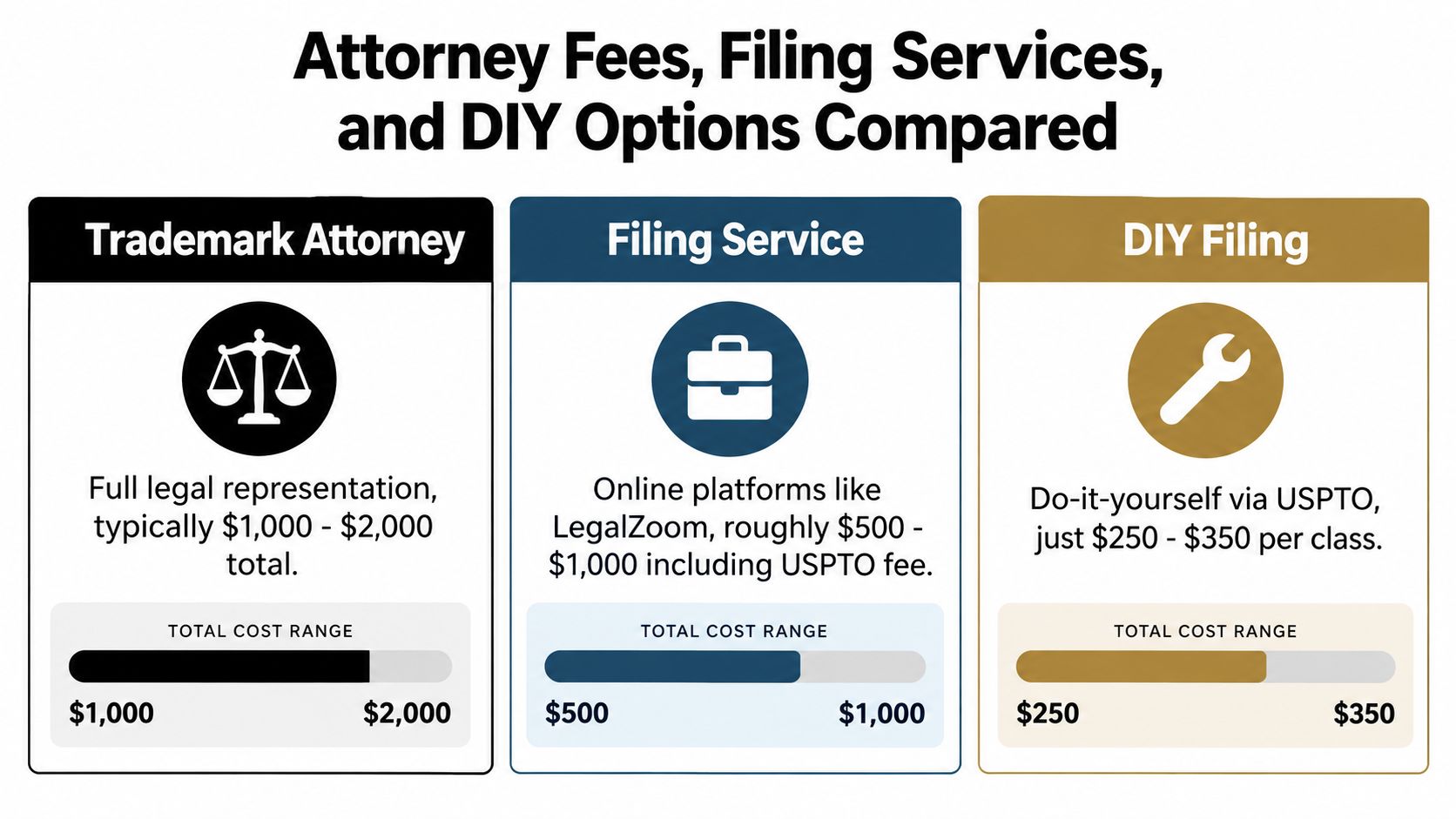
Use the USPTO's fee schedule as the known baseline, then get written quotes for professional support. Don't treat estimates from unrelated providers as a universal market rate. Ask what the package includes: clearance search, filing, classification advice, office action response, and communication about deadlines.
To compare the trademark investment with marketplace economics, enter your expected sales and channel costs into the Amazon profit calculator. For an established brand with real catalog risk, legal review is protection against an avoidable filing problem, not just administrative overhead.
Amazon IP Accelerator Pricing and What Each Package Includes
Amazon IP Accelerator offers another route: use a provider from Amazon's network to pursue trademark services while aligning the application with Brand Registry requirements. It isn't a fee charged by Brand Registry, and pricing depends on the provider and services selected. Don't assume every provider offers the same package or that the program has one universal price.
The workflow is straightforward. First, review the participating providers and ask which jurisdictions and goods they handle. Next, request a written scope that separates the trademark search, filing, and any follow-up work. Then confirm who will own and manage the application, what documents you'll need, and whether the provider will help resolve questions that arise during the process.

Treat the package description as more important than labels like “starter” or “premium.” A basic engagement may focus on a search and filing in one jurisdiction. A broader scope could include more hands-on support or filings across additional classes or markets, but you need the provider to spell out exactly what's included and what triggers extra charges.
What makes an Amazon-aligned provider useful is familiarity with the marketplace's eligibility and identity requirements. Amazon accepts certain text-based and image-based marks, and the trademark record must match the brand information submitted. The brand name or logo also needs to be permanently affixed to the product or packaging, so get the mark and evidence plan right before you commit to a filing strategy.
If inventory timing is part of your decision, use the FBA storage fee calculator to model storage exposure while you plan the launch and brand setup. The tool doesn't replace a trademark quote, but it can help you evaluate inventory costs separately from legal eligibility work.
Post-Enrollment Amazon Costs Worth Budgeting For
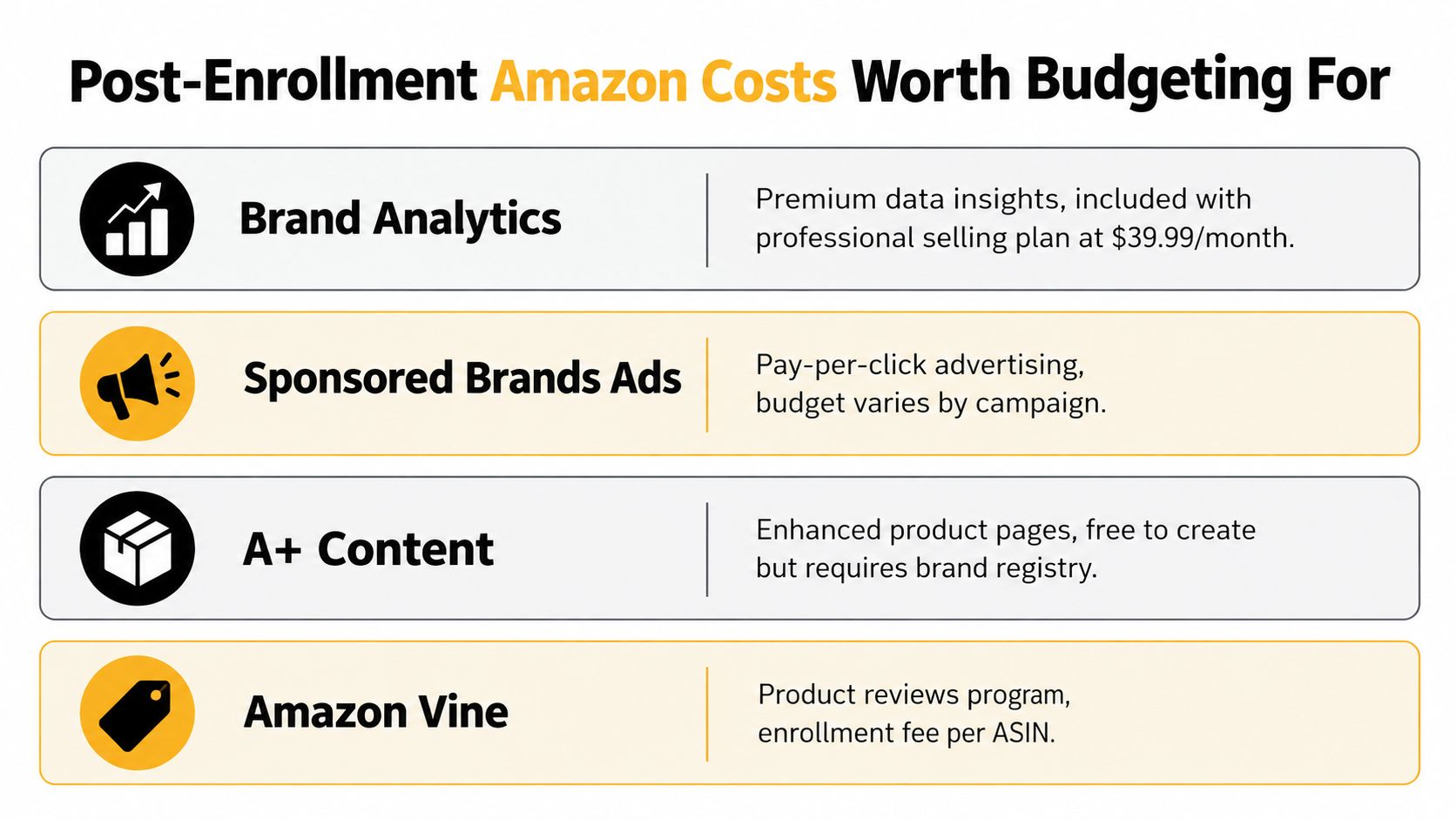
Brand Registry doesn't bill you for access, but the tools and programs available after enrollment can bring their own operating costs. Keep that distinction clear in your forecast: the trademark gets you eligible, while advertising, fulfillment, and optional programs shape the ongoing economics.
Brand Analytics is available as a brand tool, while A+ Content can require creative production, copywriting, and internal review even when the brand isn't paying a separate fee to create the content. Amazon Posts and Amazon Live may also require staff time, creative assets, or production support. Those are operational costs, not enrollment charges.
Sponsored Brands video is advertising. Set its budget based on campaign goals and your broader advertising plan, rather than treating it as a fixed Brand Registry expense. Amazon Vine is another separate program. The supplied verified information doesn't establish a fee for Vine, so confirm current charges and eligibility in Seller Central before you build it into a forecast.
Check eligibility before counting credits
Amazon's New Seller Guide says eligible new sellers who enroll a brand in Brand Registry can receive 10% back on their first $50,000 in branded sales, then 5% back through the first year until reaching $1,000,000 in branded sales (Amazon New Seller Guide). Eligibility can depend on completing Brand Registry within six months of creating the first buyable ASIN in the U.S. store and being the first owner of the brand in Brand Registry.
Don't book the credit as guaranteed revenue. Verify the current rules in Seller Central and model it separately from referral fees, fulfillment, advertising, and trademark costs. To assess the category environment once your brand controls are in place, use the Amazon sales rank checker. It can inform competitive review, but it won't replace campaign-level profitability analysis.
Hidden Costs Most Brand Owners Miss
The government filing fee is easy to find. The coordination and rework around it are what often get missed. A trademark application may require careful evidence preparation, and the Amazon submission still needs the brand identity and supporting materials to line up.
Packaging can become a cost if the brand name or logo isn't permanently affixed to the product or packaging as Amazon requires. A logo printed on a removable sticker may not be the evidence you want to rely on. A packaging change can involve design, production, and inventory decisions, so check the physical product early rather than after you've submitted the Brand Registry application.
Other potential costs include translation for non-English marks, legal work responding to a USPTO office action, and monitoring for conflicting filings or unauthorized use. Internal labor counts too. Someone has to coordinate the trademark owner, attorney or filing provider, packaging vendor, and Amazon account team. That time competes with launch, advertising, and catalog work.
The cheapest application is only cheap if it gets the mark and goods right the first time. Price the risk of rework, not just the submission.
I wouldn't tell every brand to buy extensive legal support. I would tell a growing brand not to confuse a low upfront quote with low total cost. If you're reviewing unit economics alongside trademark work, this explanation of product pricing for small businesses offers useful context for separating product costs from channel expenses.
After enrollment, keep enforcement and listing protection as ongoing operational work. This overview of Amazon brand protection is relevant when you're deciding how to handle unauthorized sellers and marketplace violations. The key is to budget for what your brand needs, not to invent a single all-in figure that assumes every company has the same packaging, legal, and enforcement situation.
Timeline and ROI of the Full Investment
The investment only makes sense when the trademark and brand controls support a real commercial need. If you're launching a private-label product or already dealing with listing or ownership problems, the trademark may be a necessary foundation. But don't promise yourself a specific payback before you've established the actual costs and the margin opportunity.
Start with the full project cost: USPTO fees, any attorney or service-provider work, packaging changes, evidence preparation, and internal hours. Then estimate what Brand Registry access would change for your operation. Could the team improve listing management, strengthen intellectual-property reporting, or use brand-building tools that support the channel plan? Those are the outcomes to assess, not an assumed sales lift.
Amazon's Brand Registry program itself is free, but access doesn't automatically remove unauthorized sellers or guarantee control over every catalog outcome. Amazon's policies still apply, and the brand needs a process for documenting issues, reporting violations, and following up. Online Brand Growth's 360 Brand Protection program handles unauthorized seller removal and MAP enforcement as an operational option for brands that need that layer of support.
Decision test: Compare the project's total cost with the contribution margin you can reasonably attribute to improved brand control. If the expected incremental margin exceeds the investment within your chosen payback window, proceed. If you can't support the forecast, fix the assumptions before you commit.
A useful way to frame the decision is to compare the investment with the operational benefits and protections discussed in this guide to Amazon Brand Registry benefits. Avoid counting every improvement as incremental profit. Separate effects you can measure, such as a reduced enforcement workload or better listing control, from sales outcomes that may also depend on pricing, advertising, inventory, and competition.
Next Steps and a Free Strategy Call
Use this checklist to move the project forward:
- Confirm trademark status and class coverage. Check that the owner, mark, and goods fit the brand you're enrolling.
- Choose a filing route. Compare an attorney, an IP Accelerator provider, and DIY based on the complexity and business risk.
- Budget the full application. Include government fees, professional services, evidence preparation, and any packaging work.
- Prepare the Amazon submission. Make the trademark record, brand name, and product or packaging images consistent.
- Check new seller eligibility. If the incentive applies, verify the current rules and timing in Seller Central before forecasting the credit.
Book a free strategy call at /#book-call to review your cost model and enrollment plan.
Online Brand Growth supports Amazon brands with marketplace operations, advertising, listing optimization, and brand-protection work, including unauthorized seller removal and MAP enforcement. If you're weighing trademark readiness against your Amazon growth plan, visit Online Brand Growth to discuss your next steps.